Carignan Courtney C, Mínguez-Alarcón Lidia, Butt Craig M, Williams Paige L, Meeker John D, Stapleton Heather M, Toth Thomas L, Ford Jennifer B, Hauser Russ
Department of Environmental Health, Harvard T.H. Chan School of Public Health , Boston, Massachusetts, USA.
Nicholas School of the Environment, Duke University , Durham, North Carolina, USA.
Environ Health Perspect. 2017 Aug 25;125(8):087018. doi: 10.1289/EHP1021.
Evidence from animal studies suggests that exposure to organophosphate flame retardants (PFRs) can disrupt endocrine function and impair embryo development. However, no epidemiologic studies have been conducted to evaluate effects on fertility and pregnancy outcomes.
We evaluated associations between urinary concentrations of PFR metabolites and outcomes of fertilization (IVF) treatment among couples recruited from an academic fertility clinic.
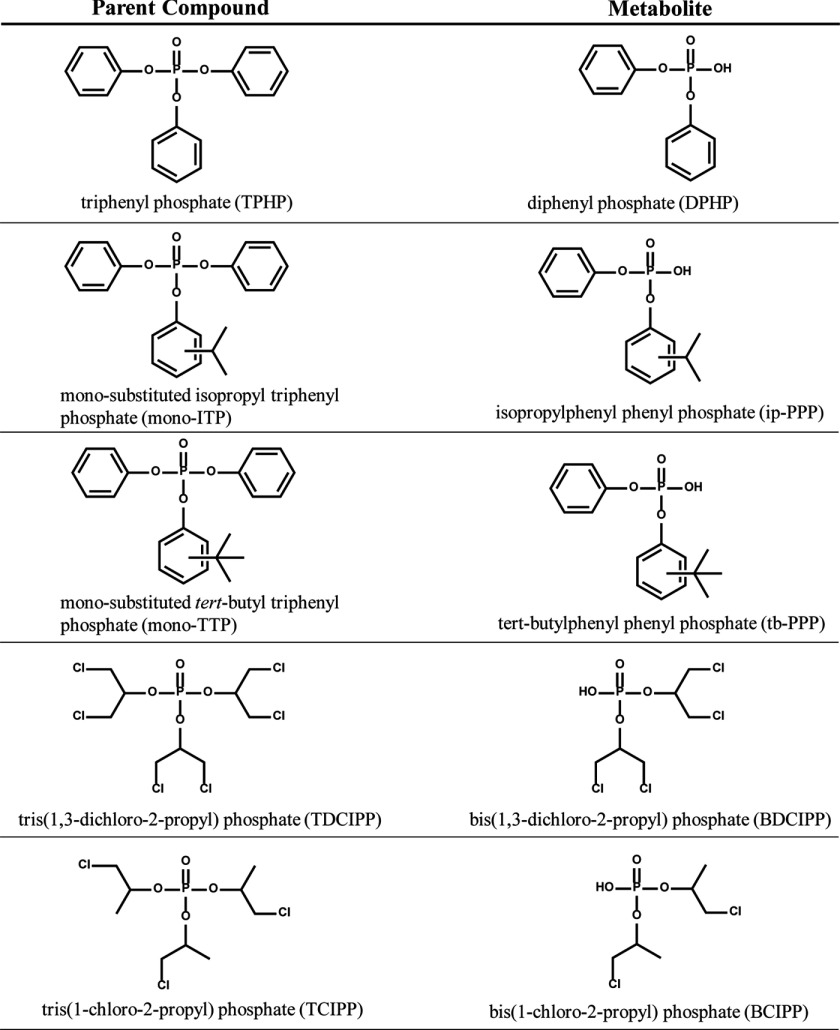
This analysis included 211 women enrolled in the Environment And Reproductive Health (EARTH) prospective cohort study (2005-2015) who provided one or two urine samples per IVF cycle. We measured five urinary PFR metabolites [bis(1,3-dichloro-2-propyl) phosphate (BDCIPP), diphenyl phosphate (DPHP), isopropylphenyl phenyl phosphate (ip-PPP), tert-butylphenyl phenyl phosphate (tb-PPP), and bis(1-chloro-2-propyl) phosphate (BCIPP)] using negative electrospray ionization liquid chromatography tandem mass spectrometry (LC-MS/MS). Molar concentrations of the urinary PFR metabolites were summed. We used multivariable generalized linear mixed models to evaluate the association of the PFR metabolites with IVF outcomes, accounting for multiple IVF cycles per woman.
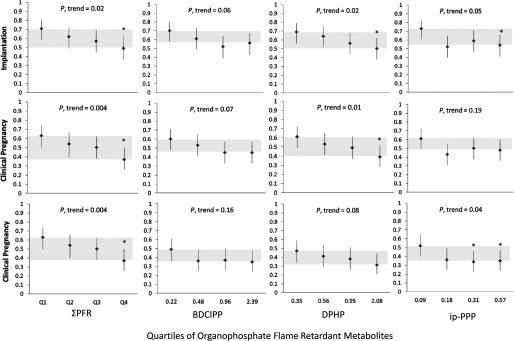
Detection frequencies were high for BDCIPP (87%), DPHP (94%), and ip-PPP (80%), but low for tb-PPP (14%) and BCIPP (0%). We observed decreased success for several IVF outcomes across increasing quartiles of both summed and individual PFR metabolites (DPHP and ip-PPP) in our adjusted multivariable models. Significant declines in adjusted means from the lowest to highest quartile of ΣPFR were observed for the proportion of cycles resulting in successful fertilization (10% decrease), implantation (31%), clinical pregnancy (41%), and live birth (38%).
Using IVF to investigate human reproduction and pregnancy outcomes, we found that concentrations of some urinary PFR metabolites were negatively associated with proportions of successful fertilization, implantation, clinical pregnancy, and live birth. https://doi.org/10.1289/EHP1021.
动物研究证据表明,接触有机磷酸酯阻燃剂(PFRs)会扰乱内分泌功能并损害胚胎发育。然而,尚未开展流行病学研究来评估其对生育力和妊娠结局的影响。
我们评估了从一家学术性生育诊所招募的夫妇中,尿中PFR代谢物浓度与体外受精(IVF)治疗结局之间的关联。
该分析纳入了211名参与环境与生殖健康(EARTH)前瞻性队列研究(2005 - 2015年)的女性,她们在每个IVF周期提供了一或两份尿液样本。我们使用负电喷雾电离液相色谱串联质谱法(LC - MS/MS)测量了五种尿中PFR代谢物[双(1,3 - 二氯 - 2 - 丙基)磷酸酯(BDCIPP)、二苯基磷酸酯(DPHP)、异丙基苯基苯基磷酸酯(ip - PPP)、叔丁基苯基苯基磷酸酯(tb - PPP)和双(1 - 氯 - 2 - 丙基)磷酸酯(BCIPP)]。将尿中PFR代谢物的摩尔浓度相加。我们使用多变量广义线性混合模型来评估PFR代谢物与IVF结局之间的关联,同时考虑到每位女性的多个IVF周期。
BDCIPP(87%)、DPHP(94%)和ip - PPP(80%)的检测频率较高,而tb - PPP(14%)和BCIPP(0%)的检测频率较低。在我们调整后的多变量模型中,我们观察到随着总PFR代谢物和单个PFR代谢物(DPHP和ip - PPP)四分位数的增加,几种IVF结局的成功率下降。从最低到最高四分位数的总PFR调整均值出现显著下降,包括成功受精周期的比例(下降10%)、着床(31%)、临床妊娠(41%)和活产(38%)。
通过IVF研究人类生殖和妊娠结局,我们发现一些尿中PFR代谢物的浓度与成功受精、着床、临床妊娠和活产的比例呈负相关。https://doi.org/10.1289/EHP1021