Foy Jean-Philippe, Bazire Louis, Ortiz-Cuaran Sandra, Deneuve Sophie, Kielbassa Janice, Thomas Emilie, Viari Alain, Puisieux Alain, Goudot Patrick, Bertolus Chloé, Foray Nicolas, Kirova Youlia, Verrelle Pierre, Saintigny Pierre
Univ Lyon, Université Claude Bernard Lyon 1, INSERM 1052, CNRS 5286, Centre Léon Bérard, Centre de recherche en cancérologie de Lyon, Lyon, F-69008, France.
Department of Translational Research and Innovation, Centre Léon Bérard, Lyon, F-69008, France.
BMC Med. 2017 Sep 1;15(1):165. doi: 10.1186/s12916-017-0929-y.
Radiotherapy for head and neck squamous cell carcinomas (HNSCC) is associated with a substantial morbidity and inconsistent efficacy. Human papillomavirus (HPV)-positive status is recognized as a marker of increased radiosensitivity. Our goal was to identify molecular markers associated with benefit to radiotherapy in patients with HPV-negative disease.
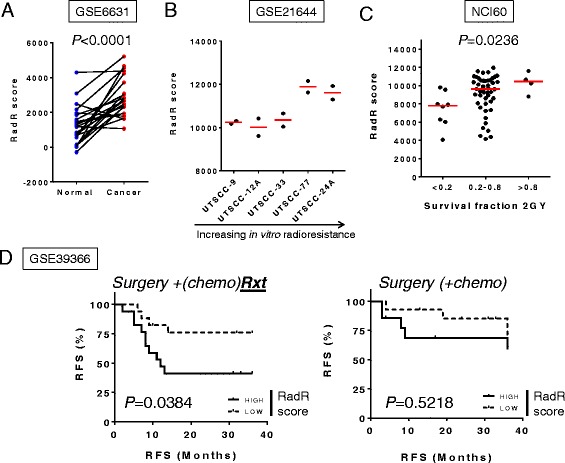
Gene expression profiles from public repositories were downloaded for data mining. Training sets included 421 HPV-negative HNSCC tumors from The Cancer Genome Atlas (TCGA) and 32 HNSCC cell lines with available radiosensitivity data (GSE79368). A radioresistance (RadR) score was computed using the single sample Gene Set Enrichment Analysis tool. The validation sets included two panels of cell lines (NCI-60 and GSE21644) and HPV-negative HNSCC tumor datasets, including 44 (GSE6631), 82 (GSE39366), and 179 (GSE65858) patients, respectively. We finally performed an integrated analysis of the RadR score with known recurrent genomic alterations in HNSCC, patterns of protein expression, biological hallmarks, and patterns of drug sensitivity using TCGA and the E-MTAB-3610 dataset (659 pancancer cell lines, 140 drugs).
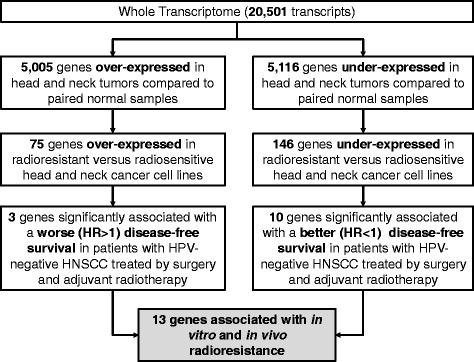
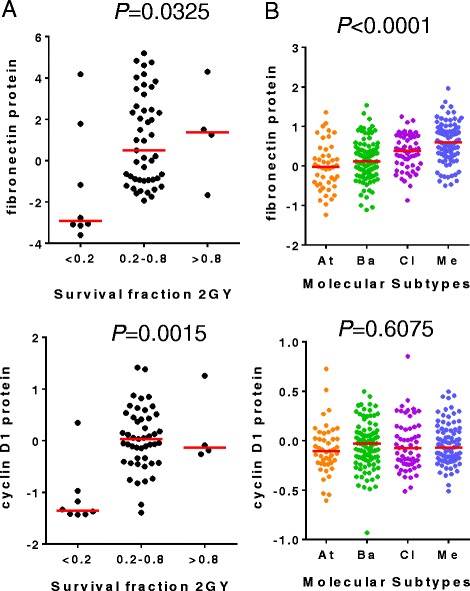
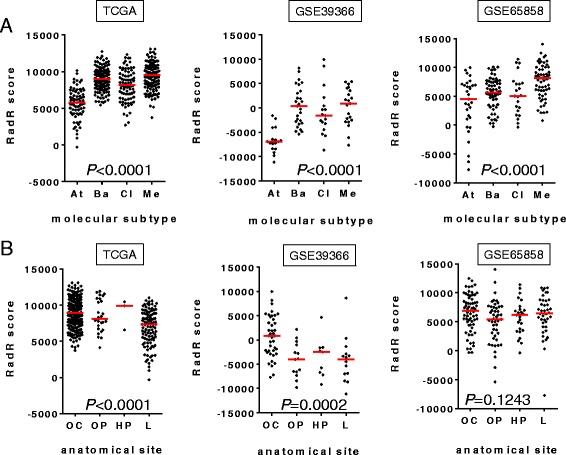
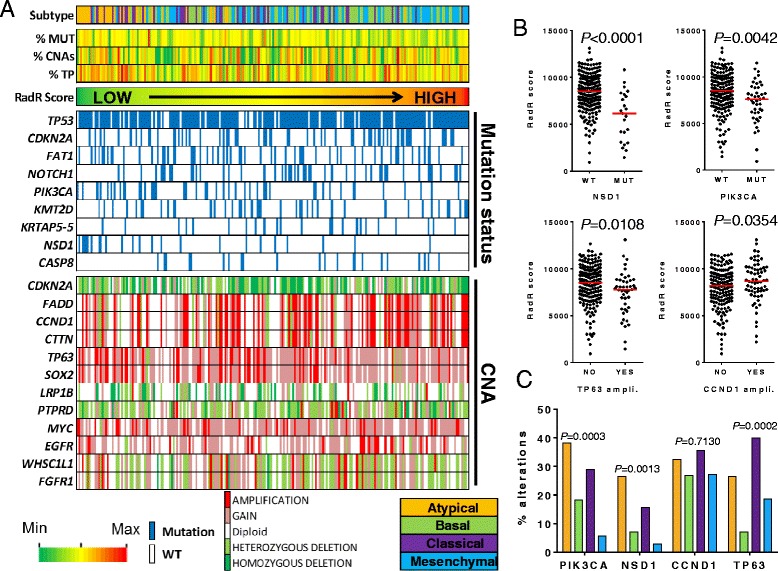
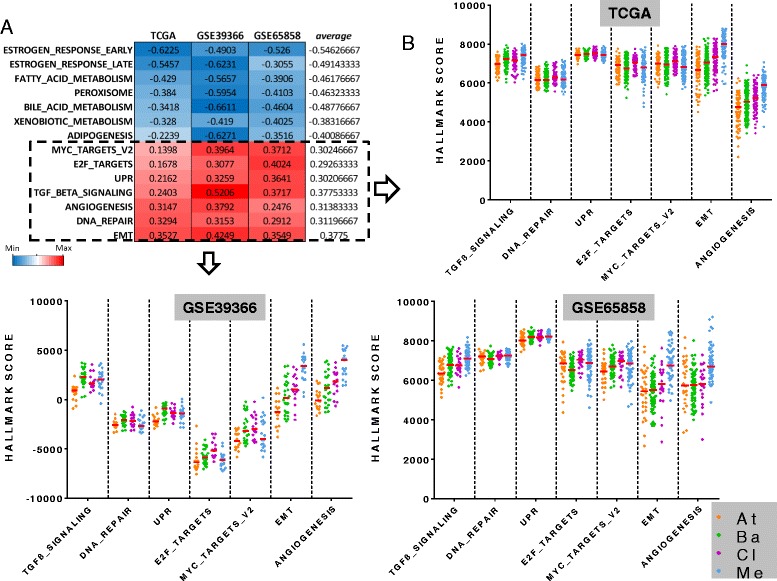
We identified 13 genes differentially expressed between tumor and normal head and neck mucosa that were associated with radioresistance in vitro and in patients. The 13-gene expression-based RadR score was associated with recurrence in patients treated with surgery and adjuvant radiotherapy but not with surgery alone. It was significantly different among different molecular subtypes of HPV-negative HNSCC and was significantly lower in the "atypical" molecular subtype. An integrated analysis of RadR score with genomic alterations, protein expression, biological hallmarks and patterns of drug sensitivity showed a significant association with CCND1 amplification, fibronectin expression, seven hallmarks (including epithelial-to-mesenchymal transition and unfolded protein response), and increased sensitivity to elesclomol, an HSP90 inhibitor.
Our study highlights the clinical relevance of the molecular classification of HNSCC and the RadR score to refine radiation strategies in HPV-negative disease.
头颈部鳞状细胞癌(HNSCC)的放射治疗会导致严重的发病率且疗效不一。人乳头瘤病毒(HPV)阳性状态被认为是放射敏感性增加的一个标志物。我们的目标是确定与HPV阴性疾病患者放射治疗获益相关的分子标志物。
从公共数据库下载基因表达谱进行数据挖掘。训练集包括来自癌症基因组图谱(TCGA)的421例HPV阴性HNSCC肿瘤以及32个具有可用放射敏感性数据的HNSCC细胞系(GSE79368)。使用单样本基因集富集分析工具计算放射抗性(RadR)评分。验证集包括两组细胞系(NCI - 60和GSE21644)以及HPV阴性HNSCC肿瘤数据集,分别包括44例(GSE6631)、82例(GSE39366)和179例(GSE65858)患者。我们最终使用TCGA和E - MTAB - 3610数据集(659个泛癌细胞系,140种药物)对RadR评分与HNSCC中已知的复发性基因组改变、蛋白质表达模式、生物学特征以及药物敏感性模式进行了综合分析。
我们鉴定出13个在肿瘤与正常头颈部黏膜之间差异表达的基因,这些基因在体外和患者中均与放射抗性相关。基于这13个基因表达的RadR评分与接受手术和辅助放疗的患者的复发相关,但与单纯手术无关。它在HPV阴性HNSCC的不同分子亚型之间存在显著差异,在“非典型”分子亚型中显著更低。RadR评分与基因组改变、蛋白质表达、生物学特征和药物敏感性模式的综合分析显示,其与CCND1扩增、纤连蛋白表达、七个特征(包括上皮 - 间质转化和未折叠蛋白反应)以及对HSP90抑制剂艾日布林的敏感性增加显著相关。
我们的研究突出了HNSCC分子分类和RadR评分在优化HPV阴性疾病放射治疗策略方面的临床相关性。