Majewski Sebastian, Pietrzak Anna, Tworek Damian, Szewczyk Karolina, Kumor-Kisielewska Anna, Kurmanowska Zofia, Górski Paweł, Zalewska-Janowska Anna, Piotrowski Wojciech Jerzy
Department of Pneumology and Allergy, Medical University of Lodz, Lodz, Poland.
Healthy Ageing Research Centre (HARC), Lodz, Poland.
Int J Chron Obstruct Pulmon Dis. 2017 Aug 11;12:2407-2415. doi: 10.2147/COPD.S141805. eCollection 2017.
The systemic (extrapulmonary) effects and comorbidities of chronic obstructive pulmonary disease (COPD) contribute substantially to its burden. The supposed link between COPD and its systemic effects on distal organs could be due to the low-grade systemic inflammation. The aim of this study was to investigate whether the systemic inflammation may influence the skin condition in COPD patients.
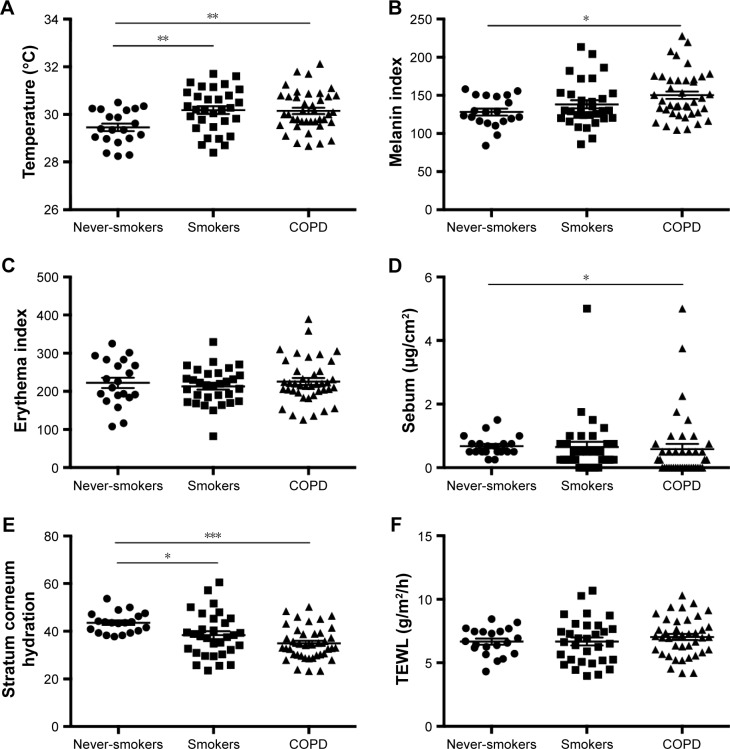
Forty patients with confirmed diagnosis of COPD and a control group consisting of 30 healthy smokers and 20 healthy never-smokers were studied. Transepidermal water loss, stratum corneum hydration, skin sebum content, melanin index, erythema index, and skin temperature were measured with worldwide-acknowledged biophysical measuring methods at the volar forearm of all participants using a multifunctional skin physiology monitor. Biomarkers of systemic inflammation, including high-sensitivity C-reactive protein (hsCRP), interleukin-6 (IL-6), and tumor necrosis factor α (TNF-α), were measured in serum using commercially available enzyme-linked immunosorbent assays.
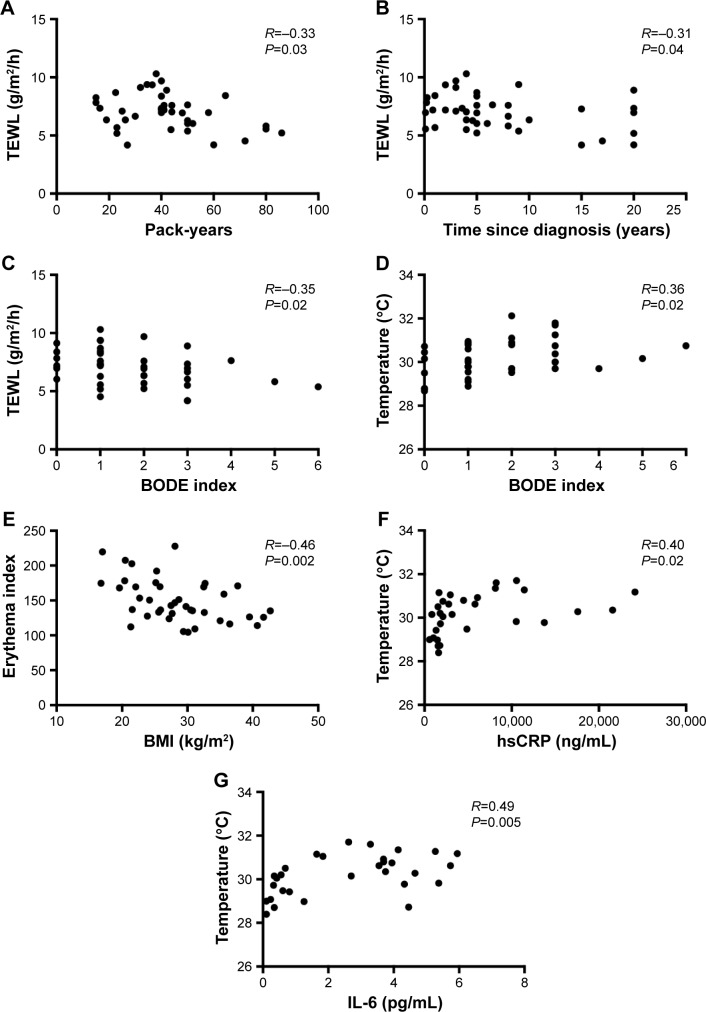
There were significant differences between COPD patients and healthy never-smokers in skin temperature, melanin index, sebum content, and hydration level (<0.05), but not for transepidermal water loss and erythema index. No significant difference was noted between COPD patients and smokers in any of the biophysical properties of the skin measured. The mean levels of hsCRP and IL-6 in serum were significantly higher in COPD patients and healthy smokers in comparison with healthy never-smokers. There were significant correlations between skin temperature and serum hsCRP (=0.40; =0.02) as well as skin temperature and serum IL-6 (=0.49; =0.005) in smokers. Stratum corneum hydration correlated significantly with serum TNF-α (=0.37; =0.01) in COPD patients.
Differences noted in several skin biophysical properties and biomarkers of systemic inflammation between COPD patients, smokers, and healthy never-smokers may suggest a possible link between smoking-driven, low-grade systemic inflammation, and the overall skin condition.
慢性阻塞性肺疾病(COPD)的全身(肺外)效应和合并症在很大程度上加重了其负担。COPD与其对远端器官的全身效应之间的假定联系可能归因于低度全身炎症。本研究的目的是调查全身炎症是否会影响COPD患者的皮肤状况。
研究了40例确诊为COPD的患者以及一个由30名健康吸烟者和20名从不吸烟者组成的对照组。使用多功能皮肤生理监测仪,采用全球公认的生物物理测量方法,在所有参与者的掌侧前臂测量经表皮水分流失、角质层水合作用、皮肤皮脂含量、黑色素指数、红斑指数和皮肤温度。使用市售酶联免疫吸附测定法测量血清中全身炎症的生物标志物,包括高敏C反应蛋白(hsCRP)、白细胞介素-6(IL-6)和肿瘤坏死因子α(TNF-α)。
COPD患者与从不吸烟者在皮肤温度、黑色素指数、皮脂含量和水合水平方面存在显著差异(<0.05),但经表皮水分流失和红斑指数无差异。在测量的任何皮肤生物物理特性方面,COPD患者与吸烟者之间均未发现显著差异。与从不吸烟者相比,COPD患者和健康吸烟者血清中hsCRP和IL-6的平均水平显著更高。吸烟者的皮肤温度与血清hsCRP(=0.40;=0.02)以及皮肤温度与血清IL-6(=0.49;=0.005)之间存在显著相关性。COPD患者的角质层水合作用与血清TNF-α(=0.37;=0.01)显著相关。
COPD患者、吸烟者和从不吸烟者在几种皮肤生物物理特性和全身炎症生物标志物方面的差异可能表明吸烟驱动的低度全身炎症与整体皮肤状况之间存在可能的联系。