Rajesh Anand E, Olvera-Barrios Abraham, Warwick Alasdair N, Wu Yue, Stuart Kelsey V, Biradar Mahantesh I, Ung Chuin Ying, Khawaja Anthony P, Luben Robert, Foster Paul J, Cleland Charles R, Makupa William U, Denniston Alastair K, Burton Matthew J, Bastawrous Andrew, Keane Pearse A, Chia Mark A, Turner Angus W, Lee Cecilia S, Tufail Adnan, Lee Aaron Y, Egan Catherine
Department of Ophthalmology, University of Washington, Seattle, WA, USA.
The Roger and Angie Karalis Johnson Retina Center, Seattle, WA, USA.
Nat Commun. 2025 Jan 2;16(1):60. doi: 10.1038/s41467-024-55198-7.
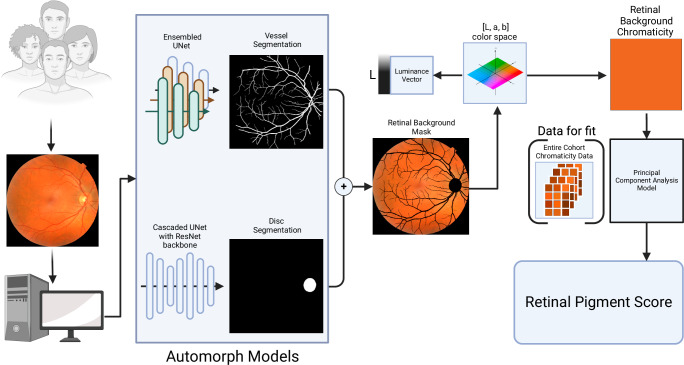
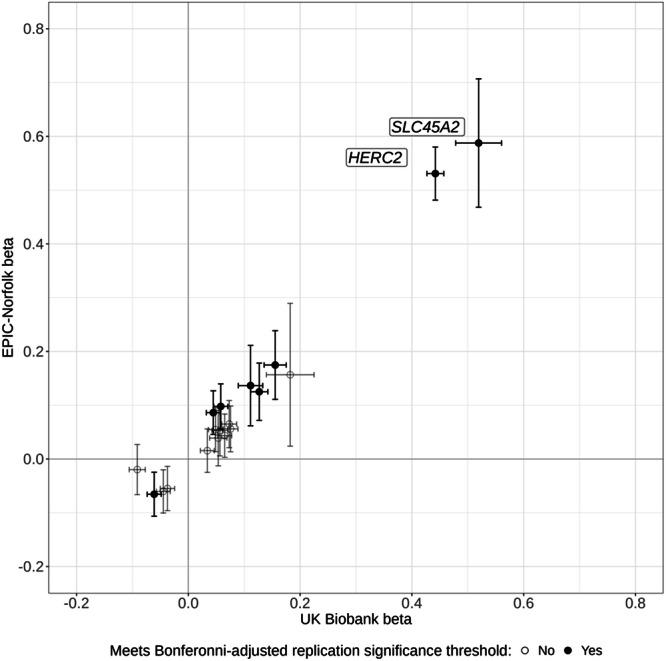
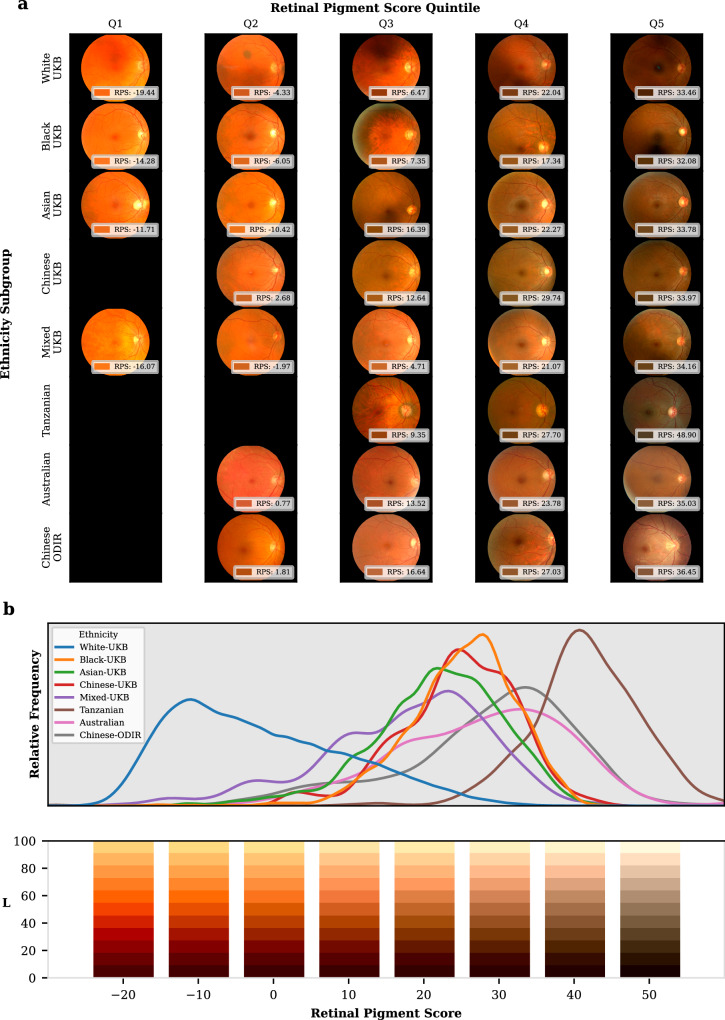
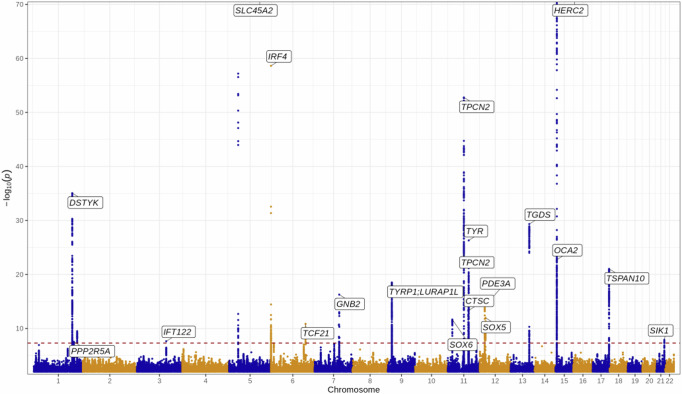
Few metrics exist to describe phenotypic diversity within ophthalmic imaging datasets, with researchers often using ethnicity as a surrogate marker for biological variability. We derived a continuous, measured metric, the retinal pigment score (RPS), that quantifies the degree of pigmentation from a colour fundus photograph of the eye. RPS was validated using two large epidemiological studies with demographic and genetic data (UK Biobank and EPIC-Norfolk Study) and reproduced in a Tanzanian, an Australian, and a Chinese dataset. A genome-wide association study (GWAS) of RPS from UK Biobank identified 20 loci with known associations with skin, iris and hair pigmentation, of which eight were replicated in the EPIC-Norfolk cohort. There was a strong association between RPS and ethnicity, however, there was substantial overlap between each ethnicity and the respective distributions of RPS scores. RPS decouples traditional demographic variables from clinical imaging characteristics. RPS may serve as a useful metric to quantify the diversity of the training, validation, and testing datasets used in the development of AI algorithms to ensure adequate inclusion and explainability of the model performance, critical in evaluating all currently deployed AI models. The code to derive RPS is publicly available at: https://github.com/uw-biomedical-ml/retinal-pigmentation-score .
用于描述眼科成像数据集中表型多样性的指标很少,研究人员通常将种族作为生物变异性的替代指标。我们推导了一种连续的、可测量的指标——视网膜色素评分(RPS),它可以从眼睛的彩色眼底照片中量化色素沉着程度。我们使用两项包含人口统计学和遗传数据的大型流行病学研究(英国生物银行和诺福克前瞻性城乡流行病学研究)对RPS进行了验证,并在一个坦桑尼亚数据集、一个澳大利亚数据集和一个中国数据集中进行了重现。一项来自英国生物银行的RPS全基因组关联研究(GWAS)确定了20个与皮肤、虹膜和头发色素沉着已知相关的基因座,其中8个在诺福克前瞻性城乡流行病学队列中得到了重复验证。RPS与种族之间存在很强的关联,然而,每个种族与RPS评分的各自分布之间存在很大重叠。RPS将传统的人口统计学变量与临床成像特征分离开来。RPS可以作为一个有用的指标,用于量化人工智能算法开发中使用的训练、验证和测试数据集的多样性,以确保模型性能具有充分的包容性和可解释性,这对于评估所有当前部署的人工智能模型至关重要。推导RPS的代码可在以下网址公开获取:https://github.com/uw-biomedical-ml/retinal-pigmentation-score 。