Capelini Camila Miliani, da Silva Talita Dias, Tonks James, Watson Suzanna, Alvarez Mayra Priscila Boscolo, de Menezes Lilian Del Ciello, Favero Francis Meire, Caromano Fátima Aparecida, Massetti Thais, de Mello Monteiro Carlos Bandeira
Graduate Program in Rehabilitation Sciences, Faculty of Medicine, University of São Paulo.
Department of Medicine, Paulista School of Medicine, Federal University of São Paulo, São Paulo, SP, Brazil.
Neuropsychiatr Dis Treat. 2017 Aug 18;13:2209-2217. doi: 10.2147/NDT.S125466. eCollection 2017.
In individuals severely affected with Duchenne muscular dystrophy (DMD), virtual reality has recently been used as a tool to enhance community interaction. Smartphones offer the exciting potential to improve communication, access, and participation, and present the unique opportunity to directly deliver functionality to people with disabilities.
To verify whether individuals with DMD improve their motor performance when undertaking a visual motor task using a smartphone game.
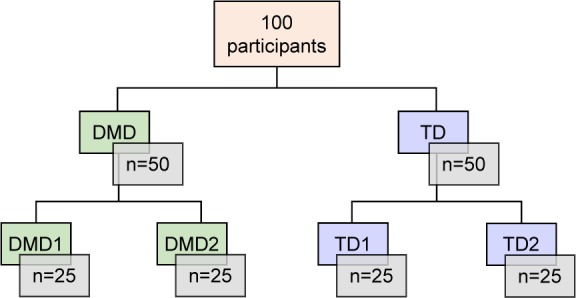
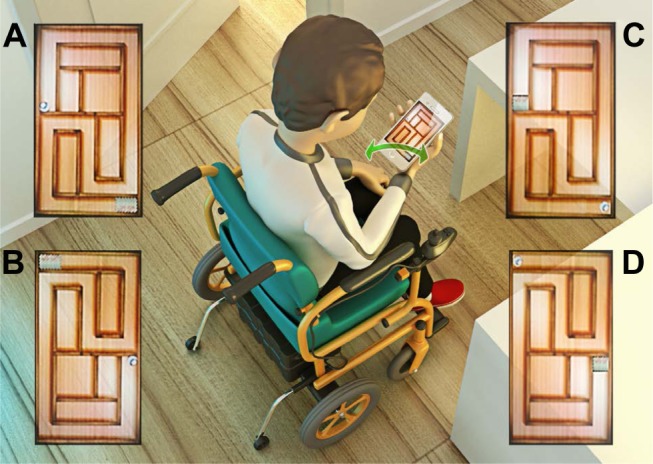
Fifty individuals with DMD and 50 healthy, typically developing (TD) controls, aged 10-34 years participated in the study. The functional characterization of the sample was determined through Vignos, Egen Klassifikation, and the Motor Function Measure scales. To complete the task, individuals moved a virtual ball around a virtual maze and the time in seconds was measured after every attempt in order to analyze improvement of performance after the practice trials. Motor performance (time to finish each maze) was measured in phases of acquisition, short-term retention, and transfer.
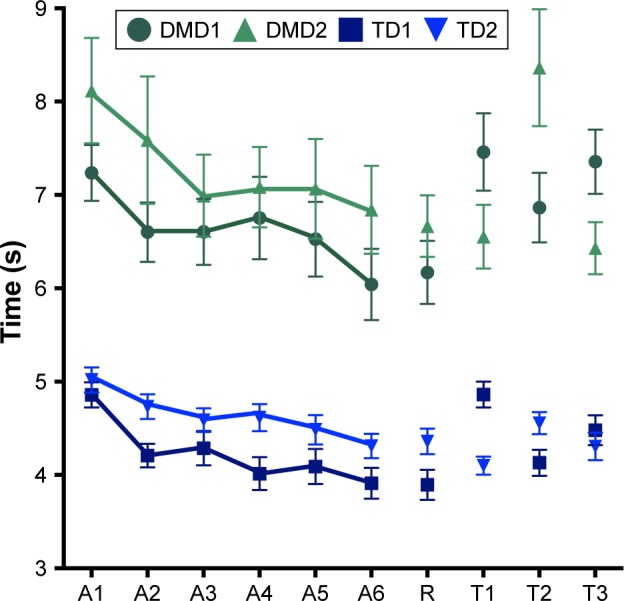
Use of the smartphone maze game promoted improvement in performance during acquisition in both groups, which remained in the retention phase. At the transfer phases, with alternative maze tasks, the performance in DMD group was similar to the performance of TD group, with the exception of the transfer to the contralateral hand (nondominant). However, the group with DMD demonstrated longer movement time at all stages of learning, compared with the TD group.
The practice of a visual motor task delivered via smartphone game promoted an improvement in performance with similar patterns of learning in both groups. Performance can be influenced by task difficulty, and for people with DMD, motor deficits are responsible for the lower speed of execution. This study indicates that individuals with DMD showed improved performance in a short-term motor learning protocol using a smartphone. We advocate that this technology could be used to promote function in this population.
在重度杜氏肌营养不良症(DMD)患者中,虚拟现实最近已被用作增强社区互动的工具。智能手机具有改善沟通、获取信息和参与度的巨大潜力,为直接向残疾人提供功能提供了独特机会。
验证DMD患者在使用智能手机游戏进行视觉运动任务时,其运动表现是否会得到改善。
50名DMD患者和50名年龄在10 - 34岁的健康正常发育(TD)对照者参与了该研究。通过维格诺斯、埃根分类法和运动功能测量量表确定样本的功能特征。为完成任务,参与者在虚拟迷宫中移动虚拟球,每次尝试后记录以秒为单位的时间,以便分析练习试验后的表现改善情况。在习得、短期保持和迁移阶段测量运动表现(完成每个迷宫的时间)。
两组在习得阶段使用智能手机迷宫游戏均促进了表现的改善,且在保持阶段得以维持。在迁移阶段,对于替代迷宫任务,除了向对侧手(非优势手)的迁移外,DMD组的表现与TD组相似。然而,与TD组相比,DMD组在学习的所有阶段都表现出更长的运动时间。
通过智能手机游戏进行视觉运动任务的练习促进了两组类似学习模式下的表现改善。表现可能受任务难度影响,对于DMD患者,运动缺陷导致执行速度较低。本研究表明,DMD患者在使用智能手机的短期运动学习方案中表现有所改善。我们主张该技术可用于促进这一人群的功能。