Man Rongzhou, Lu Pengxin, Dang Qing-Lai
Ontario Ministry of Natural Resources and Forestry, Ontario Forest Research Institute, Sault Ste. MarieON, Canada.
Faculty of Natural Resources Management, Lakehead University, Thunder BayON, Canada.
Front Plant Sci. 2017 Aug 15;8:1354. doi: 10.3389/fpls.2017.01354. eCollection 2017.
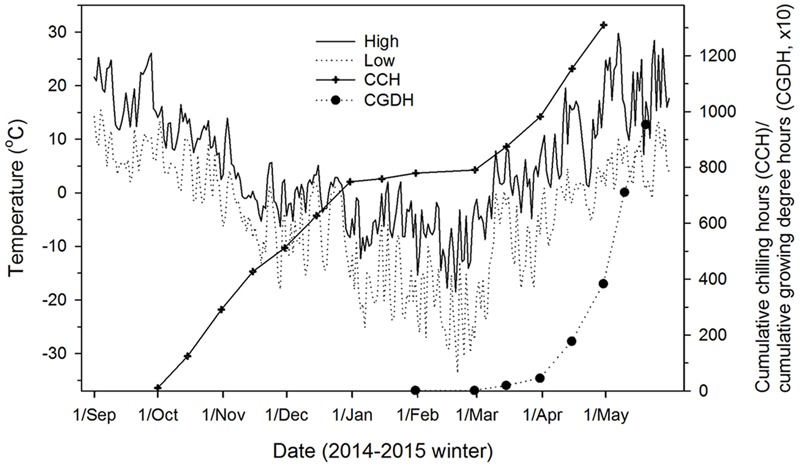
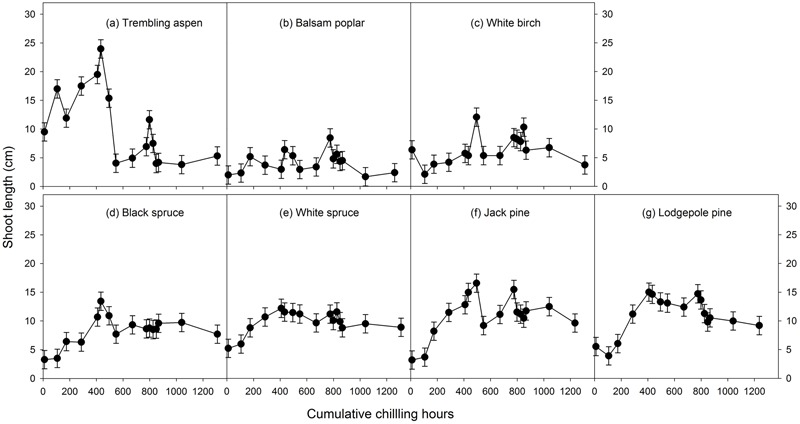
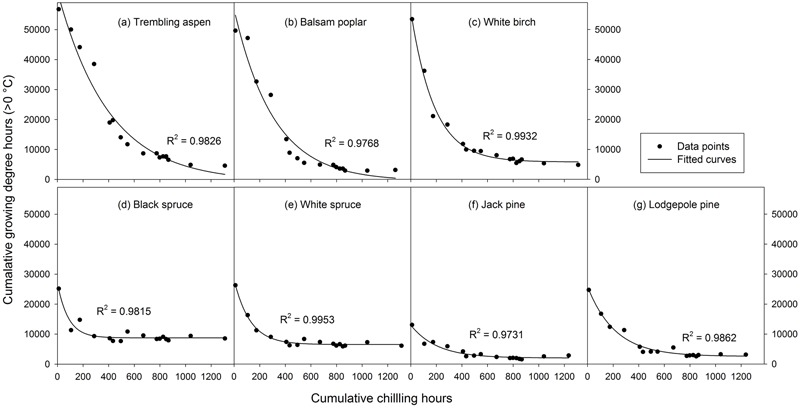
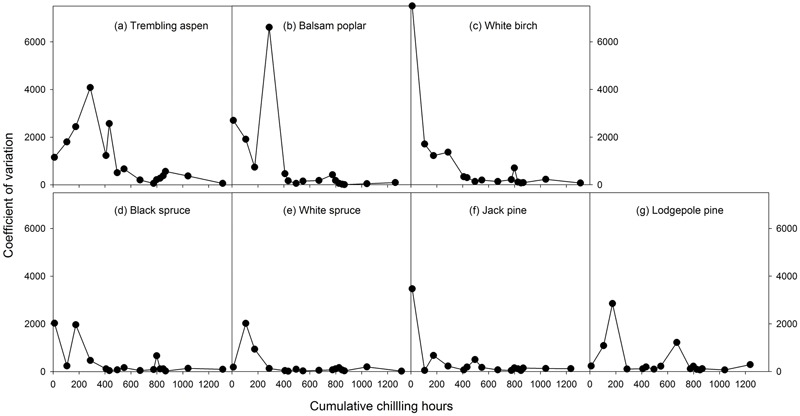
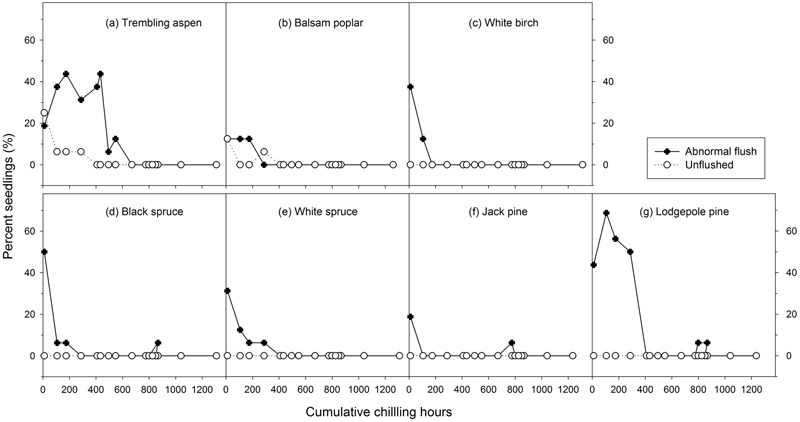
Insufficient chilling resulting from rising winter temperatures associated with climate warming has been an area of particular interest in boreal and temperate regions where a period of cool temperatures in fall and winter is required to break plant dormancy. In this study, we examined the budburst and growth of trembling aspen ( Michx.), balsam poplar ( L.), white birch ( Marsh.), black spruce ( (Mill.) B.S.P.), white spruce ( (Moench) Voss), jack pine ( Lamb.), and lodgepole pine ( Dougl. ex. Loud.) seedlings subjected to typical northern Ontario, Canada, spring conditions in climate chambers after different exposures to natural chilling. Results indicate that chilling requirements (cumulative weighted chilling hours) differed substantially among the seven species, ranging from 300 to 500 h for spruce seedlings to more than 1100 h for trembling aspen and lodgepole pine. Only spruce seedlings had fulfilled their chilling requirements before December 31, whereas the other species continued chilling well into March and April. Species with lower chilling requirements needed more heat accumulation for budburst and vice versa. Insufficient chilling delayed budburst but only extremely restricted chilling hours (<400) resulted in abnormal budburst and growth, including reduced needle and shoot expansion, early budburst in lower crowns, and erratic budburst on lower stems and roots. Effects, however, depended on both the species' chilling requirements and the chilling-heat relationship. Among the seven tree species examined, trembling aspen is most likely to be affected by reduced chilling accumulation possible under future climate scenarios, followed by balsam poplar, white birch, lodgepole pine, and jack pine. Black and white spruce are least likely to be affected by changes in chilling hours.
与气候变暖相关的冬季气温上升导致的低温不足,一直是北方和温带地区特别关注的领域,在这些地区,秋冬季节需要一段凉爽的气温来打破植物休眠。在本研究中,我们对经过不同自然低温处理的颤杨(Populus tremuloides Michx.)、香脂杨(Populus balsamifera L.)、白桦(Betula papyrifera Marsh.)、黑云杉(Picea mariana (Mill.) B.S.P.)、白云杉(Picea glauca (Moench) Voss)、短叶松(Pinus banksiana Lamb.)和黑松(Pinus contorta Dougl. ex. Loud.)幼苗进行了研究,使其在气候箱中经历加拿大安大略省北部典型的春季条件。结果表明,这七个树种的低温需求(累积加权低温小时数)差异很大,云杉幼苗为300至500小时,而颤杨和黑松则超过1100小时。只有云杉幼苗在12月31日前满足了其低温需求,而其他树种的低温需求一直持续到3月和4月。低温需求较低的树种在芽萌发时需要更多的热量积累,反之亦然。低温不足会延迟芽萌发,但只有极低的低温小时数(<400)会导致异常的芽萌发和生长,包括针叶和新梢扩展减少、树冠下部提前芽萌发以及下部茎和根上的芽萌发不稳定。然而,影响取决于树种的低温需求和低温 - 热量关系。在所研究的七种树种中,颤杨最有可能受到未来气候情景下可能出现的低温积累减少的影响,其次是香脂杨、白桦、黑松和短叶松。黑云杉和白云杉受低温小时数变化的影响最小。