Zehbe Ingeborg, Wakewich Pamela, King Amy-Dee, Morrisseau Kyla, Tuck Candace
Department of Biology, Lakehead University, Thunder Bay, Canada.
Probe Development and Biomarker Exploration, Thunder Bay Regional Health Research Institute, Thunder Bay, Canada.
BMJ Open. 2017 Sep 1;7(8):e017384. doi: 10.1136/bmjopen-2017-017384.
While (Pap)anicolaou screening has helped to decrease cervical cancer incidence in Canada, First Nations women continue to have a higher burden and mortality relative to mainstream populations. Many First Nations women may feel uncomfortable with the invasiveness of this test, contributing to this statistic. Implemented from 2009 to 2015 in 10 Northwest Ontario First Nations communities, the Anishinaabek Cervical Cancer Screening Study (ACCSS) uniquely addressed this Indigenous health inequity through a mixed methods approach.
Our goal was to offer an alternative test which the women could do themselves: human papillomavirus (HPV) testing based on self-sampling. We investigated whether First Nations women preferred HPV self-sampling over healthcare provider (HCP)-administered Pap screening.
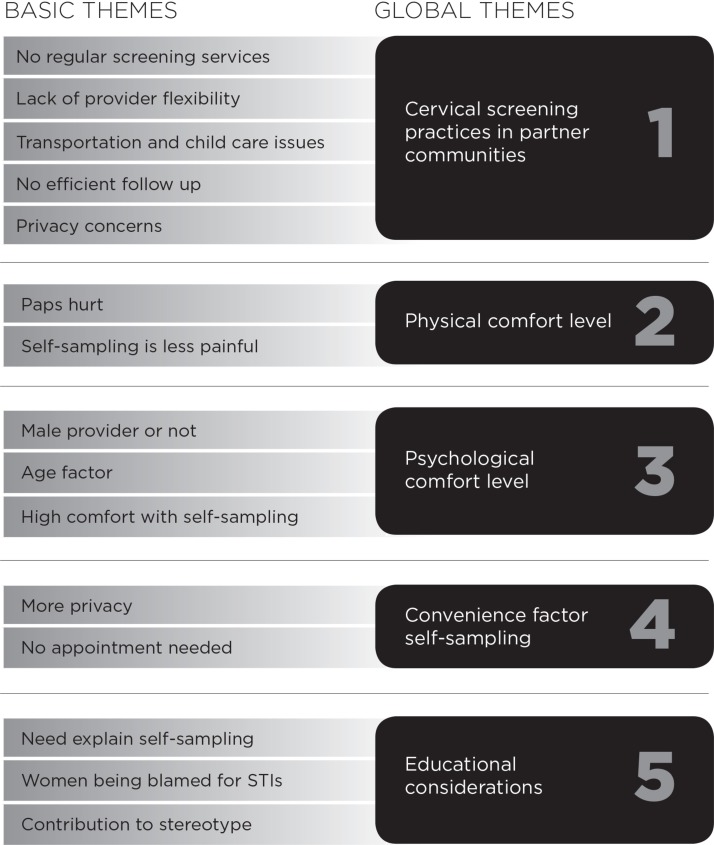
Participatory action researchinformed by the ethical space concept has guided all stages of the ACCSS. We conducted qualitative interviews with 16 HCPs and 8 focus group discussions with 69 female community members followed by a cluster-randomised controlled trial (RCT). Here, we draw on the qualitative field data and an end-of-study community update gathering to disseminate and contextualise research findings. Informant data were evaluated using thematic analysis.
We discuss factors influencing participants' strong preference for HPV self-sampling over physician-conducted Pap screening. Key arguments included enhanced accessibility and more personal control, less physical and emotional discomfort and fewer concerns regarding privacy of test results. For future implementation of HPV self-sampling, study participants emphasised the need for more culturally sensitive education addressed to community members of all genders, starting at school, clarifying that HPV causes cervical cancer. Further, HPV infection should be de-stigmatised by accentuating that it affects men and women alike.
Here we show that self-sampling in conjunction with community engagement and culturally sensitive education and could be a viable option for underscreened Canadian First Nations women. These informant data echo our previous RCT results.
虽然巴氏涂片筛查有助于降低加拿大宫颈癌的发病率,但与主流人群相比,原住民女性的负担和死亡率仍然较高。许多原住民女性可能对这种检查的侵入性感到不适,这导致了这一统计数据。阿尼什纳贝克宫颈癌筛查研究(ACCSS)于2009年至2015年在安大略省西北部的10个原住民社区实施,通过混合方法独特地解决了这种原住民健康不平等问题。
我们的目标是提供一种女性可以自行进行的替代检测:基于自我采样的人乳头瘤病毒(HPV)检测。我们调查了原住民女性是否更喜欢HPV自我采样而非由医疗服务提供者(HCP)进行的巴氏涂片筛查。
以伦理空间概念为指导的参与式行动研究贯穿了ACCSS的各个阶段。我们对16名HCP进行了定性访谈,并与69名女性社区成员进行了8次焦点小组讨论,随后进行了一项整群随机对照试验(RCT)。在此,我们利用定性实地数据和研究结束时的社区最新情况收集来传播研究结果并将其置于背景中。使用主题分析对 informant 数据进行评估。
我们讨论了影响参与者强烈倾向于HPV自我采样而非医生进行的巴氏涂片筛查的因素。关键论点包括更高的可及性和更多的个人控制权、更少的身体和情感不适以及对检测结果隐私的担忧更少。对于HPV自我采样的未来实施,研究参与者强调需要针对所有性别的社区成员开展更具文化敏感性的教育,从学校开始,阐明HPV会导致宫颈癌。此外,应通过强调HPV对男性和女性的影响相同来消除对HPV感染的污名化。
我们在此表明,自我采样与社区参与以及具有文化敏感性的教育相结合,可能是筛查不足的加拿大原住民女性的一个可行选择。这些 informant 数据与我们之前的RCT结果一致。