Cheong E Von, Sinnott Carol, Dahly Darren, Kearney Patricia M
School of Medicine, University College Cork, Cork, Ireland.
Department of General Practice, University College Cork, Cork, Ireland.
BMJ Open. 2017 Sep 1;7(9):e013228. doi: 10.1136/bmjopen-2016-013228.
To investigate associations between adverse childhood experiences (ACEs) and later-life depressive symptoms; and to explore whether perceived social support (PSS) moderates these.
We analysed baseline data from the Mitchelstown (Ireland) 2010-2011 cohort of 2047 men and women aged 50-69 years. Self-reported measures included ACEs (Centre for Disease Control ACE questionnaire), PSS (Oslo Social Support Scale) and depressive symptoms (CES-D). The primary exposure was self-report of at least one ACE. We also investigated the effects of ACE exposure by ACE scores and ACE subtypes abuse, neglect and household dysfunction. Associations between each of these exposures and depressive symptoms were estimated using logistic regression, adjusted for socio-demographic factors. We tested whether the estimated associations varied across levels of PSS (poor, moderate and strong).
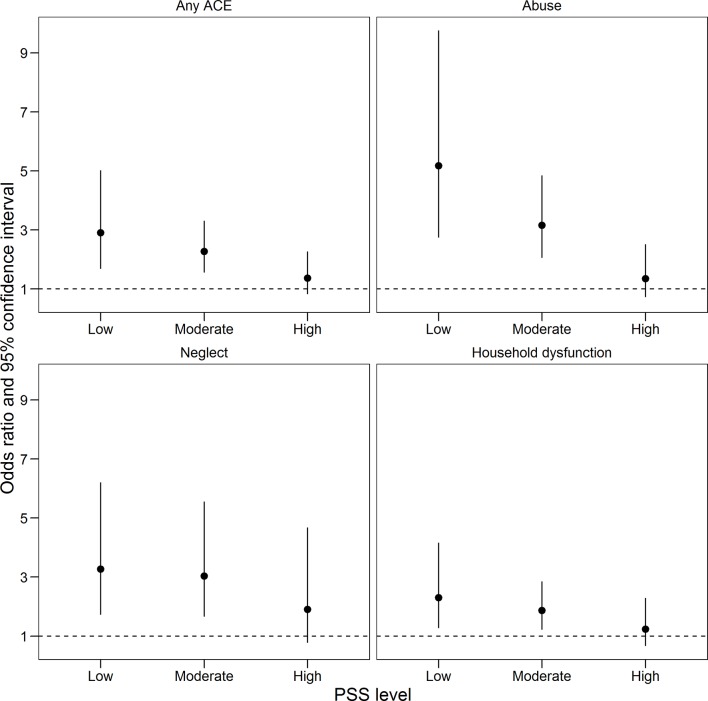
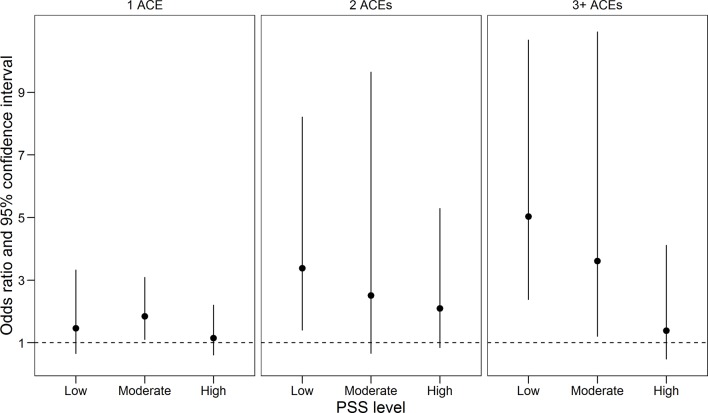
23.7% of participants reported at least one ACE (95% CI 21.9% to 25.6%). ACE exposures (overall, subtype or ACE scores) were associated with a higher odds of depressive symptoms, but only among individuals with poor PSS. Exposure to any ACE (vs none) was associated with almost three times the odds of depressive symptoms (adjusted OR 2.85; 95% CI 1.64 to 4.95) among individuals reporting poor PSS, while among those reporting moderate and strong PSS, the adjusted ORs were 2.21 (95% CI 1.52 to 3.22) and 1.39 (95% CI 0.85 to 2.29), respectively. This pattern of results was similar when exposures were based on ACE subtype and ACE scores, though the interaction was clearly strongest among those reporting abuse.
ACEs are common among older adults in Ireland and are associated with higher odds of later-life depressive symptoms, particularly among those with poor PSS. Interventions that enhance social support, or possibly perceptions of social support, may help reduce the burden of depression in older populations with ACE exposure, particularly in those reporting abuse.
调查童年不良经历(ACEs)与晚年抑郁症状之间的关联;并探讨感知社会支持(PSS)是否会调节这些关联。
我们分析了来自爱尔兰米切尔斯敦2010 - 2011年队列中2047名年龄在50 - 69岁之间的男性和女性的基线数据。自我报告的测量指标包括ACEs(疾病控制中心ACE问卷)、PSS(奥斯陆社会支持量表)和抑郁症状(流调中心抑郁量表)。主要暴露因素是自我报告至少有一次ACE。我们还通过ACE得分以及ACE亚型(虐待、忽视和家庭功能障碍)来研究ACE暴露的影响。使用逻辑回归估计这些暴露因素与抑郁症状之间的关联,并对社会人口学因素进行了调整。我们检验了估计的关联在不同水平的PSS(差、中等和强)之间是否有所不同。
23.7%的参与者报告至少有一次ACE(95%置信区间21.9%至25.6%)。ACE暴露(总体、亚型或ACE得分)与抑郁症状的较高几率相关,但仅在PSS较差的个体中如此。在报告PSS较差的个体中,暴露于任何ACE(与未暴露相比)与抑郁症状几率几乎高出三倍相关(调整后的比值比为2.85;95%置信区间1.64至4.95),而在报告PSS中等和较强的个体中,调整后的比值比分别为2.21(95%置信区间1.52至3.22)和1.39(95%置信区间0.85至2.29)。当暴露基于ACE亚型和ACE得分时结果模式相似,尽管在报告遭受虐待的个体中这种相互作用显然最强。
ACEs在爱尔兰老年人中很常见,并且与晚年抑郁症状的较高几率相关,特别是在PSS较差的个体中。增强社会支持或可能增强对社会支持的感知的干预措施,可能有助于减轻有ACE暴露的老年人群中的抑郁负担,特别是在那些报告遭受虐待的人群中。