The Pennsylvania State University, USA.
The Pennsylvania State University, USA.
Soc Sci Med. 2017 Oct;190:174-180. doi: 10.1016/j.socscimed.2017.08.004. Epub 2017 Aug 8.
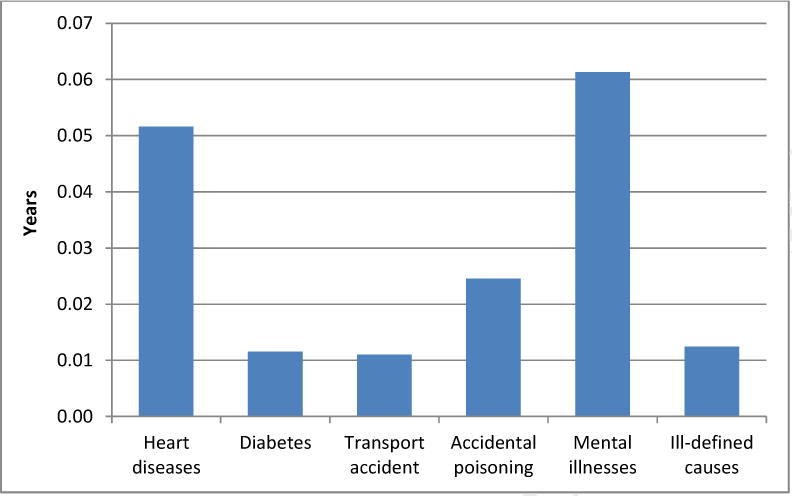
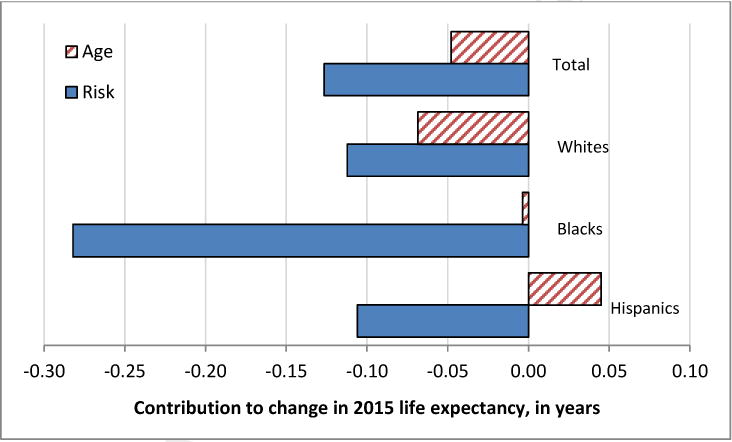
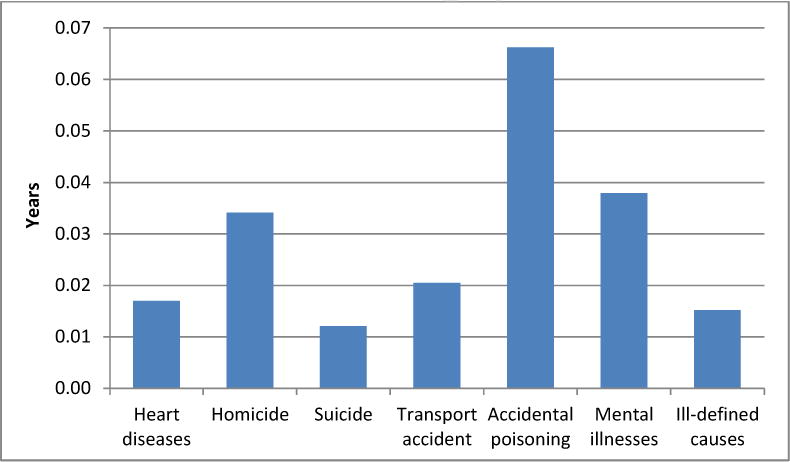
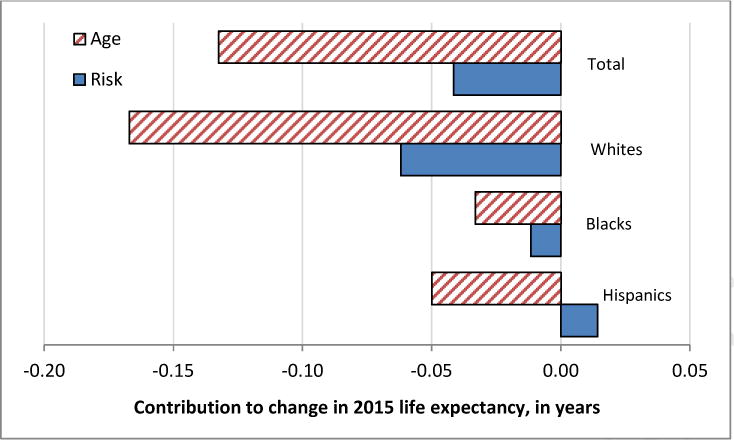
In 2015, age-adjusted mortality rates increased for 8 of the 10 leading causes of death in the United States. As a result, life expectancy declined by 0.17 years for both women and men. The decline could be just an anomaly, or it could represent the start of a new trend of stagnation or decline in life expectancy, as some scholars have warned. The first step is to determine the sources of the decline. In this study we analyze the contribution of specific causes of death to the decline in men's versus women's life expectancy, as well as the mechanisms that generated the decline. With regard to mechanisms, we examine whether the decline in life expectancy resulted from reductions in the average age at death for most causes of death, or from a greater risk of dying of causes that disproportionately affect the young and middle-aged. Using CDC mortality data, we construct life tables for men and women separately, based on 20 different underlying causes of death. We find that men's reduction in life expectancy was attributable primarily to changes in midlife mortality, with a greater risk of dying of causes such as accidental poisoning or homicide. The reduction in women's life expectancy, on the other hand, was attributable primarily to changes in old-age mortality, where the mean age at death for most causes (such as heart disease and mental illnesses) was lower in 2015 than it was in 2014. These gender-specific mechanisms that contributed to the decline in life expectancy are common to the major racial/ethnic groups, but the magnitude of the decline differs greatly across racial/ethnic groups. Future research can use the tools provided here to investigate in more detail how the gender-specific mechanisms of the 2015 decline differ by race.
2015 年,美国十大主要死因中有 8 种的年龄调整死亡率上升。因此,男性和女性的预期寿命均下降了 0.17 年。这一下降可能只是一个异常现象,也可能代表着预期寿命停滞或下降的新趋势的开始,正如一些学者所警告的那样。第一步是确定下降的原因。在这项研究中,我们分析了导致男性和女性预期寿命下降的特定死因的贡献,以及导致下降的机制。关于机制,我们研究了预期寿命的下降是否是由于大多数死因的死亡平均年龄降低所致,还是由于年轻人和中年人更容易死于某些不成比例影响他们的原因所致。我们使用疾病预防控制中心的死亡率数据,根据 20 种不同的根本死因,分别为男性和女性构建生命表。我们发现,男性预期寿命的缩短主要归因于中年死亡率的变化,死于意外中毒或杀人等原因的风险更大。另一方面,女性预期寿命的缩短主要归因于老年死亡率的变化,2015 年大多数死因(如心脏病和精神疾病)的平均死亡年龄低于 2014 年。导致预期寿命下降的这些性别特定机制在主要种族/族裔群体中是共同的,但下降的幅度在不同种族/族裔群体中差异很大。未来的研究可以使用这里提供的工具更详细地研究 2015 年下降的性别特定机制在不同种族之间的差异。