Centre for Human Psychopharmacology, Swinburne University of Technology, John St, Hawthorn, Melbourne 3122, Australia.
The National Institute of Integrative Medicine, 21 Burwood Rd, Hawthorn, Melbourne 3122, Australia.
Nutrients. 2017 Aug 30;9(9):960. doi: 10.3390/nu9090960.
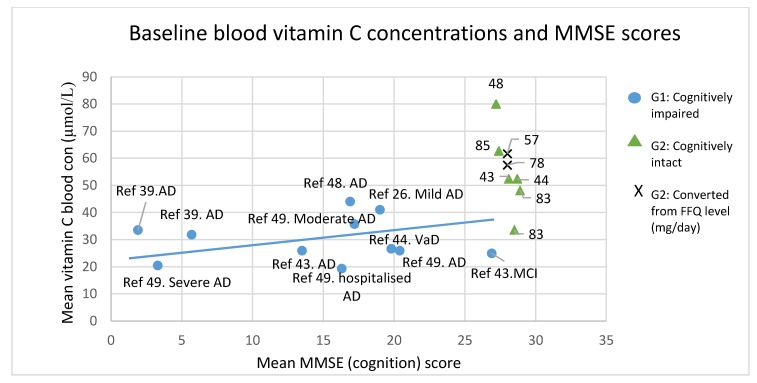
Vitamin C plays a role in neuronal differentiation, maturation, myelin formation and modulation of the cholinergic, catecholinergic, and glutaminergic systems. This review evaluates the link between vitamin C status and cognitive performance, in both cognitively intact and impaired individuals. We searched the PUBMED, SCOPUS, SciSearch and the Cochrane Library from 1980 to January 2017, finding 50 studies, with randomised controlled trials (RCTs, = 5), prospective ( = 24), cross-sectional ( = 17) and case-control ( = 4) studies. Of these, 36 studies were conducted in healthy participants and 14 on cognitively impaired individuals (including Alzheimer's and dementia). Vitamin C status was measured using food frequency questionnaires or plasma vitamin C. Cognition was assessed using a variety of tests, mostly the Mini-Mental-State-Examination (MMSE). In summary, studies demonstrated higher mean vitamin C concentrations in the cognitively intact groups of participants compared to cognitively impaired groups. No correlation between vitamin C concentrations and MMSE cognitive function was apparent in the cognitively impaired individuals. The MMSE was not suitable to detect a variance in cognition in the healthy group. Analysis of the studies that used a variety of cognitive assessments in the cognitively intact was beyond the scope of this review; however, qualitative assessment revealed a potential association between plasma vitamin C concentrations and cognition. Due to a number of limitations in these studies, further research is needed, utilizing plasma vitamin C concentrations and sensitive cognitive assessments that are suitable for cognitively intact adults.
维生素 C 在神经元分化、成熟、髓鞘形成以及胆碱能、儿茶酚胺能和谷氨酰胺能系统的调节中发挥作用。本综述评估了维生素 C 状态与认知表现之间的关系,包括认知正常和受损个体。我们从 1980 年到 2017 年 1 月在 PUBMED、SCOPUS、SciSearch 和 Cochrane Library 进行了检索,发现了 50 项研究,其中随机对照试验(RCT, = 5)、前瞻性研究( = 24)、横断面研究( = 17)和病例对照研究( = 4)。其中,36 项研究在健康参与者中进行,14 项在认知受损者中进行(包括阿尔茨海默病和痴呆)。维生素 C 状态通过食物频率问卷或血浆维生素 C 测量。认知通过各种测试进行评估,主要是简易精神状态检查(MMSE)。总之,研究表明,与认知受损组相比,认知正常组参与者的平均维生素 C 浓度更高。在认知受损个体中,维生素 C 浓度与 MMSE 认知功能之间没有明显相关性。MMSE 不适合检测健康组认知的差异。由于认知正常组中使用各种认知评估的研究分析超出了本综述的范围;然而,定性评估显示血浆维生素 C 浓度与认知之间存在潜在关联。由于这些研究存在许多局限性,需要进一步研究,利用血浆维生素 C 浓度和适合认知正常成年人的敏感认知评估。