Palmela Carolina, Torres Joana, Cravo Marilia
Gastroenterology Department, Surgical Department, Hospital Beatriz Ângelo, Loures, Portugal.
GE Port J Gastroenterol. 2015 May 11;22(3):103-111. doi: 10.1016/j.jpge.2015.03.009. eCollection 2015 May-Jun.
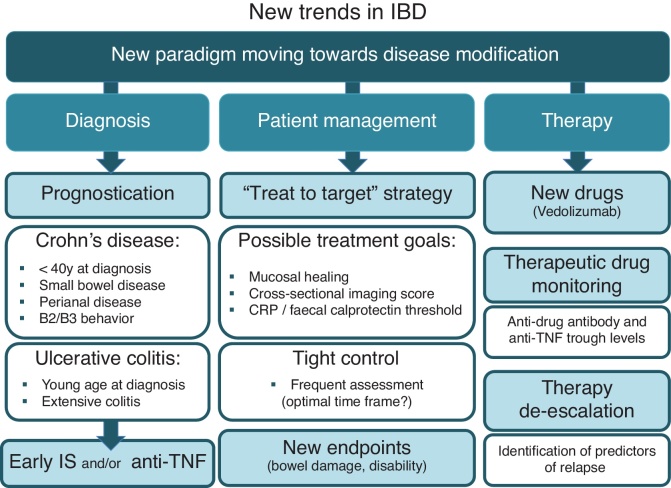
Inflammatory bowel disease (IBD) is a chronic idiopathic inflammatory disease of the gastrointestinal (GI) tract. In the past decade a shift in the treatment paradigm of IBD has ensued. The availability of drugs capable of inducing mucosal healing, combined with the recognition that IBD is not an intermittent disease, but rather a progressive one causing bowel damage and disability, led us to a more stringent strategy. Tailored therapy with more aggressive treatment in high-risk patients, treating beyond symptoms, intervening early before damage occurs, optimizing therapeutic regimens, and actively pursuing sustained remission and sustained control of inflammation are strategies that are slowly being incorporated in our clinical practice. Furthermore, new drugs targeting different immunological pathways, such as vedolizumab, have recently been approved and therefore more therapeutic resources for patients failing anti-tumour necrosis factor alpha (anti-TNFα) agents will be available. The future years look promising for IBD. Hopefully the new trends in IBD management, combined with new drugs, will make possible to change the course of disease and provide better therapy and quality of life for patients suffering from this disabling disease.
炎症性肠病(IBD)是一种胃肠道(GI)的慢性特发性炎症性疾病。在过去十年中,IBD的治疗模式发生了转变。能够诱导黏膜愈合的药物的出现,以及认识到IBD不是一种间歇性疾病,而是一种导致肠道损伤和残疾的进行性疾病,促使我们采取更严格的策略。在高危患者中采用更积极治疗的个体化治疗、超越症状进行治疗、在损伤发生前尽早干预、优化治疗方案以及积极追求持续缓解和持续控制炎症等策略正在逐渐融入我们的临床实践。此外,针对不同免疫途径的新药,如维多珠单抗,最近已获批准,因此对于抗肿瘤坏死因子α(抗TNFα)药物治疗失败的患者将有更多的治疗资源。IBD的未来几年前景光明。希望IBD管理的新趋势与新药相结合,将有可能改变疾病进程,并为患有这种致残性疾病的患者提供更好的治疗和生活质量。