Singh Shweta R, Coker Richard, Vrijhoef Hubertus J-M, Leo Yee Sin, Chow Angela, Lim Poh Lian, Tan Qinghui, Chen Mark I-Cheng, Hildon Zoe Jane-Lara
Saw Swee Hock School of Public Health, National University of Singapore, Tahir Foundation Building, Block MD1, 12 Science Drive 2, Singapore, 117549, Singapore.
Mahidol University, 9th Floor, Satharanaukwisit Bldg, 420/1 Rajwithi Rd, Bangkok, 10400, Thailand.
BMC Health Serv Res. 2017 Sep 4;17(1):622. doi: 10.1186/s12913-017-2552-1.
Hospital usage and service demand during an Infectious Disease (ID) outbreak can tax the health system in different ways. Herein we conceptualize hospital surge elements, and lessons learnt from such events, to help build appropriately matched responses to future ID surge threats.
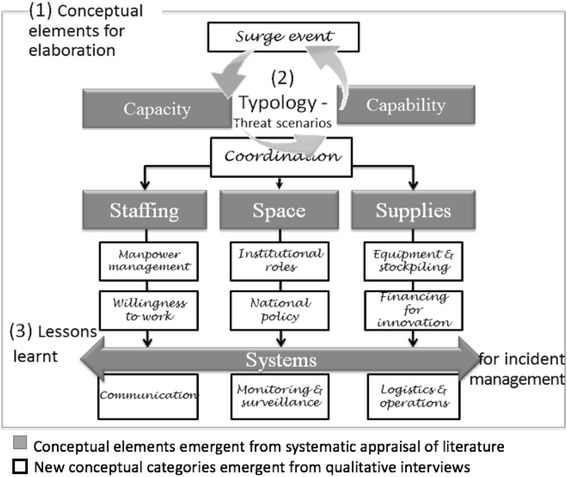
We used the Interpretive Descriptive qualitative approach. Interviews (n = 35) were conducted with governance and public health specialists; hospital based staff; and General Practitioners. Key policy literature in tandem with the interview data were used to iteratively generate a Hospital ID Surge framework. We anchored our narrative account within this framework, which is used to structure our analysis.
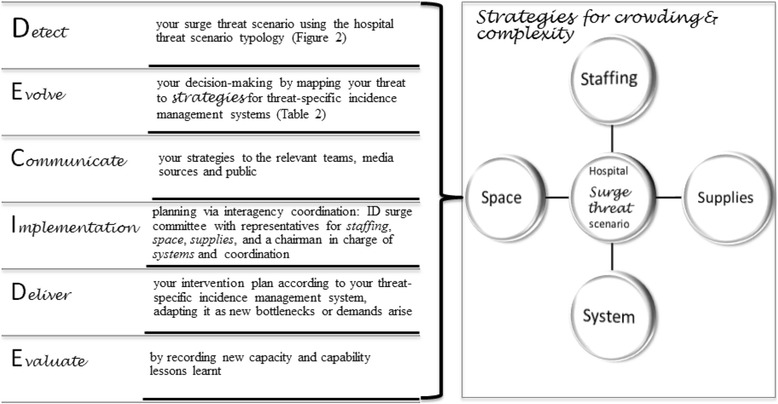
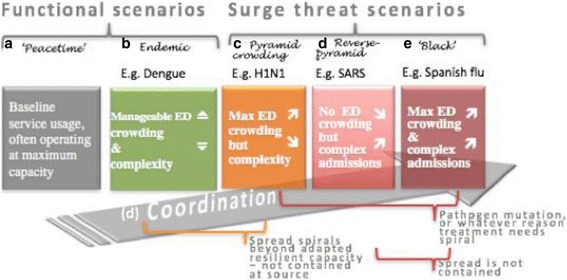
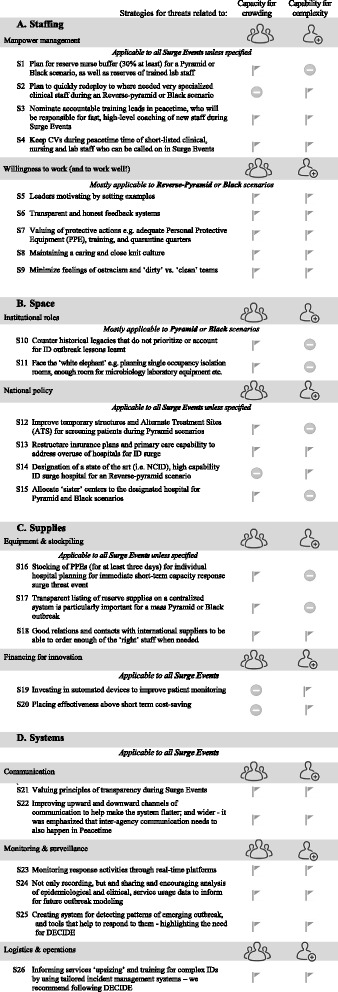
A spectrum of surge threats from combinations of capacity (for crowding) and capability (for treatment complexity) demands were identified. Starting with the Pyramid scenario, or an influx of high screening rates flooding Emergency Departments, alongside fewer and manageable admissions; the Reverse-Pyramid occurs when few cases are screened and admitted but those that are, are complex; during a 'Black' scenario, the system is overburdened by both crowding and complexity. The Singapore hospital system is highly adapted to crowding, functioning remarkably well at constant near-full capacity in Peacetime and resilient to Endemic surges. We catalogue 26 strategies from lessons learnt relating to staffing, space, supplies and systems, crystalizing institutional memory. The DECIDE model advocates linking these strategies to types of surge threats and offers a step-by-step guide for coordinating outbreak planning and response.
Lack of a shared definition and decision making of surge threats had rendered the procedures somewhat duplicative. This burden was paradoxically exacerbated by a health system that highly prizes planning and forward thinking, but worked largely in silo until an ID crisis hit. Many such lessons can be put into play to further strengthen our current hospital governance and adapted to more diverse settings.
传染病爆发期间的医院使用情况和服务需求会以不同方式给卫生系统带来压力。在此,我们对医院应对激增情况的要素以及从此类事件中吸取的经验教训进行概念化,以帮助构建对未来传染病激增威胁的适当匹配应对措施。
我们采用了解释性描述性定性方法。对治理和公共卫生专家、医院工作人员以及全科医生进行了访谈(n = 35)。结合关键政策文献和访谈数据,反复生成了一个医院传染病激增框架。我们将叙述内容基于此框架,该框架用于构建我们的分析。
确定了一系列由容量(针对拥挤情况)和能力(针对治疗复杂性)需求组合产生的激增威胁。从金字塔情景开始,即高筛查率的大量涌入使急诊科不堪重负,同时入院人数较少且易于管理;反向金字塔情景则是筛查和入院的病例很少,但这些病例很复杂;在“黑色”情景下,系统因拥挤和复杂性而不堪重负。新加坡医院系统高度适应拥挤情况,在和平时期接近满负荷运转时功能良好,并且能抵御地方病激增。我们从人员配备、空间、物资和系统方面吸取经验,整理出26项策略,固化机构记忆。DECIDE模型主张将这些策略与激增威胁类型相联系,并为协调疫情规划和应对提供逐步指导。
对激增威胁缺乏共同定义和决策导致程序有些重复。矛盾的是,一个高度重视规划和前瞻性思维,但在传染病危机来袭之前基本各自为政的卫生系统加剧了这种负担。许多这样的经验教训可以发挥作用,以进一步加强我们当前的医院治理,并适用于更多样化的环境。