Interdisciplinary Program in Bioengineering, Georgia Institute of Technology, Atlanta, GA, 30332, USA.
George W. Woodruff School of Mechanical Engineering, Georgia Institute of Technology, Atlanta, GA, 30332, USA.
Sci Rep. 2017 Sep 4;7(1):10402. doi: 10.1038/s41598-017-11032-3.
We describe the use of PEDOT:PSS conducting polymer microwires to modulate action potentials in single cells.
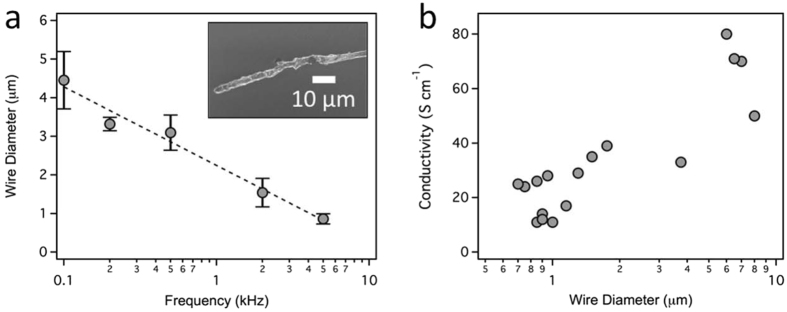
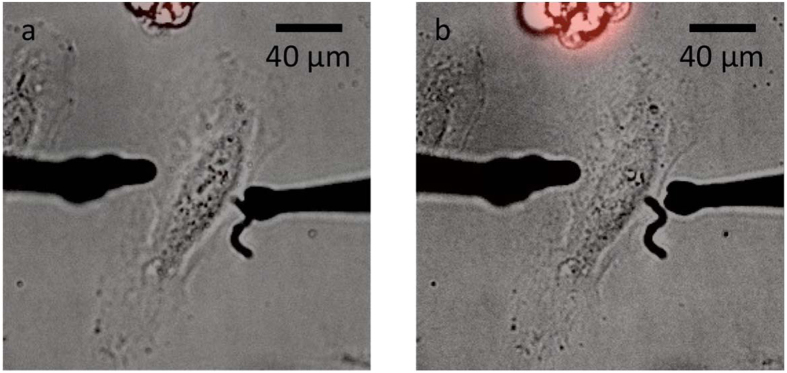
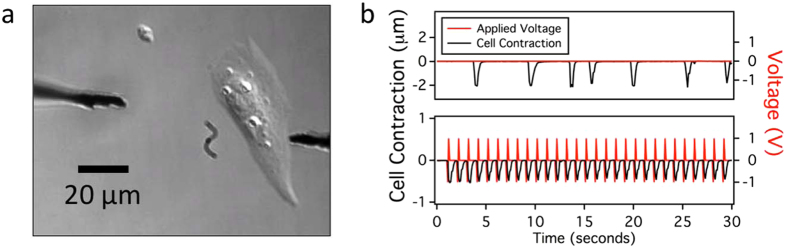
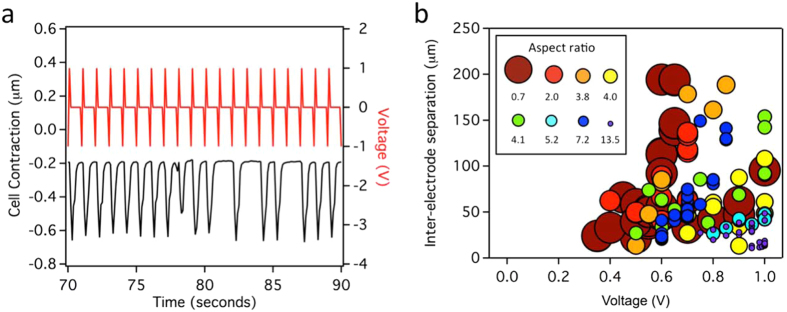
PSS conducting polymer microwires are electrochemically synthesized with diameters ranging from 860 nm to 4.5 μm and conductivities of ~30 S/cm. The length of the microwires is controlled by the spacing of the electrodes used for the electrochemical polymerization. We demonstrate the use of these microwires to control the action potentials of cardiomyocytes, showing that the cellular contractions match the frequency of the applied voltage. Membrane integrity assays confirm that the voltage delivered by the wires does not damage cells. We expect the conducting polymer microwires will be useful as minimally invasive devices to control the electrical properties of cells with high spatial precision.
我们描述了使用 PEDOT:PSS 导电聚合物微丝来调节单细胞中的动作电位。
PSS 导电聚合物微丝通过电化学合成,直径范围从 860nm 到 4.5μm,电导率约为 30S/cm。微丝的长度由用于电化学聚合的电极之间的间距控制。我们展示了这些微丝在控制心肌细胞动作电位方面的应用,表明细胞收缩与施加电压的频率相匹配。细胞膜完整性测定证实,微丝传递的电压不会损伤细胞。我们预计导电聚合物微丝将作为微创装置,以高精度空间控制细胞的电特性。