He Shaomei, Barco Roman A, Emerson David, Roden Eric E
Department of Geoscience, University of Wisconsin-MadisonMadison, WI, United States.
NASA Astrobiology Institute, University of WisconsinMadison, WI, United States.
Front Microbiol. 2017 Aug 21;8:1584. doi: 10.3389/fmicb.2017.01584. eCollection 2017.
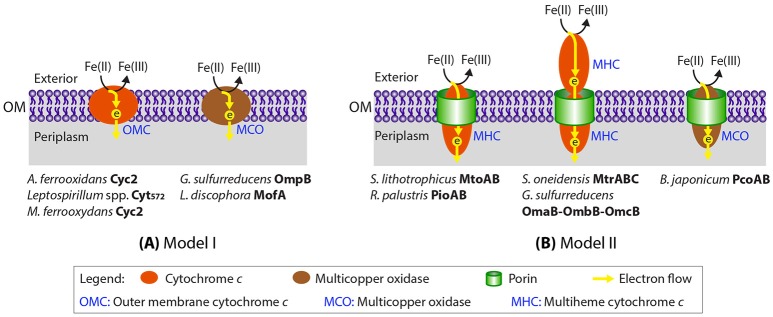
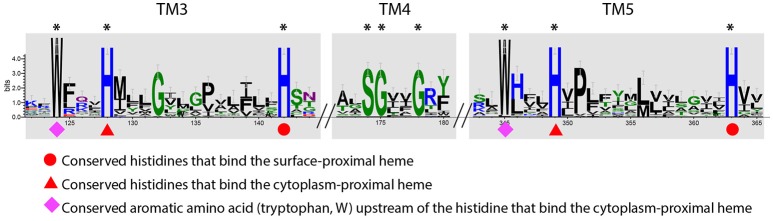
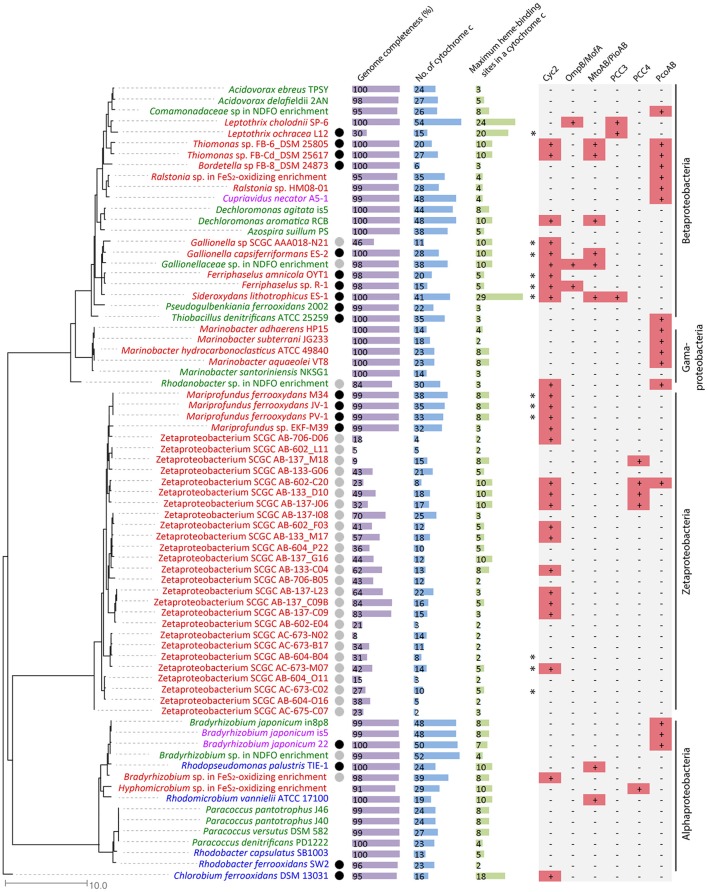
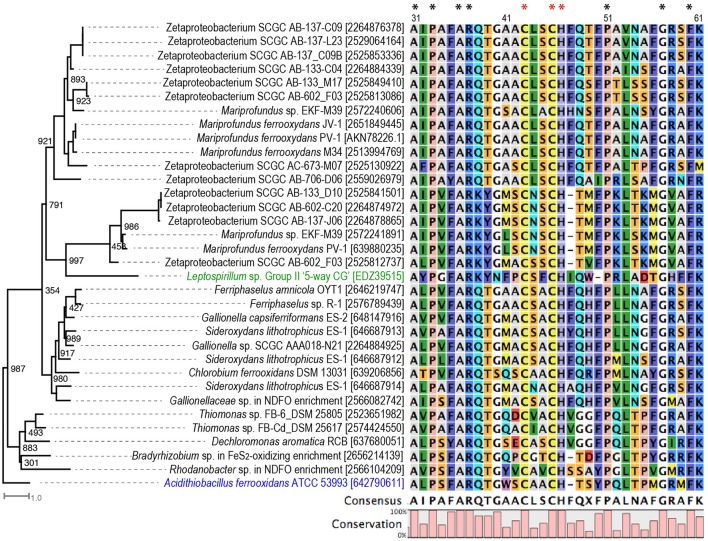
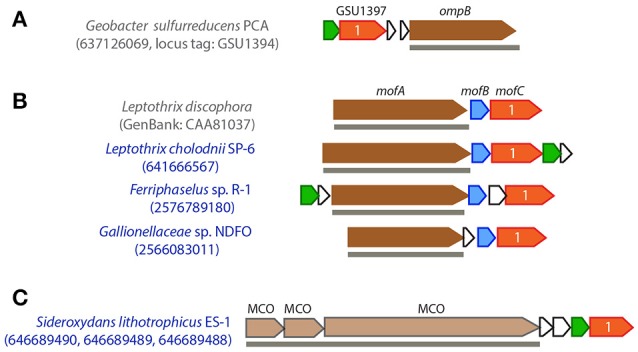
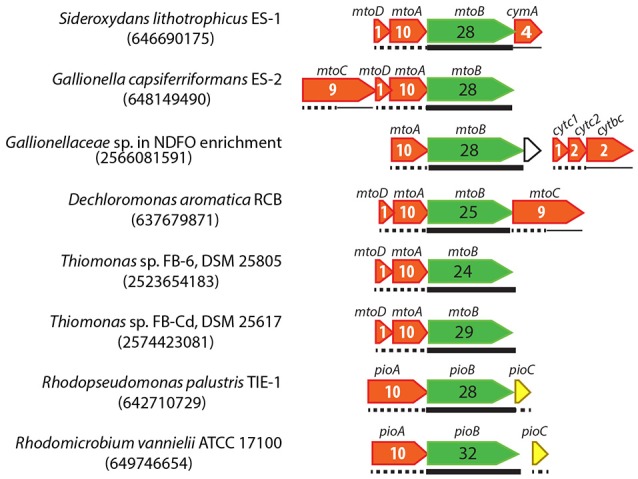
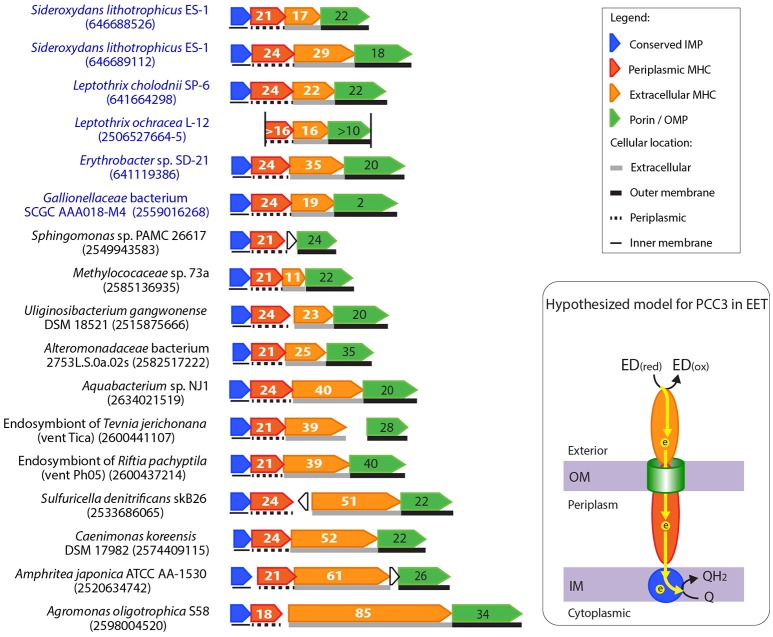
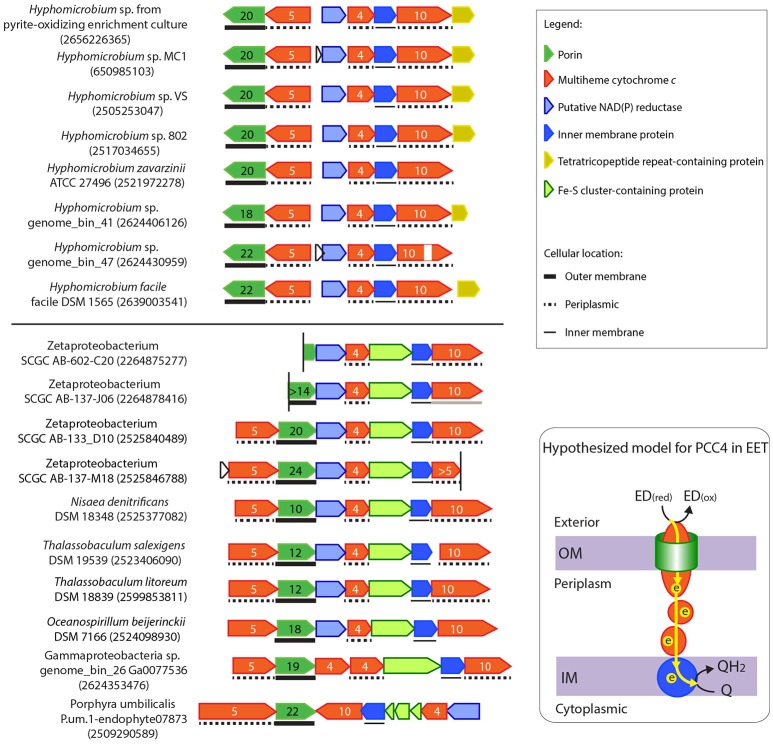
Extracellular electron transfer (EET) is recognized as a key biochemical process in circumneutral pH Fe(II)-oxidizing bacteria (FeOB). In this study, we searched for candidate EET genes in 73 neutrophilic FeOB genomes, among which 43 genomes are complete or close-to-complete and the rest have estimated genome completeness ranging from 5 to 91%. These neutrophilic FeOB span members of the microaerophilic, anaerobic phototrophic, and anaerobic nitrate-reducing FeOB groups. We found that many microaerophilic and several anaerobic FeOB possess homologs of Cyc2, an outer membrane cytochrome originally identified in . The "porin-cytochrome complex" (PCC) gene clusters homologous to MtoAB/PioAB are present in eight FeOB, accounting for 19% of complete and close-to-complete genomes examined, whereas PCC genes homologous to OmbB-OmaB-OmcB in are absent. Further, we discovered gene clusters that may potentially encode two novel PCC types. First, a cluster (tentatively named "PCC3") encodes a porin, an extracellular and a periplasmic cytochrome with remarkably large numbers of heme-binding motifs. Second, a cluster (tentatively named "PCC4") encodes a porin and three periplasmic multiheme cytochromes . A conserved inner membrane protein (IMP) encoded in PCC3 and PCC4 gene clusters might be responsible for translocating electrons across the inner membrane. Other bacteria possessing PCC3 and PCC4 are mostly Proteobacteria isolated from environments with a potential niche for Fe(II) oxidation. In addition to cytochrome , multicopper oxidase (MCO) genes potentially involved in Fe(II) oxidation were also identified. Notably, candidate EET genes were not found in some FeOB, especially the anaerobic ones, probably suggesting EET genes or Fe(II) oxidation mechanisms are different from the searched models. Overall, based on current EET models, the search extends our understanding of bacterial EET and provides candidate genes for future research.
细胞外电子转移(EET)被认为是环境pH值中性的亚铁氧化细菌(FeOB)中的关键生化过程。在本研究中,我们在73个嗜中性FeOB基因组中寻找候选EET基因,其中43个基因组是完整的或接近完整的,其余基因组的估计完整性范围为5%至91%。这些嗜中性FeOB涵盖了微需氧、厌氧光合和厌氧硝酸盐还原FeOB组的成员。我们发现许多微需氧FeOB和一些厌氧FeOB拥有Cyc2的同源物,Cyc2是一种最初在[具体文献未提及]中鉴定出的外膜细胞色素。与MtoAB/PioAB同源的“孔蛋白 - 细胞色素复合物”(PCC)基因簇存在于8个FeOB中,占所检测的完整和接近完整基因组的19%,而与[具体文献未提及]中的OmbB - OmaB - OmcB同源的PCC基因则不存在。此外,我们发现了可能潜在编码两种新型PCC类型的基因簇。首先,一个基因簇(暂命名为“PCC3”)编码一种孔蛋白、一种细胞外和一种周质细胞色素,具有大量的血红素结合基序。其次,一个基因簇(暂命名为“PCC4”)编码一种孔蛋白和三种周质多血红素细胞色素。PCC3和PCC4基因簇中编码的一种保守内膜蛋白(IMP)可能负责将电子跨内膜转运。拥有PCC3和PCC4的其他细菌大多是从具有亚铁氧化潜在生态位的环境中分离出的变形菌。除了细胞色素外,还鉴定出了可能参与亚铁氧化的多铜氧化酶(MCO)基因。值得注意的是,在一些FeOB中未发现候选EET基因,尤其是厌氧FeOB,这可能表明EET基因或亚铁氧化机制与所搜索的模型不同。总体而言,基于当前的EET模型,该搜索扩展了我们对细菌EET的理解,并为未来研究提供了候选基因。