Roelants Françoise M, Leskoske Kristin L, Martinez Marshall Maria Nieves, Locke Melissa N, Thorner Jeremy
Division of Biochemistry, Biophysics and Structural Biology and Division of Cell and Developmental Biology, Department of Molecular and Cell Biology, University of California, Berkeley, CA 94720-3202, USA.
Biomolecules. 2017 Sep 5;7(3):66. doi: 10.3390/biom7030066.
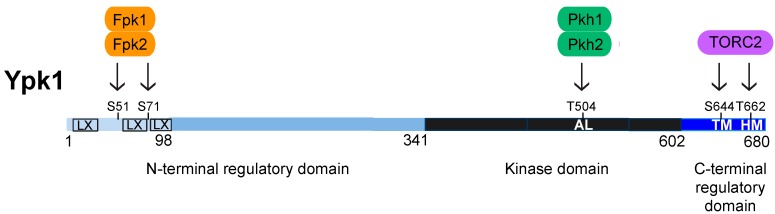
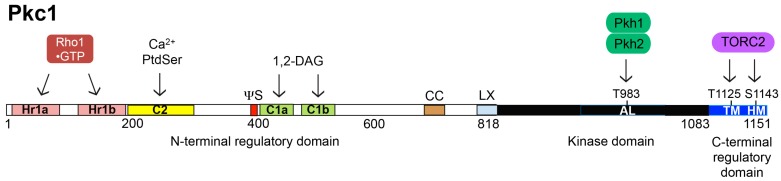
To grow, eukaryotic cells must expand by inserting glycerolipids, sphingolipids, sterols, and proteins into their plasma membrane, and maintain the proper levels and bilayer distribution. A fungal cell must coordinate growth with enlargement of its cell wall. In Saccharomyces cerevisiae, a plasma membrane-localized protein kinase complex, Target of Rapamicin (TOR) complex-2 (TORC2) (mammalian ortholog is mTORC2), serves as a sensor and masterregulator of these plasma membrane- and cell wall-associated events by directly phosphorylating and thereby stimulating the activity of two types of effector protein kinases: Ypk1 (mammalian ortholog is SGK1), along with a paralog (Ypk2); and, Pkc1 (mammalian ortholog is PKN2/PRK2). Ypk1 is a central regulator of pathways and processes required for plasma membrane lipid and protein homeostasis, and requires phosphorylation on its T-loop by eisosome-associated protein kinase Pkh1 (mammalian ortholog is PDK1) and a paralog (Pkh2). For cell survival under various stresses, Ypk1 function requires TORC2-mediated phosphorylation at multiple sites near its C terminus. Pkc1 controls diverse processes, especially cell wall synthesis and integrity. Pkc1 is also regulated by Pkh1- and TORC2-dependent phosphorylation, but, in addition, by interaction with Rho1-GTP and lipids phosphatidylserine (PtdSer) and diacylglycerol (DAG). We also describe here what is currently known about the downstream substrates modulated by Ypk1-mediated and Pkc1-mediated phosphorylation.
为了生长,真核细胞必须通过将甘油脂、鞘脂、固醇和蛋白质插入质膜来实现扩张,并维持适当的水平和双层分布。真菌细胞必须协调生长与细胞壁的扩大。在酿酒酵母中,一种定位于质膜的蛋白激酶复合物,雷帕霉素靶蛋白(TOR)复合物2(TORC2)(哺乳动物同源物是mTORC2),通过直接磷酸化并从而刺激两种效应蛋白激酶的活性,作为这些质膜和细胞壁相关事件的传感器和主要调节因子:Ypk1(哺乳动物同源物是SGK1)以及一个旁系同源物(Ypk2);还有Pkc1(哺乳动物同源物是PKN2/PRK2)。Ypk1是质膜脂质和蛋白质稳态所需途径和过程的核心调节因子,并且需要与核内体相关的蛋白激酶Pkh1(哺乳动物同源物是PDK1)和一个旁系同源物(Pkh2)在其T环上进行磷酸化。为了在各种应激条件下细胞存活,Ypk1功能需要TORC2在其C末端附近的多个位点介导磷酸化。Pkc1控制多种过程,尤其是细胞壁合成和完整性。Pkc1也受Pkh1和TORC2依赖性磷酸化调节,但此外,还受与Rho1-GTP以及脂质磷脂酰丝氨酸(PtdSer)和二酰基甘油(DAG)相互作用的调节。我们在此还描述了目前已知的由Ypk1介导和Pkc1介导的磷酸化所调节的下游底物。