Ecole Doctorale Nutrition Environnement Santé (EDNES), Université de Mahajanga, Mahajanga, Madagascar.
Thématique: Sante Publique, Ecole Doctorale Nutrition Environnement Santé (EDNES), Université de Mahajanga, Mahajanga, Madagascar.
BMC Med Educ. 2017 Sep 6;17(1):152. doi: 10.1186/s12909-017-0991-3.
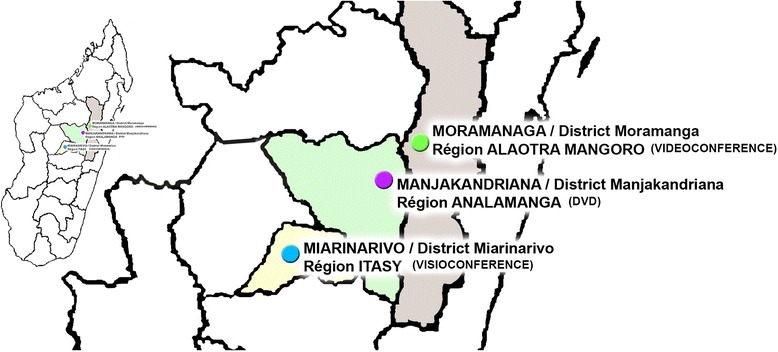
Distance Learning (DL) is a means to overcome the barriers that prevent health workers access to medical education and training sessions to update their knowledge. The main objective of this study is to compare the knowledge acquisition among practitioners Heads of Health Based Center (HBC) for the management of hypertension in two training modalities, one interactive, via internet (by Visio conferencing and video Conferencing), and other non-interactive, via DVD in the three regions (Miarinarivo, Moramanga and Manjakandriana) of Madagascar.
This is a quasi-experimental study comparing two distance learning methodologies, one via internet (VS or VD) and the other via DVD before and after training. Ninety-two (92) Heads of HBC participated in the training, including 56 via the Internet (24 doctors and 32 paramedics) and 36 via DVD (24 doctors and 12 paramedics).
According to the training mode: the mean score of knowledge of the participants was 7 (+ -2) for two terms before training. It is 14 (+ -2.5) in the internet group (VS or VD) and 15 (+ -2.7) in the DVD group after training. The difference between the two groups was not significant p = 0.076. For doctors, the score was 7 (+ -3.1) via internet and 8 (+ -2.3) via DVD in pre test and 14 (+ - 2.4) via internet and 16 (+ -. 2.7) via DVD in post test, the difference between the two training methods was significant (p = 0.008). Among the paramedics, the results are the same for both conditions, 7 (+ - 2.4 to + -3.2) in pre test and 14 (+ - 2.2 to + -2.7) in post test.
Both training methods have improved participants' knowledge and the DVD mode is the first choice for Heads HBC of Madagascar with the majority located in remote areas.
远程学习(DL)是一种克服阻碍卫生工作者获得医学教育和培训课程以更新知识的手段。本研究的主要目的是比较两种培训模式下,通过互联网(通过视频会议和视频会议)和其他非交互式方式(通过 DVD)进行的管理高血压的卫生保健中心负责人(HBC)从业者之间的知识获取情况。
这是一项比较两种远程学习方法的准实验研究,一种是通过互联网(VS 或 VD),另一种是通过培训前后的 DVD。92 名 HBC 负责人参加了培训,其中 56 名通过互联网(24 名医生和 32 名医务人员)和 36 名通过 DVD(24 名医生和 12 名医务人员)。
根据培训模式:培训前两期,参与者的知识平均得分为 7(+ -2)。互联网组(VS 或 VD)为 14(+ -2.5),DVD 组为 15(+ -2.7)。两组之间的差异无统计学意义(p = 0.076)。对于医生来说,通过互联网的分数为 7(+ -3.1),通过 DVD 的分数为 8(+ -2.3),在预测试中为 14(+ -2.4),通过互联网的分数为 16(+ -2.7),通过 DVD 的分数为 16(+ -2.7),两种培训方法之间的差异具有统计学意义(p = 0.008)。在医务人员中,两种情况的结果相同,预测试中为 7(+ -2.4 至+ -3.2),后测中为 14(+ -2.2 至+ -2.7)。
两种培训方法都提高了参与者的知识水平,DVD 模式是马达加斯加 HBC 负责人的首选,因为大多数负责人都位于偏远地区。