Division of Neurogenetics, Center for Neurological Diseases and Cancer, Nagoya University Graduate School of Medicine, Nagoya, Aichi, Japan.
Sci Rep. 2017 Sep 5;7(1):10446. doi: 10.1038/s41598-017-11036-z.
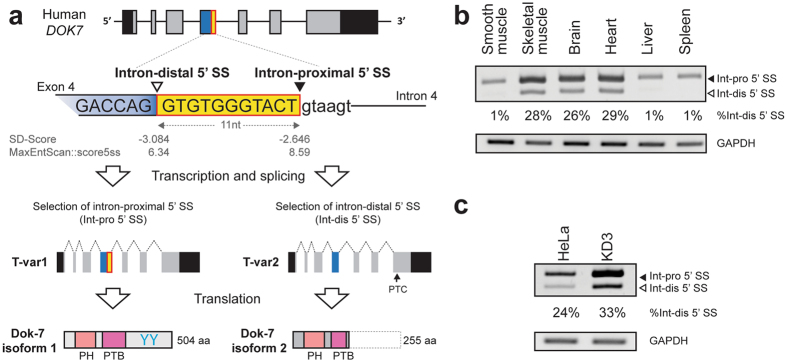
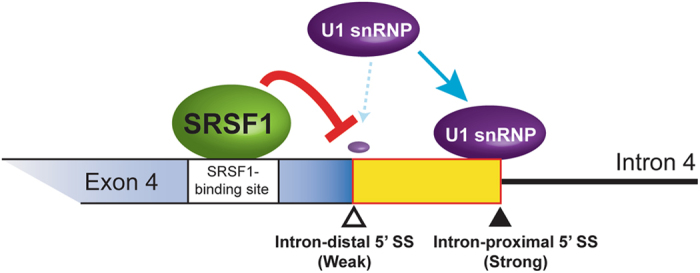
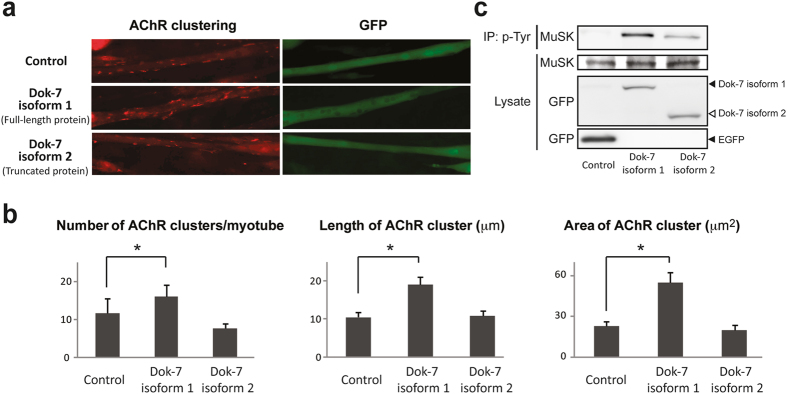
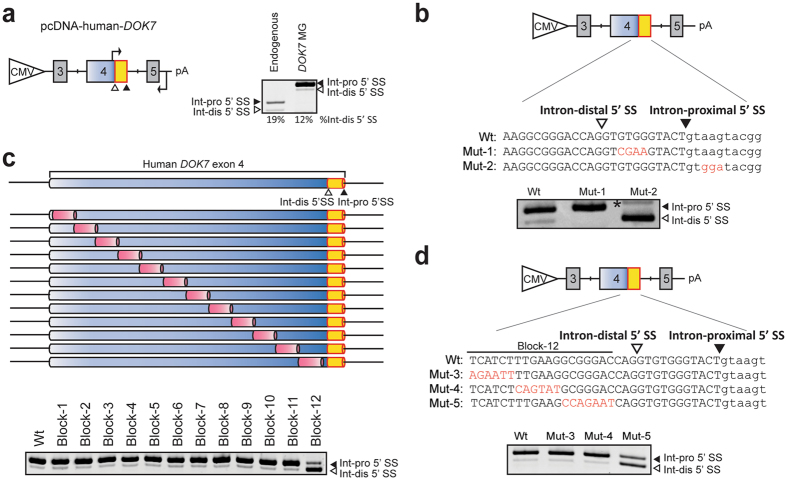
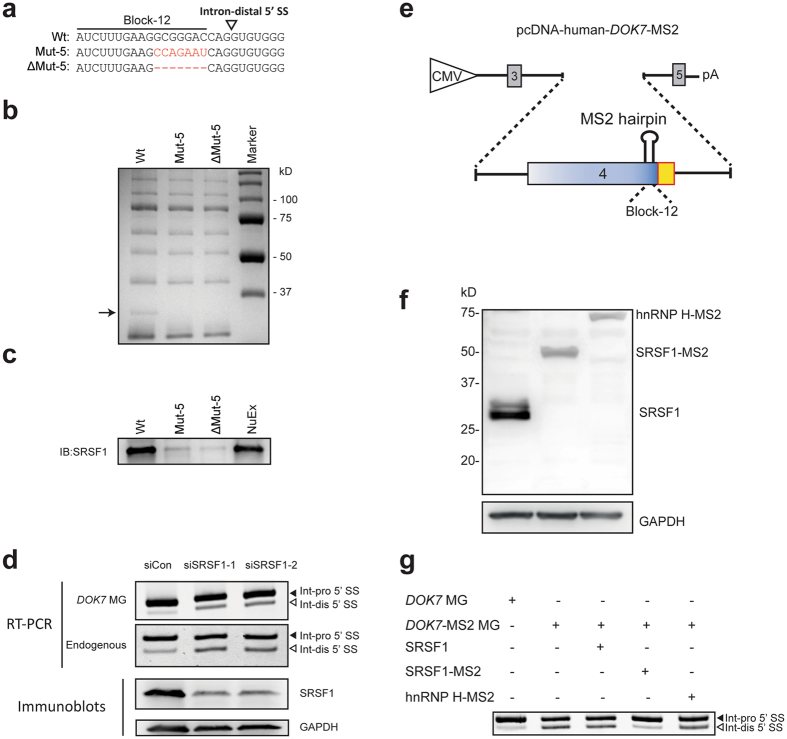
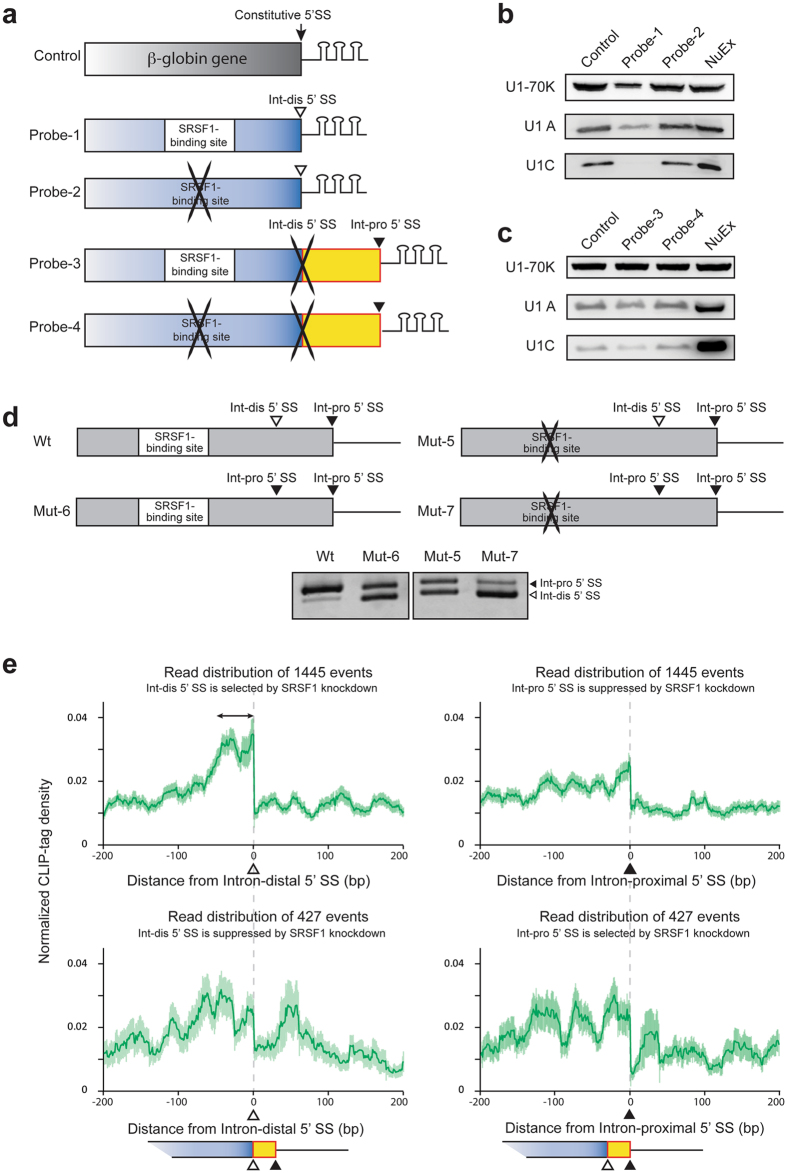
Dok-7 is a non-catalytic adaptor protein that facilitates agrin-induced clustering of acetylcholine receptors (AChR) at the neuromuscular junction. Alternative selection of 5' splice sites (SSs) of DOK7 intron 4 generates canonical and frame-shifted transcripts. We found that the canonical full-length Dok-7 enhanced AChR clustering, whereas the truncated Dok-7 did not. We identified a splicing cis-element close to the 3' end of exon 4 by block-scanning mutagenesis. RNA affinity purification and mass spectrometry revealed that SRSF1 binds to the cis-element. Knocking down of SRSF1 enhanced selection of the intron-distal 5' SS of DOK7 intron 4, whereas MS2-mediated artificial tethering of SRSF1 to the identified cis-element suppressed it. Isolation of an early spliceosomal complex revealed that SRSF1 inhibited association of U1 snRNP to the intron-distal 5' SS, and rather enhanced association of U1 snRNP to the intron-proximal 5' SS, which led to upregulation of the canonical DOK7 transcript. Integrated global analysis of CLIP-seq and RNA-seq also indicated that binding of SRSF1 immediately upstream to two competing 5' SSs suppresses selection of the intron-distal 5' SS in hundreds of human genes. We demonstrate that SRSF1 critically regulates alternative selection of adjacently placed 5' SSs by modulating binding of U1 snRNP.
Dok-7 是一种非催化衔接蛋白,可促进神经肌肉接头处乙酰胆碱受体 (AChR) 的聚集。Dok-7 内含子 4 的 5' 剪接位点 (SS) 的选择性选择产生了规范和移框转录本。我们发现规范的全长 Dok-7 增强了 AChR 的聚集,而截短的 Dok-7 则没有。我们通过块扫描诱变鉴定了靠近外显子 4 3' 端的剪接顺式元件。RNA 亲和纯化和质谱分析显示 SRSF1 结合到顺式元件上。敲低 SRSF1 增强了 Dok-7 内含子 4 内含子远端 5' SS 的选择,而 MS2 介导的 SRSF1 人工连接到鉴定的顺式元件上则抑制了它。早期剪接体复合物的分离表明,SRSF1 抑制了 U1 snRNP 与内含子远端 5' SS 的结合,而增强了 U1 snRNP 与内含子近端 5' SS 的结合,从而上调了规范的 Dok-7 转录本。CLIP-seq 和 RNA-seq 的综合全局分析还表明,SRSF1 立即在上游两个竞争 5' SS 上的结合抑制了数百个人类基因中内含子远端 5' SS 的选择。我们证明,SRSF1 通过调节 U1 snRNP 的结合,对邻近放置的 5' SS 的选择性选择起着至关重要的调节作用。