Fileccia Veronica, Ruisi Paolo, Ingraffia Rosolino, Giambalvo Dario, Frenda Alfonso Salvatore, Martinelli Federico
Dipartimento di Scienze Agrarie, Alimentari e Forestali, Università degli Studi di Palermo, Palermo, Italy.
PLoS One. 2017 Sep 6;12(9):e0184158. doi: 10.1371/journal.pone.0184158. eCollection 2017.
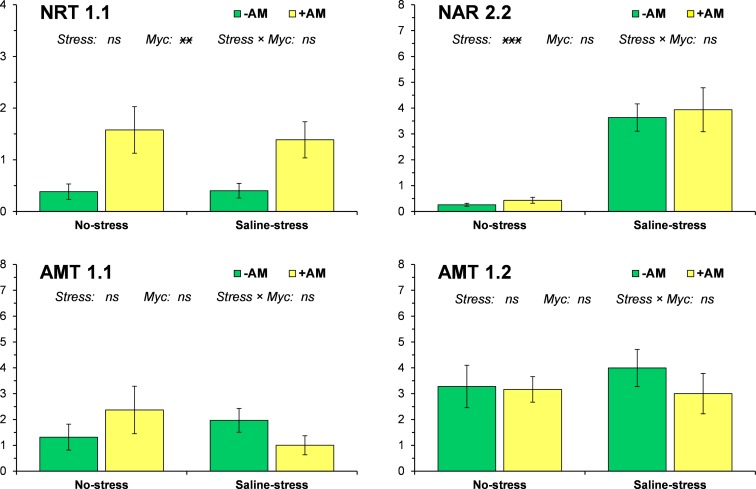
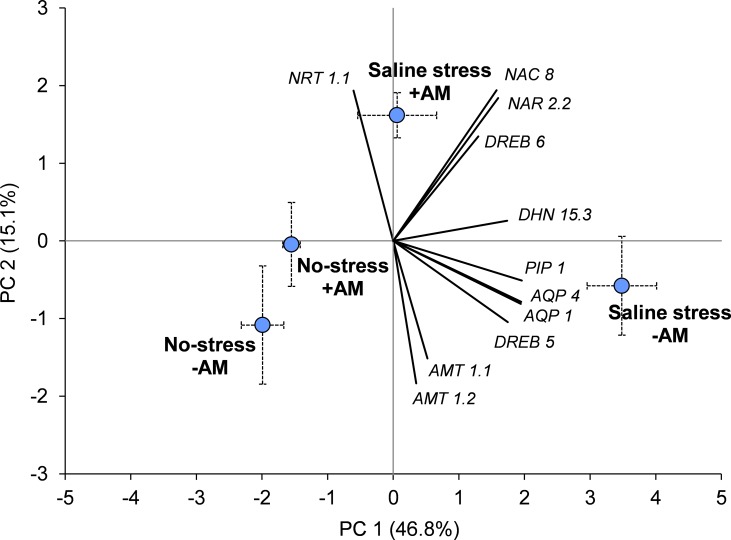
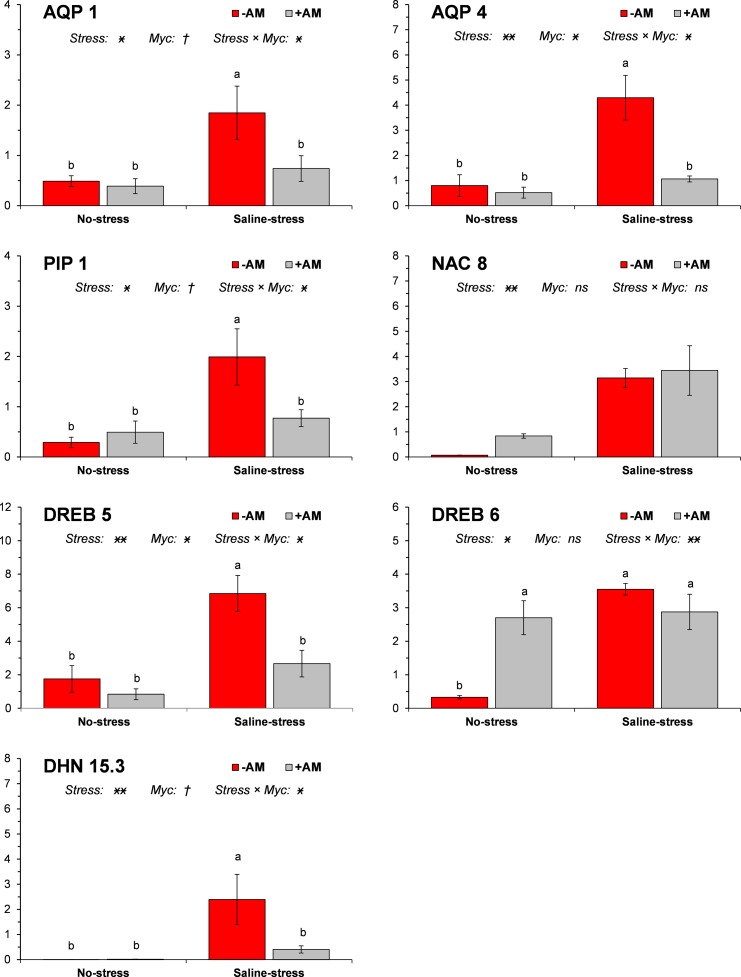
Arbuscular mycorrhizal (AM) symbiosis is generally considered to be effective in ameliorating the plant tolerance to salt stress. Unfortunately, the comprehension of the mechanisms implicated in salinity stress alleviation by AM symbiosis is far from being complete. Thus, an experiment was performed by growing durum wheat (Triticum durum Desf.) plants under salt-stress conditions to evaluate the influence of AM symbiosis on both the plant growth and the regulation of a number of genes related to salt stress and nutrient uptake. Durum wheat plants were grown outdoors in pots in absence or in presence of salt stress and with or without AM fungi inoculation. The inoculum consisted of a mixture of spores of Rhizophagus irregularis (formerly Glomus intraradices) and Funneliformis mosseae (formerly G. mosseae). Results indicate that AM symbiosis can alleviate the detrimental effects of salt stress on the growth of durum wheat plants. In fact, under salt stress conditions mycorrhizal plants produced more aboveground and root biomass, had higher N uptake and aboveground N concentration, and showed greater stability of plasma membranes compared to non-mycorrhizal plants. Inoculation with AM fungi had no effect on the expression of the N transporter genes AMT1.1, AMT1.2, and NAR2.2, either under no-stress or salt stress conditions, probably due to the fact that plants were grown under optimal N conditions; on the contrary, NRT1.1 was always upregulated by AM symbiosis. Moreover, the level of expression of the drought stress-related genes AQP1, AQP4, PIP1, DREB5, and DHN15.3 observed in the mycorrhizal stressed plants was markedly lower than that observed in the non-mycorrhizal stressed plants and very close to that observed in the non-stressed plants. Our hypothesis is that, in the present study, AM symbiosis did not increase the plant tolerance to salt stress but instead generated a condition in which plants were subjected to a level of salt stress lower than that of non-mycorrhizal plants.
丛枝菌根(AM)共生通常被认为能有效提高植物对盐胁迫的耐受性。不幸的是,对于AM共生缓解盐胁迫所涉及的机制的理解还远未完整。因此,进行了一项实验,在盐胁迫条件下种植硬粒小麦(Triticum durum Desf.)植株,以评估AM共生对植物生长以及一些与盐胁迫和养分吸收相关基因调控的影响。硬粒小麦植株在室外花盆中生长,分别处于有无盐胁迫以及有无接种AM真菌的条件下。接种物由不规则根孢囊霉(原称Glomus intraradices)和摩西管柄囊霉(原称G. mosseae)的孢子混合物组成。结果表明,AM共生可以减轻盐胁迫对硬粒小麦植株生长的不利影响。事实上,在盐胁迫条件下,与非菌根植株相比,菌根植株地上部和根部生物量更多,氮吸收量更高,地上部氮浓度更高,并且质膜稳定性更强。在无胁迫或盐胁迫条件下,接种AM真菌对氮转运蛋白基因AMT1.1、AMT1.2和NAR2.2的表达均无影响,这可能是因为植株是在最佳氮条件下生长;相反,NRT1.1总是被AM共生上调。此外,在菌根胁迫植株中观察到的干旱胁迫相关基因AQP1、AQP4、PIP1、DREB5和DHN15.3的表达水平明显低于非菌根胁迫植株,且非常接近非胁迫植株中观察到的水平。我们的假设是,在本研究中,AM共生并没有提高植物对盐胁迫的耐受性,而是产生了一种植物所受盐胁迫水平低于非菌根植物的状况。