Yao Haidong, Zhao Xia, Fan Ruifeng, Sattar Hamid, Zhao Jinxin, Zhao Wenchao, Zhang Ziwei, Li Yufeng, Xu Shiwen
Department of Veterinary Medicine, Northeast Agricultural University, Harbin, P. R. China.
CAS Key Laboratory for Biomedical Effects of Nanomaterials and Nanosafety, and Center for Environmental Safety and Health, Institute of High Energy Physics, Chinese Academy of Sciences, Beijing, China.
PLoS One. 2017 Sep 6;12(9):e0184186. doi: 10.1371/journal.pone.0184186. eCollection 2017.
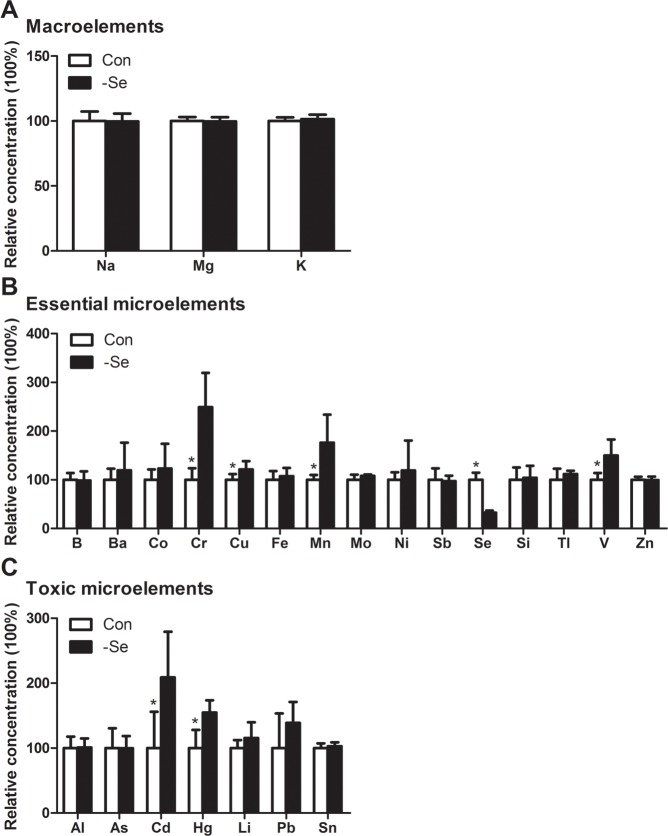
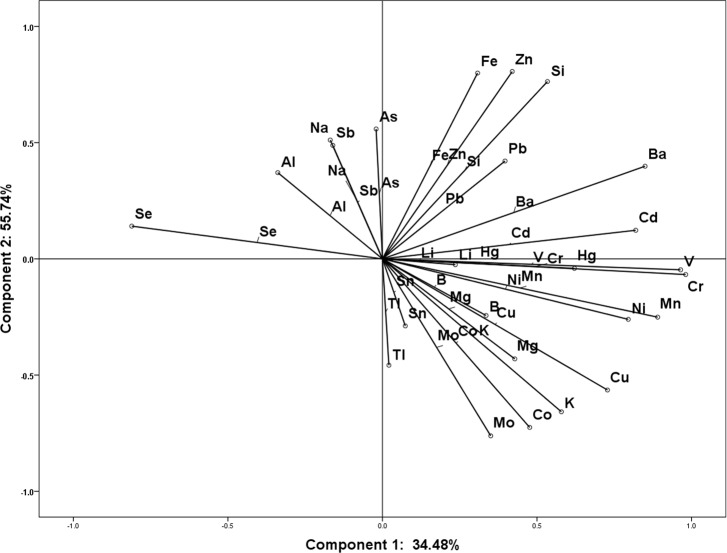
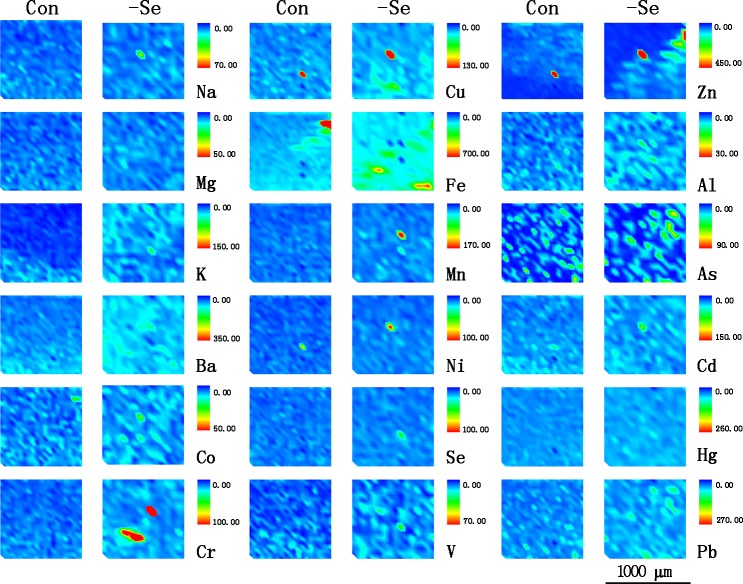
Ion homeostasis plays important roles in development of metabolic diseases. In the present study, we examined the contents and distributions of 25 ions in chicken muscles following treatment with selenium (Se) deficiency for 25 days. The results revealed that in chicken muscles, the top ranked microelements were silicon (Si), iron (Fe), zinc (Zn), aluminum (Al), copper (Cu) and boron (B), showing low contents that varied from 292.89 ppb to 100.27 ppm. After Se deficiency treatment, essential microelements [Cu, chromium (Cr), vanadium (V) and manganese (Mn)], and toxic microelements [cadmium (Cd) and mercury (Hg)] became more concentrated (P < 0.05). Elements distribution images showed generalized accumulation of barium (Ba), cobalt (Co), Cu, Fe and V, while Cr, Mn, and Zn showed pin point accumulations in muscle sections. Thus, the ion profiles were generally influenced by Se deficiency, which suggested a possible role of Se deficiency in muscle dysfunctions caused by these altered ion profiles.
离子稳态在代谢性疾病的发展中起着重要作用。在本研究中,我们检测了缺硒25天后鸡肌肉中25种离子的含量和分布。结果显示,在鸡肌肉中,排名靠前的微量元素是硅(Si)、铁(Fe)、锌(Zn)、铝(Al)、铜(Cu)和硼(B),其含量较低,范围从292.89 ppb到100.27 ppm。缺硒处理后,必需微量元素[铜(Cu)、铬(Cr)、钒(V)和锰(Mn)]以及有毒微量元素[镉(Cd)和汞(Hg)]变得更加富集(P < 0.05)。元素分布图显示钡(Ba)、钴(Co)、铜(Cu)、铁(Fe)和钒(V)普遍积累,而铬(Cr)、锰(Mn)和锌(Zn)在肌肉切片中呈点状积累。因此,离子谱总体上受缺硒影响,这表明缺硒可能在这些改变的离子谱导致的肌肉功能障碍中起作用。