Schuez-Havupalo Linnea, Toivonen Laura, Karppinen Sinikka, Kaljonen Anne, Peltola Ville
Department of Paediatrics and Adolescent Medicine, Turku University Hospital, Turku, Finland.
Turku Institute for Child and Youth Research, University of Turku, Turku, Finland.
BMJ Open. 2017 Sep 5;7(9):e014635. doi: 10.1136/bmjopen-2016-014635.
We explored the burden of respiratory tract infections (RTIs) in young children with regard to day-care initiation.
Longitudinal prospective birth cohort study.
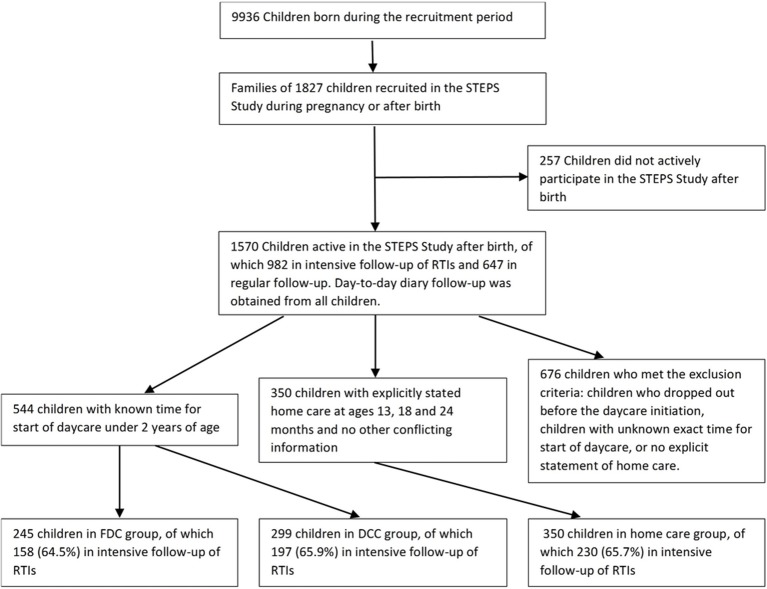
We recruited 1827 children for follow-up until the age of 24 months collecting diary data on RTIs and daycare. Children with continuous daycare type and complete data were divided into groups of centre-based daycare (n=299), family day care (FDC) (n=245) and home care (n=350). Using repeated measures variance analyses, we analysed days per month with symptoms of respiratory tract infection, antibiotic treatments and parental absence from work for a period of 6 months prior to and 9 months after the start of daycare.
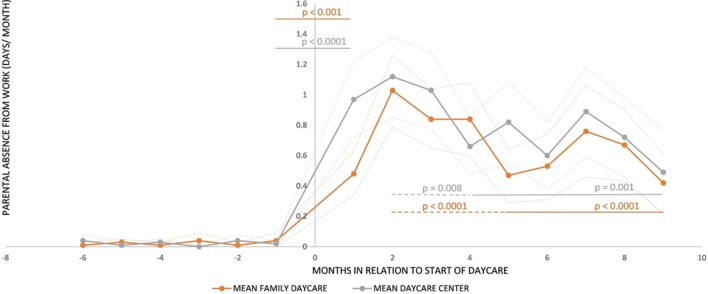
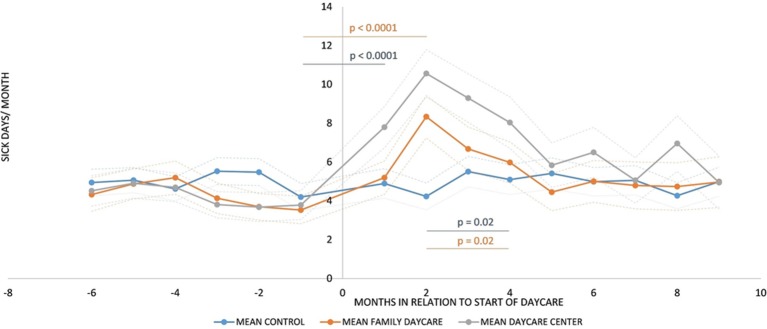
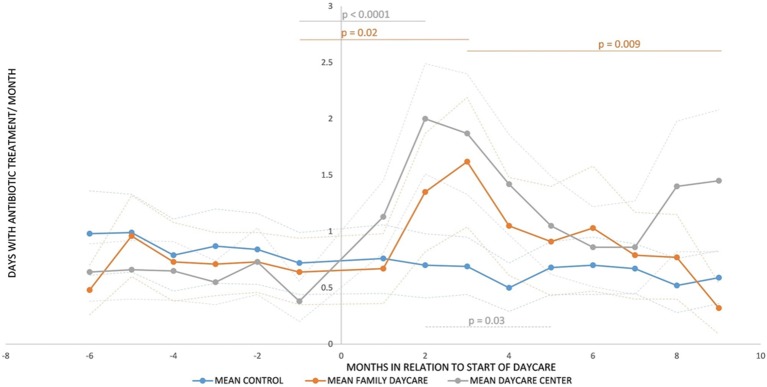
We documented a significant effect of time and type of daycare, as well as a significant interaction between them for all outcome measures. There was a rise in mean days with symptoms from 3.79 (95% CI 3.04 to 4.53) during the month preceding centre-based daycare to 10.57 (95% CI 9.35 to 11.79) at 2 months after the start of centre-based daycare, with a subsequent decrease within the following 9 months. Similar patterns with a rise and decline were observed in the use of antibiotics and parental absences. The start of FDC had weaker effects. Our findings were not changed when taking into account confounding factors.
Our study shows the rapid increase in respiratory infections after start of daycare and a relatively fast decline in the course of time with continued daycare. It is important to support families around the beginning of daycare.
我们探讨了幼儿呼吸道感染(RTIs)与开始日托之间的负担情况。
纵向前瞻性出生队列研究。
我们招募了1827名儿童进行随访,直至24个月龄,收集有关呼吸道感染和日托的日记数据。将日托类型持续且数据完整的儿童分为中心式日托组(n = 299)、家庭日托组(FDC)(n = 245)和家庭照料组(n = 350)。我们使用重复测量方差分析,分析了日托开始前6个月和开始后9个月期间每月出现呼吸道感染症状的天数、抗生素治疗情况以及父母缺勤情况。
我们记录到时间和日托类型对所有结局指标均有显著影响,且二者之间存在显著交互作用。在中心式日托开始前一个月,出现症状的平均天数为3.79天(95%可信区间3.04至4.53),在中心式日托开始后2个月时增至10.57天(95%可信区间9.35至11.79),随后在接下来的9个月内下降。在抗生素使用和父母缺勤方面也观察到类似的先上升后下降的模式。家庭日托开始时的影响较弱。在考虑混杂因素后,我们的研究结果没有改变。
我们的研究表明,日托开始后呼吸道感染迅速增加,随着日托持续,感染情况会在一段时间内相对快速下降。在日托开始前后为家庭提供支持很重要。