Division of Clinical Geriatrics, Department of Neurobiology, Care Sciences and Society, Karolinska Institutet, Stockholm, Sweden.
Department of Geriatric Medicine, Karolinska University Hospital, Stockholm, Sweden.
Neuroimage Clin. 2017 Aug 14;16:418-428. doi: 10.1016/j.nicl.2017.08.014. eCollection 2017.
A disease severity index (SI) for Alzheimer's disease (AD) has been proposed that summarizes MRI-derived structural measures into a single score using multivariate data analysis.
To longitudinally evaluate the use of the SI to monitor disease progression and predict future progression to AD in mild cognitive impairment (MCI). Further, to investigate the association between longitudinal change in the SI and cognitive impairment, Apolipoprotein E (APOE) genotype as well as the levels of cerebrospinal fluid amyloid-beta 1-42 (Aβ) peptide.
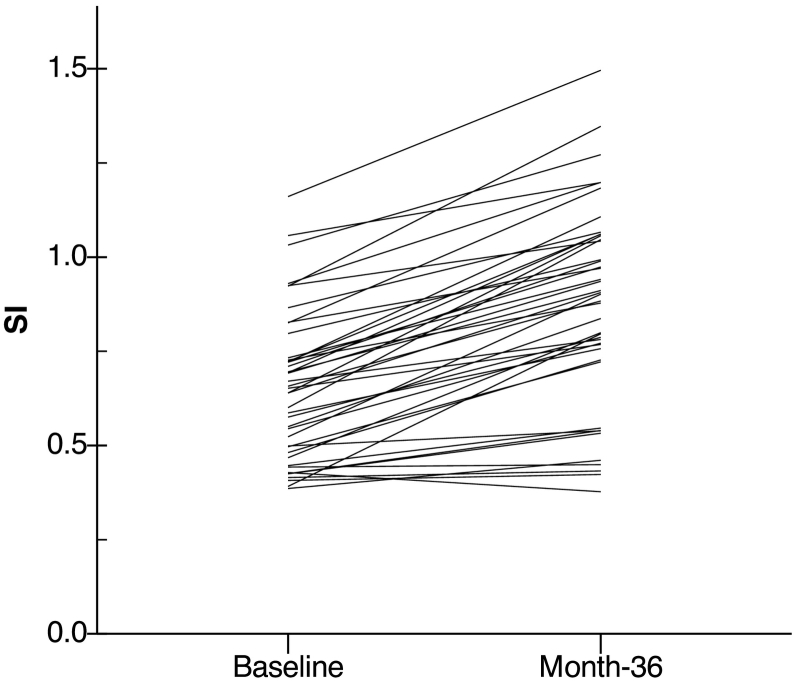
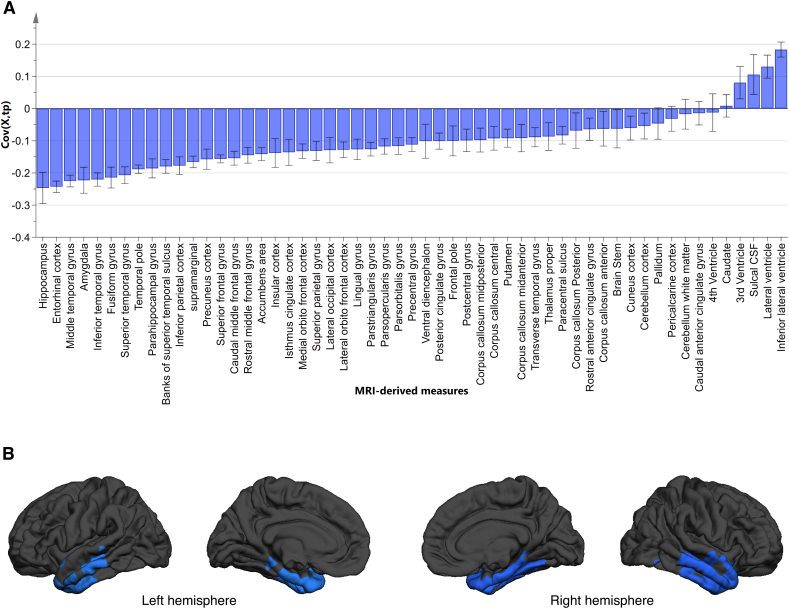
The dataset included 195 AD, 145 MCI and 228 control subjects with annual follow-up for three years, where 70 MCI subjects progressed to AD (MCI-p). For each subject the SI was generated at baseline and follow-ups using 55 regional cortical thickness and subcortical volumes measures that extracted by the FreeSurfer longitudinal stream.
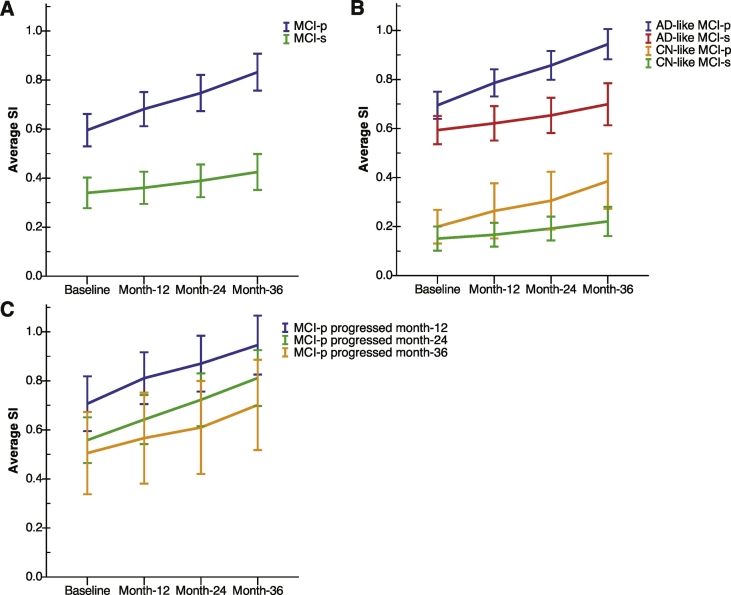
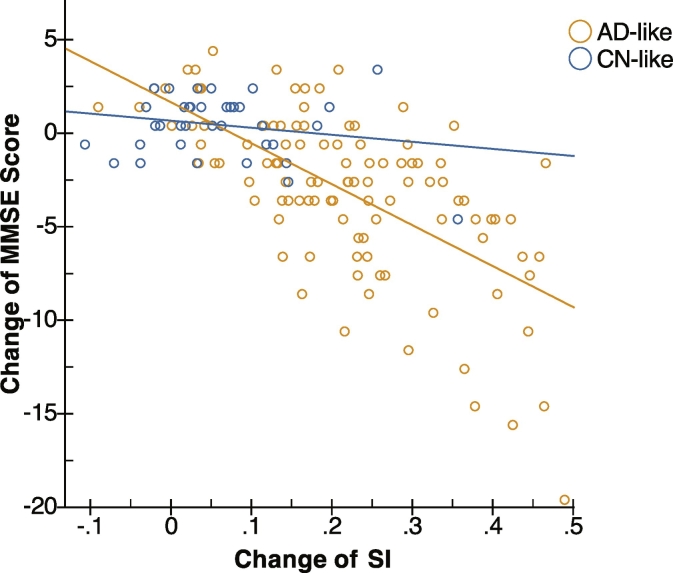
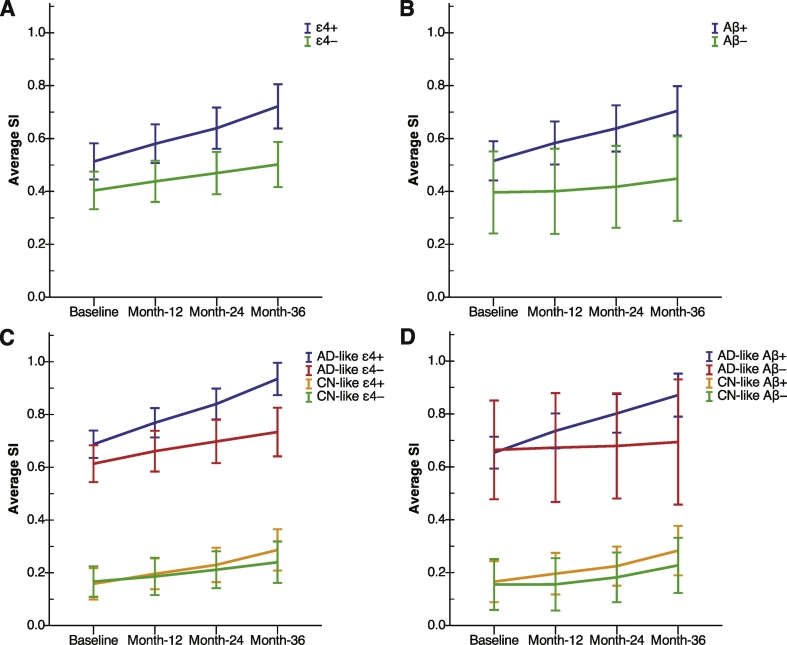
MCI-p subjects had a faster increase of the SI over time ( < 0.001). A higher SI at baseline in MCI-p was related to progression to AD at earlier follow-ups ( < 0.001) and worse cognitive impairment ( < 0.001). AD-like MCI patients with the APOE ε4 allele and abnormal Aβ levels had a faster increase of the SI, independently ( = 0.003 and = 0.004).
Longitudinal changes in the SI reflect structural brain changes and can identify MCI patients at risk of progression to AD. Disease-related brain structural changes are influenced independently by APOE genotype and amyloid pathology. The SI has the potential to be used as a sensitive tool to predict future dementia, monitor disease progression as well as an outcome measure for clinical trials.
已经提出了一种用于阿尔茨海默病(AD)的疾病严重程度指数(SI),它使用多变量数据分析将 MRI 衍生的结构测量结果汇总为一个单一的分数。
纵向评估 SI 用于监测轻度认知障碍(MCI)患者的疾病进展和预测未来进展为 AD。此外,还研究了 SI 的纵向变化与认知障碍、载脂蛋白 E(APOE)基因型以及脑脊液淀粉样蛋白-β1-42(Aβ)肽水平之间的关系。
该数据集包括 195 名 AD 患者、145 名 MCI 患者和 228 名对照者,他们每年随访三年,其中 70 名 MCI 患者进展为 AD(MCI-p)。对于每个患者,使用 FreeSurfer 纵向流提取的 55 个皮质区域厚度和皮质下体积测量值在基线和随访时生成 SI。
MCI-p 患者的 SI 随时间的增加更快(<0.001)。MCI-p 患者基线时较高的 SI 与较早随访时进展为 AD(<0.001)和认知障碍恶化(<0.001)相关。具有 APOE ε4 等位基因和异常 Aβ水平的 AD 样 MCI 患者的 SI 增加更快,独立相关(=0.003 和=0.004)。
SI 的纵向变化反映了结构脑变化,并可识别有进展为 AD 风险的 MCI 患者。与疾病相关的脑结构变化独立受 APOE 基因型和淀粉样蛋白病理学的影响。SI 有可能成为一种敏感的工具,用于预测未来的痴呆症、监测疾病进展以及作为临床试验的结果衡量标准。