Park Fiona Daye, Park Sookyung, Chi Seong-In, Kim Hyun Jeong, Seo Kwang-Suk, Kim Hye-Jung, Han Jin-Hee, Han Hee-Jeong, Lee Eun-Hee
Department of Dental Anesthesiology, the Graduate School, Seoul National University, Seoul, Korea.
Department of Dental Anesthesiology, Seoul National University Dental Hospital, Seoul, Korea.
J Dent Anesth Pain Med. 2015 Dec;15(4):193-200. doi: 10.17245/jdapm.2015.15.4.193. Epub 2015 Dec 31.
During head and neck surgery including orthognathic surgery, mild intraoperative hypothermia occurs frequently. Hypothermia is associated with postanesthetic shivering, which may increase the risk of other postoperative complications. To improve intraoperative thermoregulation, devices such as forced-air warming blankets can be applied. This study aimed to evaluate the effect of supplemental forced-air warming blankets in preventing postanesthetic shivering.
This retrospective study included 113 patients who underwent orthognathic surgery between March and September 2015. According to the active warming method utilized during surgery, patients were divided into two groups: Group W (n = 55), circulating-water mattress; and Group F (n = 58), circulating-water mattress and forced-air warming blanket. Surgical notes and anesthesia and recovery room records were evaluated.
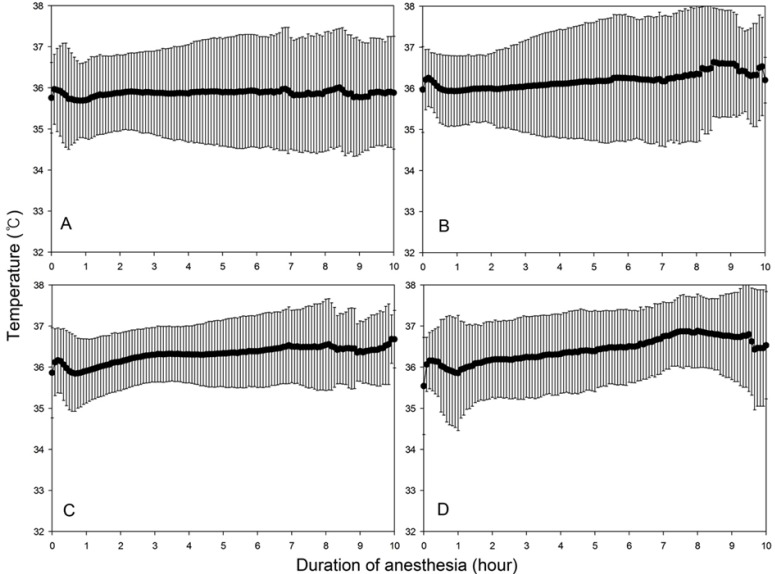
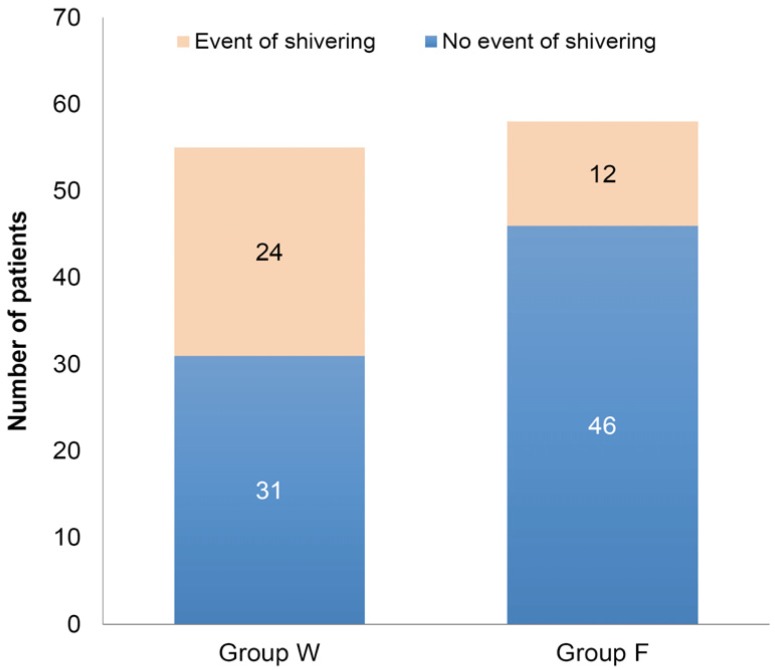
Initial axillary temperatures did not significantly differ between groups (Group W = 35.9 ± 0.7℃, Group F = 35.8 ± 0.6℃). However, at the end of surgery, the temperatures in Group W were significantly lower than those in Group F (35.2 ± 0.5℃ and 36.2 ± 0.5℃, respectively, P = 0.04). The average body temperatures in Groups W and F were, respectively, 35.9 ± 0.5℃ and 36.2 ± 0.5℃ (P = 0.0001). In Group W, 24 patients (43.6%) experienced postanesthetic shivering, while in Group F, only 12 (20.7%) patients required treatment for postanesthetic shivering (P = 0.009, odds ratio = 0.333, 95% confidence interval: 0.147-0.772).
Additional use of forced-air warming blankets in orthognathic surgery was superior in maintaining normothermia and reduced the incidence of postanesthetic shivering.
在包括正颌手术在内的头颈外科手术中,术中轻度体温过低频繁发生。体温过低与麻醉后寒战相关,这可能会增加其他术后并发症的风险。为改善术中体温调节,可应用诸如强制空气加温毯等设备。本研究旨在评估补充使用强制空气加温毯对预防麻醉后寒战的效果。
这项回顾性研究纳入了2015年3月至9月期间接受正颌手术的113例患者。根据手术期间采用的主动加温方法,将患者分为两组:W组(n = 55),循环水床垫组;F组(n = 58),循环水床垫加强制空气加温毯组。对手术记录以及麻醉和恢复室记录进行了评估。
两组患者最初的腋窝温度无显著差异(W组 = 35.9 ± 0.7℃,F组 = 35.8 ± 0.6℃)。然而,在手术结束时,W组的温度显著低于F组(分别为35.2 ± 0.5℃和36.2 ± 0.5℃,P = 0.04)。W组和F组的平均体温分别为35.9 ± 0.5℃和36.2 ± 0.5℃(P = 0.0001)。在W组中,24例患者(43.6%)出现麻醉后寒战,而在F组中,仅12例(20.7%)患者需要接受麻醉后寒战治疗(P = 0.009,比值比 = 0.333,95%置信区间:0.147 - 0.772)。
在正颌手术中额外使用强制空气加温毯在维持正常体温方面更具优势,并降低了麻醉后寒战的发生率。