Department of Anaesthesiology and Intensive Care, Vejle and Middelfart Hospitals, Beriderbakken 4, 7100, Vejle, Denmark.
Institute of Regional Health Research, University of Southern Denmark, J.B.Winsløwsvej 19, 5000, Odense, Denmark.
Crit Care. 2017 Sep 7;21(1):239. doi: 10.1186/s13054-017-1826-7.
Families' perspectives are of great importance in evaluating quality of care in the intensive care unit (ICU). This Danish-Dutch study tested a European adaptation of the "Family Satisfaction in the ICU" (euroFS-ICU). The aim of the study was to examine assessments of satisfaction with care in a large cohort of Danish and Dutch family members and to examine the measurement characteristics of the euroFS-ICU.
Data were from 11 Danish and 10 Dutch ICUs and included family members of patients admitted to the ICU for 48 hours or more. Surveys were mailed 3 weeks after patient discharge from the ICU. Selected patient characteristics were retrieved from hospital records.
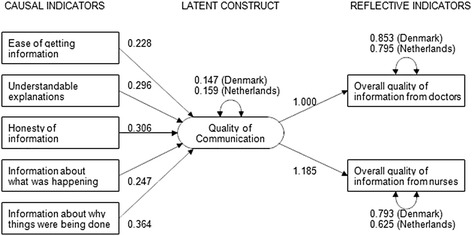
A total of 1077 family members of 920 ICU patients participated. The response rate among family members who were approached was 72%. "Excellent" or "Very good" ratings on all items ranged from 58% to 96%. Items with the highest ratings were concern toward patients, ICU atmosphere, opportunities to be present at the bedside, and ease of getting information. Items with room for improvement were management of patient agitation, emotional support of the family, consistency of information, and inclusion in and support during decision-making processes. Exploratory factor analysis suggested four underlying factors, but confirmatory factor analysis failed to yield a multi-factor model with between-country measurement invariance. A hypothesis that this failure was due to misspecification of causal indicators as reflective indicators was supported by analysis of a factor representing satisfaction with communication, measured with a combination of causal and reflective indicators.
Most family members were moderately or very satisfied with patient care, family care, information and decision-making, but areas with room for improvement were also identified. Psychometric assessments suggest that composite scores constructed from these items as representations of either overall satisfaction or satisfaction with specific sub-domains do not meet rigorous measurement standards. The euroFS-ICU and other similar instruments may benefit from adding reflective indicators.
家庭的观点在评估重症监护病房(ICU)的护理质量方面非常重要。本项丹麦-荷兰研究对“ICU 家庭满意度”(euroFS-ICU)进行了欧洲适应性测试。该研究的目的是检验大量丹麦和荷兰家庭成员对护理满意度的评估,并检验 euroFS-ICU 的测量特征。
数据来自丹麦 11 家和荷兰 10 家 ICU,包括入住 ICU 48 小时或更长时间的患者的家属。在患者从 ICU 出院后 3 周内通过邮件发送调查。从医院记录中检索选定的患者特征。
共有 920 名 ICU 患者的 1077 名家属参加。接触到的家属的回复率为 72%。所有项目的“优秀”或“非常好”评分范围为 58%至 96%。评分最高的项目是对患者的关注、ICU 氛围、在床边陪伴的机会和获取信息的便利性。有待改进的项目是管理患者的躁动、对家庭的情感支持、信息的一致性以及参与和支持决策过程。探索性因子分析表明存在四个潜在因素,但验证性因子分析未能得出具有跨国测量不变性的多因素模型。一个假设是,这种失败是由于因果指标的指定不正确作为反射指标,这一假设得到了对满意度的代表因素(通过因果和反射指标的组合来衡量)的分析的支持。
大多数家属对患者护理、家庭护理、信息和决策较为满意或非常满意,但也确定了一些有待改进的领域。心理测量评估表明,这些项目作为整体满意度或特定子领域满意度的代表构建的综合评分不符合严格的测量标准。euroFS-ICU 和其他类似的工具可能受益于添加反射指标。