Kim Young Soo, Kim Hee Yeon, Ahn Hyo-Suk, Sohn Tae Seo, Song Jae Yen, Lee Young Bok, Lee Dong-Hee, Lee Jae-Im, Jeong Seong Cheol, Chae Hiun Suk, Han Kyungdo, Yeo Chang Dong
Epidemiology Study Cluster of Uijeongbu St. Mary's Hospital, Uijeongbu St. Mary's Hospital, College of Medicine, The Catholic University of Korea, Korea.
Intern Med. 2017 Oct 1;56(19):2571-2577. doi: 10.2169/internalmedicine.8737-16. Epub 2017 Sep 6.
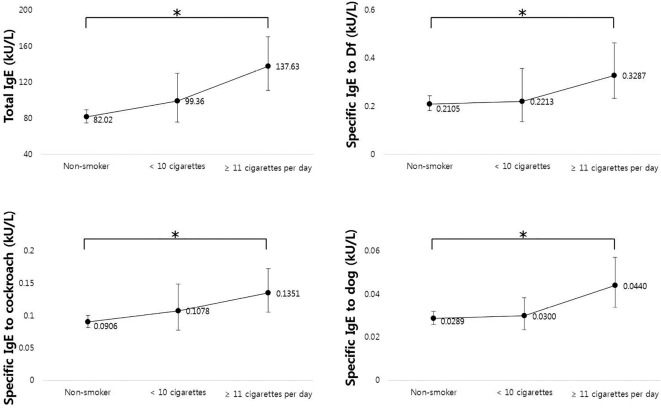
Objective Smoking is common in patients with allergic diseases. The aim of this study was to evaluate the cross-sectional association between the current smoking status and total and specific Immunoglobulin E (IgE) levels in Korean adults. Methods Data were obtained from the 2010 Korean National Health and Nutrition Examination Survey, a national cross-sectional study. We analyzed the data of subjects whose smoking status and serum IgE levels were of acceptable quality. Results A total of 1,963 subjects (1,118 never smokers, 340 ex-smokers, and 505 current smokers) were included. The total IgE levels and specific IgE levels to house dust mite Dermatophagoides farinae (Df), cockroach, and dog allergens in never smokers were significantly (p<0.0001) lower than in ex-smokers or current smokers. After adjusting for other variables, current smokers independently had significantly higher levels of total IgE and cockroach-specific IgE than ex-smokers or never smokers. The proportions of subjects with total IgE ≥150 kU/L and specific IgE ≥0.35 kU/L to Df-specific IgE were significantly (p value for trend <0.05) increased in ex-smokers and current smokers. The total IgE levels and IgE levels specific to Df, cockroaches, and dogs significantly (p value for trend <0.05) and proportionally increased with increasing numbers of cigarettes smoked daily. Conclusion Smoking was associated with elevated total IgE levels and IgE levels specific to Df, cockroach, and dog allergens in a cumulative, dose-dependent manner. Furthermore, current smoking status was an independent risk factor for elevated total IgE levels and IgE levels specific to cockroach allergen.
吸烟在过敏性疾病患者中很常见。本研究的目的是评估韩国成年人当前吸烟状况与总免疫球蛋白E(IgE)及特异性IgE水平之间的横断面关联。方法:数据来自2010年韩国全国健康与营养检查调查,这是一项全国性横断面研究。我们分析了吸烟状况和血清IgE水平质量合格的受试者的数据。结果:共纳入1963名受试者(1118名从不吸烟者、340名曾经吸烟者和505名当前吸烟者)。从不吸烟者的总IgE水平以及对屋尘螨粉尘螨(Df)、蟑螂和狗过敏原的特异性IgE水平显著(p<0.0001)低于曾经吸烟者或当前吸烟者。在调整其他变量后,当前吸烟者的总IgE和蟑螂特异性IgE水平独立地显著高于曾经吸烟者或从不吸烟者。曾经吸烟者和当前吸烟者中总IgE≥150 kU/L以及Df特异性IgE≥0.35 kU/L的受试者比例显著(趋势p值<0.05)增加。总IgE水平以及对Df、蟑螂和狗的特异性IgE水平随着每日吸烟量的增加而显著(趋势p值<0.05)且成比例增加。结论:吸烟与总IgE水平以及对Df、蟑螂和狗过敏原的特异性IgE水平升高呈累积性、剂量依赖性关联。此外,当前吸烟状况是总IgE水平以及蟑螂过敏原特异性IgE水平升高的独立危险因素。