Department of Pharmaceutical Sciences, Leslie Dan Faculty of Pharmacy, University of Toronto, 144 College Street, Toronto, ON, M5S 3M2, Canada.
J Neuroinflammation. 2017 Sep 8;14(1):183. doi: 10.1186/s12974-017-0957-8.
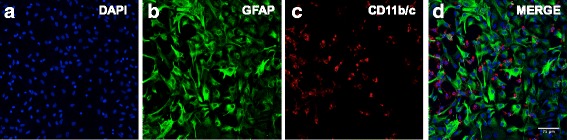
Despite the use of combination antiretroviral therapy for the treatment of HIV-1 infection, cognitive impairments remain prevalent due to persistent viral replication and associated brain inflammation. Primary cellular targets of HIV-1 in the brain are macrophages, microglia, and to a certain extent astrocytes which in response to infection release inflammatory markers, viral proteins [i.e., glycoprotein 120 (gp120)] and exhibit impaired glutamate uptake. Peroxisome proliferator-activated receptors (PPARs) are members of the nuclear receptor superfamily of ligand-activated transcription factors. Compelling evidence suggests that PPARγ exerts anti-inflammatory properties in neurological disorders. The goal of this study was to examine the role of PPARγ in the context of HIV-1 gp120-induced inflammation in vitro, in primary cultures of rat astrocytes and microglia, and in vivo, in a rodent model of HIV-1 gp120-associated brain inflammation.
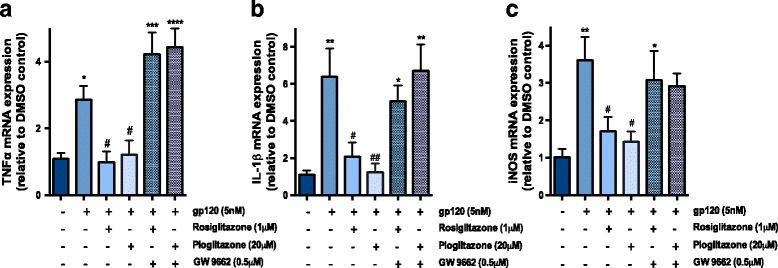
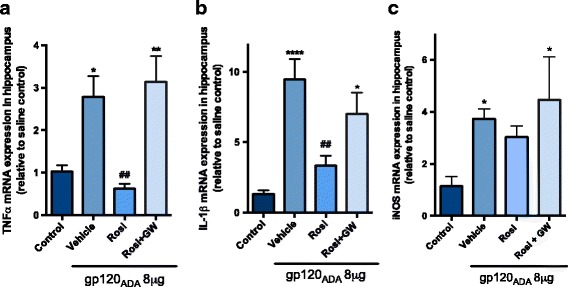
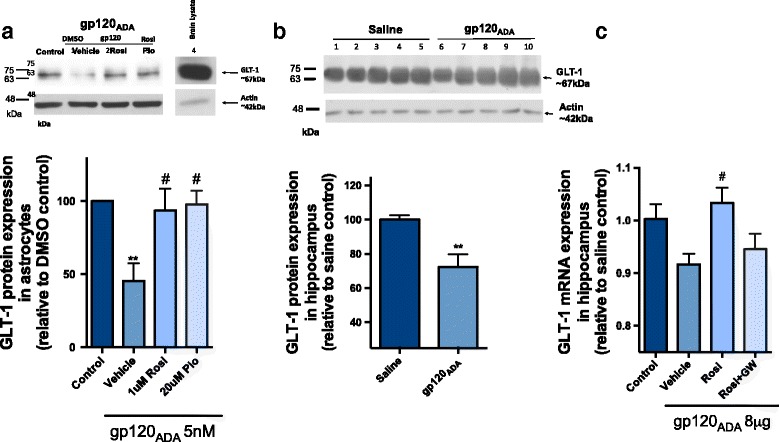
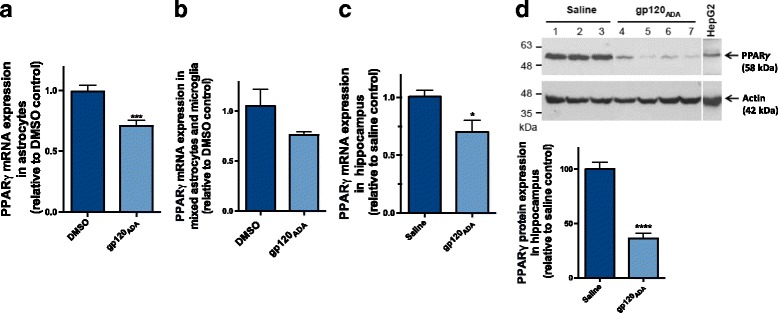
Primary mixed cultures of rat astrocytes and microglia were treated with PPARγ agonists (rosiglitazone or pioglitazone) and exposed to HIV-1 gp120. Inflammatory cytokines and indicator of oxidative stress response (TNFα, IL-1β, iNOS) were measured using qPCR, and glutamate transporter (GLT-1) was quantified by immunoblotting. In vivo, rats were administered an intracerebroventricular injection of HIV-1 gp120 and an intraperitoneal injection of PPARγ agonist (rosiglitazone) or co-administration with PPARγ antagonist (GW9662). qPCR and immunoblotting analyses were applied to measure inflammatory markers, GLT-1 and PPARγ.
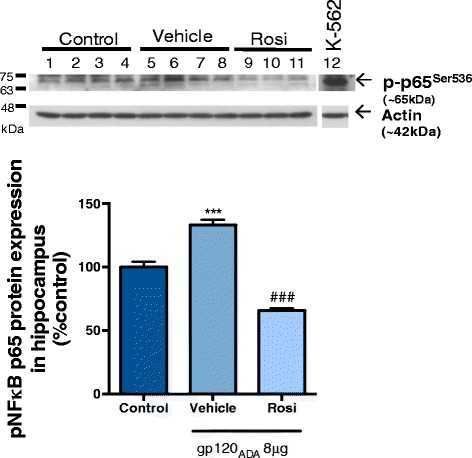
In primary mixed cultures of rat astrocytes and microglia, HIV-1 gp120 exposure resulted in a significant elevation of inflammatory markers and a decrease in GLT-1 expression which were significantly attenuated with rosiglitazone or pioglitazone treatment. Similarly, in vivo, treatment with rosiglitazone reversed the gp120-mediated inflammatory response and downregulation of GLT-1. Furthermore, we demonstrated that the anti-inflammatory effects of PPARγ agonist rosiglitazone were mediated through inhibition of NF-κB.
Our data demonstrate that gp120 can induce an inflammatory response and decrease expression of GLT-1 in the brain in vitro and in vivo. We have also successfully shown that these effects can be reversed by treatment with PPARγ agonists, rosiglitazone or pioglitazone. Together our data suggest that targeting PPARγ signaling may provide an option for preventing/treating HIV-associated brain inflammation.
尽管采用联合抗逆转录病毒疗法治疗 HIV-1 感染,但由于持续的病毒复制和相关的脑炎症,认知障碍仍然普遍存在。HIV-1 在大脑中的主要细胞靶标是巨噬细胞、小胶质细胞,在一定程度上还有星形胶质细胞,它们在感染后会释放炎症标志物、病毒蛋白(即糖蛋白 120[gp120]),并表现出谷氨酸摄取受损。过氧化物酶体增殖物激活受体(PPAR)是配体激活转录因子的核受体超家族的成员。大量证据表明,PPARγ 在神经疾病中具有抗炎作用。本研究的目的是在体外原代大鼠星形胶质细胞和小胶质细胞培养物中以及体内 HIV-1 gp120 相关脑炎症的啮齿动物模型中,研究 PPARγ 在 HIV-1 gp120 诱导的炎症中的作用。
用 PPARγ 激动剂(罗格列酮或吡格列酮)处理原代大鼠星形胶质细胞和小胶质细胞混合培养物,并暴露于 HIV-1 gp120。通过 qPCR 测量炎性细胞因子和氧化应激反应指标(TNFα、IL-1β、iNOS),通过免疫印迹定量测定谷氨酸转运体(GLT-1)。在体内,通过侧脑室注射 HIV-1 gp120 和腹腔内注射 PPARγ 激动剂(罗格列酮)或联合给予 PPARγ 拮抗剂(GW9662)对大鼠进行给药。应用 qPCR 和免疫印迹分析来测量炎性标志物、GLT-1 和 PPARγ。
在体外原代大鼠星形胶质细胞和小胶质细胞混合培养物中,HIV-1 gp120 暴露会导致炎症标志物显著升高,GLT-1 表达显著降低,而罗格列酮或吡格列酮治疗可显著减轻这些变化。同样,在体内,罗格列酮治疗逆转了 gp120 介导的炎症反应和 GLT-1 的下调。此外,我们证明了 PPARγ 激动剂罗格列酮的抗炎作用是通过抑制 NF-κB 来介导的。
我们的数据表明,gp120 可以在体外和体内诱导大脑的炎症反应和 GLT-1 表达下调。我们还成功地表明,这些影响可以通过用 PPARγ 激动剂、罗格列酮或吡格列酮治疗来逆转。总之,我们的数据表明,靶向 PPARγ 信号可能是预防/治疗 HIV 相关脑炎症的一种选择。