Shafer Robin L, Newell Karl M, Lewis Mark H, Bodfish James W
Vanderbilt Neuroscience Graduate Program, Vanderbilt Brain Institute, Vanderbilt UniversityNashville, TN, United States.
Department of Kinesiology, University of GeorgiaAthens, GA, United States.
Front Integr Neurosci. 2017 Aug 25;11:19. doi: 10.3389/fnint.2017.00019. eCollection 2017.
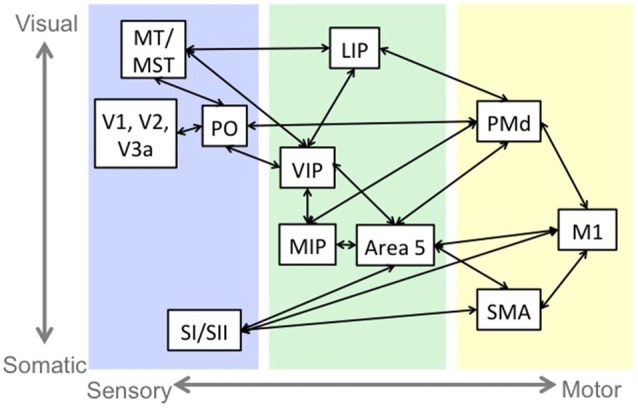
Stereotyped motor behavior manifests as rhythmic, repetitive movements. It is common in several neurologic and psychiatric disorders where it is considered maladaptive. However, it also occurs early in typical development where it serves an adaptive function in the development of complex, controlled motor behavior. Currently, no framework accounts for both adaptive and maladaptive forms of motor stereotypy. We propose a conceptual model that implicates sensorimotor mechanisms in the phenomenology of adaptive and maladaptive stereotypy. The extensive structural and functional connectivity between sensory and motor neural circuits evidences the importance of sensory integration in the production of controlled movement. In support of our model, motor stereotypy in normative development occurs when the sensory and motor brain regions are immature and the infant has limited sensory and motor experience. With maturation and experience, complex movements develop and replace simple, stereotyped movements. This developmental increase in motor complexity depends on the availability of sensory feedback indicating that the integration of sensory information with ongoing movement allows individuals to adaptively cater their movements to the environmental context. In atypical development, altered neural function of sensorimotor circuitry may limit an individual's ability to integrate sensory feedback to adapt movements to appropriately respond to environmental conditions. Consequently, the motor repertoire would remain relatively simple, resulting in the persistence of motor stereotypy. A framework that considers motor stereotypy as a manifestation of low motor complexity resulting from poor sensorimotor integration has many implications for research, identification and treatment of motor stereotypy in a variety of developmental disorders.
刻板运动行为表现为有节奏的重复运动。它在几种神经和精神疾病中很常见,被认为是适应不良的。然而,它也在典型发育的早期出现,在复杂的、可控的运动行为发展中发挥着适应性功能。目前,尚无框架能解释运动刻板行为的适应性和适应不良形式。我们提出了一个概念模型,该模型认为感觉运动机制与适应性和适应不良性刻板行为的现象学有关。感觉神经回路和运动神经回路之间广泛的结构和功能连接证明了感觉整合在可控运动产生中的重要性。支持我们模型的是,在正常发育过程中,当感觉和运动脑区不成熟且婴儿的感觉和运动经验有限时,就会出现运动刻板行为。随着成熟和经验的积累,复杂运动得以发展并取代简单的刻板运动。运动复杂性的这种发育性增加取决于感觉反馈的可用性,这表明感觉信息与正在进行的运动的整合使个体能够根据环境背景适应性地调整自己的运动。在非典型发育中,感觉运动回路的神经功能改变可能会限制个体整合感觉反馈以调整运动以适当应对环境条件的能力。因此,运动技能库将保持相对简单,导致运动刻板行为持续存在。一个将运动刻板行为视为感觉运动整合不良导致的低运动复杂性表现的框架,对各种发育障碍中运动刻板行为的研究、识别和治疗具有许多启示。