Steffen Patrick R, Austin Tara, DeBarros Andrea, Brown Tracy
Brigham Young University, Provo, UT, United States.
Front Public Health. 2017 Aug 25;5:222. doi: 10.3389/fpubh.2017.00222. eCollection 2017.
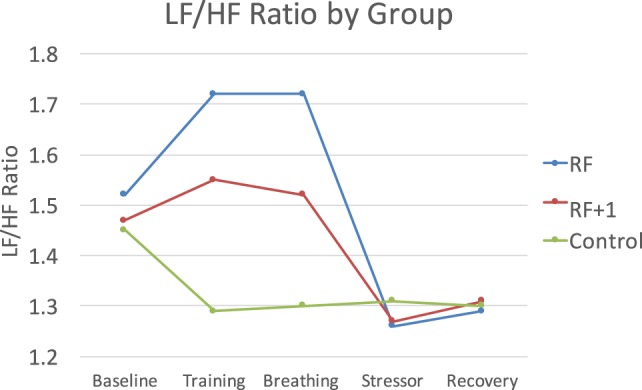
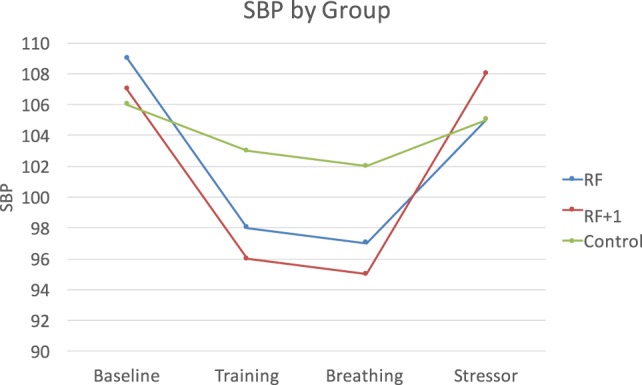
Heart rate variability biofeedback (HRVB) significantly improves heart rate variability (HRV). Breathing at resonance frequency (RF, approximately 6 breaths/min) constitutes a key part of HRVB training and is hypothesized to be a pathway through which biofeedback improves HRV. No studies to date, however, have experimentally examined whether RF breathing impacts measures of HRV. The present study addressed this question by comparing three groups: the RF group breathed at their determined RF for 15 min; the RF + 1 group breathed at 1 breath/min higher than their determined RF for 15 min; and the third group sat quietly for 15 min. After this 15-min period, all groups participated in the Paced Auditory Serial Addition Task (PASAT) for 8 min, and then sat quietly during a 10-min recovery period. HRV, blood pressure, and mood were measured throughout the experiment. Groups were not significantly different on any of the measures at baseline. After the breathing exercise, the RF group reported higher positive mood than the other two groups and a significantly higher LF/HF HRV ratio relative to the control group, a key goal in HRVB training ( < 0.05). Additionally, the RF group showed lower systolic blood pressure during the PASAT and during the recovery period relative to the control group, with the RF + 1 group not being significantly different from either group ( < 0.05). Overall, RF breathing appears to play an important role in the positive effect HRVB has on measures of HRV.
心率变异性生物反馈(HRVB)可显著改善心率变异性(HRV)。以共振频率(RF,约每分钟6次呼吸)呼吸是HRVB训练的关键部分,据推测这是生物反馈改善HRV的一条途径。然而,迄今为止尚无研究通过实验检验RF呼吸是否会影响HRV的测量指标。本研究通过比较三组来解决这个问题:RF组以其确定的RF呼吸15分钟;RF + 1组以比其确定的RF高1次呼吸/分钟的频率呼吸15分钟;第三组安静地坐15分钟。在这15分钟的时间段之后,所有组参与8分钟的听觉序列加法任务(PASAT),然后在10分钟的恢复期内安静地坐着。在整个实验过程中测量HRV、血压和情绪。在基线时,各组在任何测量指标上均无显著差异。呼吸练习后,RF组报告的积极情绪高于其他两组,并且相对于对照组,其低频/高频HRV比值显著更高,这是HRVB训练的一个关键目标(<0.05)。此外,相对于对照组,RF组在PASAT期间和恢复期的收缩压较低,RF + 1组与两组中的任何一组均无显著差异(<0.05)。总体而言,RF呼吸似乎在HRVB对HRV测量指标产生的积极影响中发挥着重要作用。