Lee Ye Jin, Choi Sun Mi, Lee Yeon Joo, Cho Young-Jae, Yoon Ho Il, Lee Jae-Ho, Lee Choon-Taek, Park Jong Sun
Division of Pulmonary and Critical Care Medicine, Department of Internal Medicine, Seoul National University College of Medicine, Seoul National University Hospital, Seoul, Korea.
Division of Pulmonary and Critical Care Medicine, Department of Internal Medicine, Seoul National University College of Medicine, Seoul National University Bundang Hospital, Seongnam, Korea.
PLoS One. 2017 Sep 11;12(9):e0184300. doi: 10.1371/journal.pone.0184300. eCollection 2017.
Although depression and anxiety represent significant yet treatable comorbidities in patients with idiopathic pulmonary fibrosis (IPF), their impact on the clinical course and prognosis of IPF remain unclear.
We investigated the prevalence and clinical significance of depression and anxiety in patients with IPF.
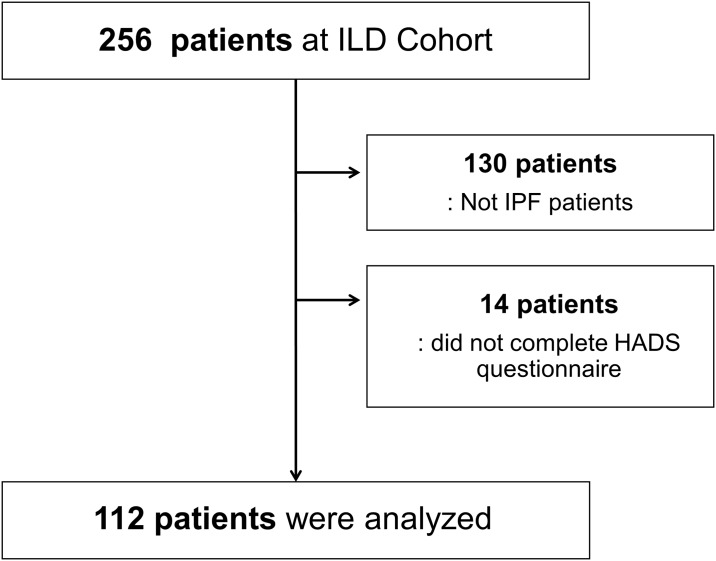
The present study included a prospective cohort comprising 112 Korean patients with IPF who had completed the Hospital Anxiety and Depression Scale (HADS) questionnaire.
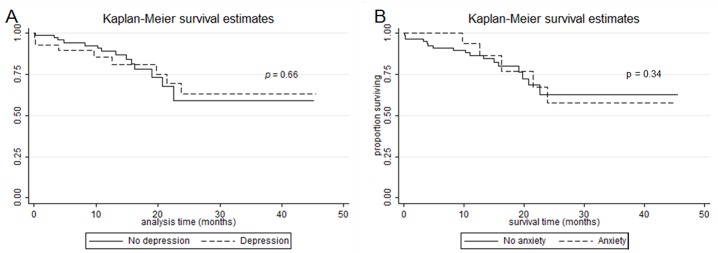
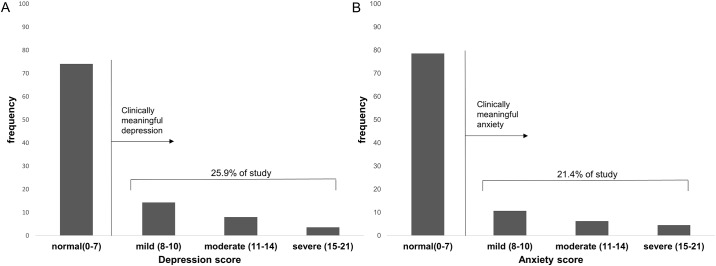
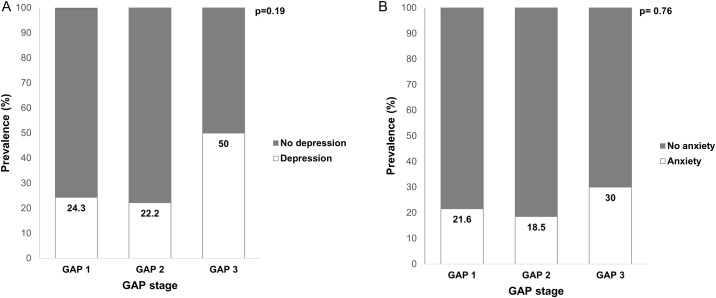
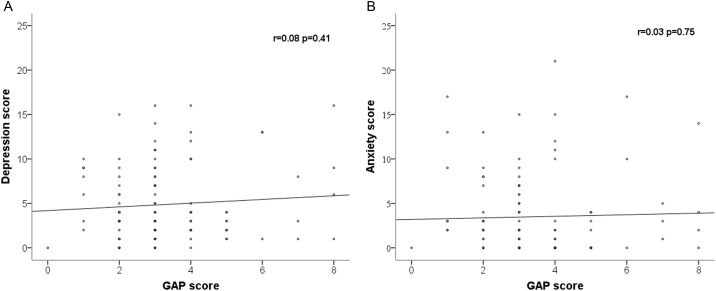
Symptoms of depression and anxiety were present in 25.9% and 21.4% of patients with IPF, respectively (HADS scores ≥8). No significant differences in demographic data, age, sex, smoking status, Modified Medical Research Council Dyspnea Scale (MMRC) scores, pulmonary function tests, or Gender-Age-Physiology Index for IPF were observed between patients with depression or anxiety and those without. However, in patients with anxiety, St. George's Respiratory Questionnaire (SGRQ) scores were significantly higher than those of patients without anxiety (40.5 versus 23.5; p = 0.003). The survival rate and total number of hospital admissions did not significantly differ between patients with depression/anxiety and those without.
Our findings indicate that depression and anxiety are relatively common in patients with IPF. Although no significant differences were noted with regard to survival rate and hospitalization, the present study suggests that depression and anxiety significantly influence quality of life in patients with IPF.
尽管抑郁和焦虑在特发性肺纤维化(IPF)患者中是显著且可治疗的共病,但它们对IPF临床病程和预后的影响仍不清楚。
我们调查了IPF患者中抑郁和焦虑的患病率及临床意义。
本研究纳入了一个前瞻性队列,包括112名完成医院焦虑抑郁量表(HADS)问卷的韩国IPF患者。
IPF患者中分别有25.9%和21.4%存在抑郁和焦虑症状(HADS评分≥8)。在有抑郁或焦虑的患者与无抑郁或焦虑的患者之间,在人口统计学数据、年龄、性别、吸烟状况、改良医学研究委员会呼吸困难量表(MMRC)评分、肺功能测试或IPF的性别-年龄-生理指数方面未观察到显著差异。然而,焦虑患者的圣乔治呼吸问卷(SGRQ)评分显著高于无焦虑患者(40.5对23.5;p = 0.003)。抑郁/焦虑患者与无抑郁/焦虑患者的生存率和住院总次数无显著差异。
我们的研究结果表明,抑郁和焦虑在IPF患者中相对常见。尽管在生存率和住院方面未观察到显著差异,但本研究表明抑郁和焦虑会显著影响IPF患者的生活质量。