Center for Applied Malaria Research and Evaluation, Department of Global Health Systems and Development, Tulane University School of Public Health and Tropical Medicine, 1440 Canal Street, New Orleans, LA 70112, USA.
Parasit Vectors. 2013 Jun 14;6:174. doi: 10.1186/1756-3305-6-174.
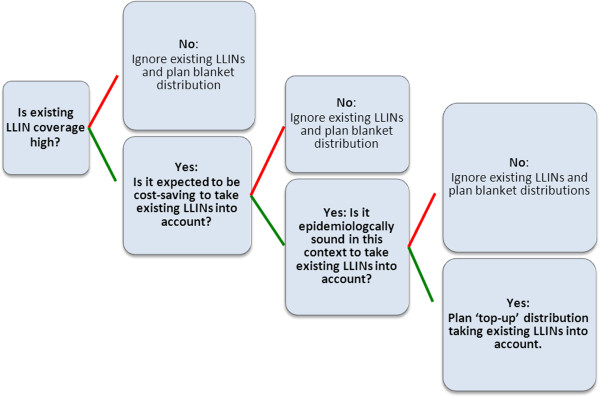
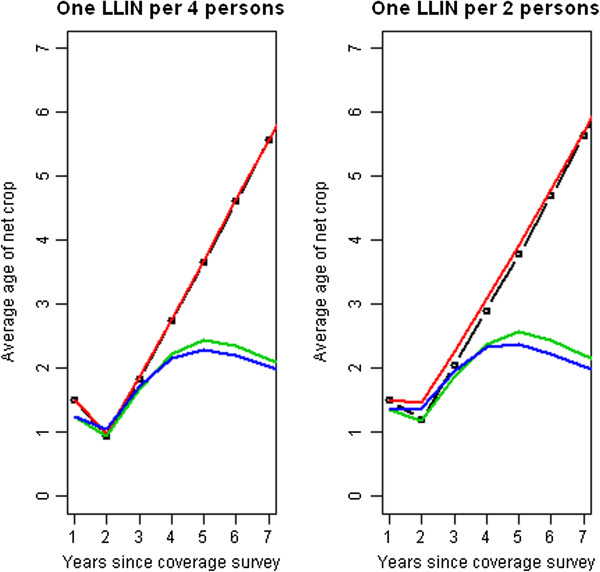
Mass distribution of long-lasting insecticide treated bed nets (LLINs) has led to large increases in LLIN coverage in many African countries. As LLIN ownership levels increase, planners of future mass distributions face the challenge of deciding whether to ignore the nets already owned by households or to take these into account and attempt to target individuals or households without nets. Taking existing nets into account would reduce commodity costs but require more sophisticated, and potentially more costly, distribution procedures. The decision may also have implications for the average age of nets in use and therefore on the maintenance of universal LLIN coverage over time.
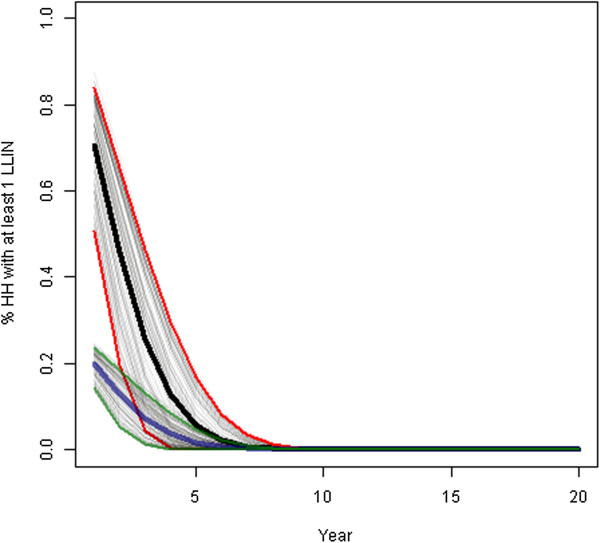
A stochastic simulation model based on the NetCALC algorithm was used to determine the scenarios under which it would be cost saving to take existing nets into account, and the potential effects of doing so on the age profile of LLINs owned. The model accounted for variability in timing of distributions, concomitant use of continuous distribution systems, population growth, sampling error in pre-campaign coverage surveys, variable net 'decay' parameters and other factors including the feasibility and accuracy of identifying existing nets in the field.
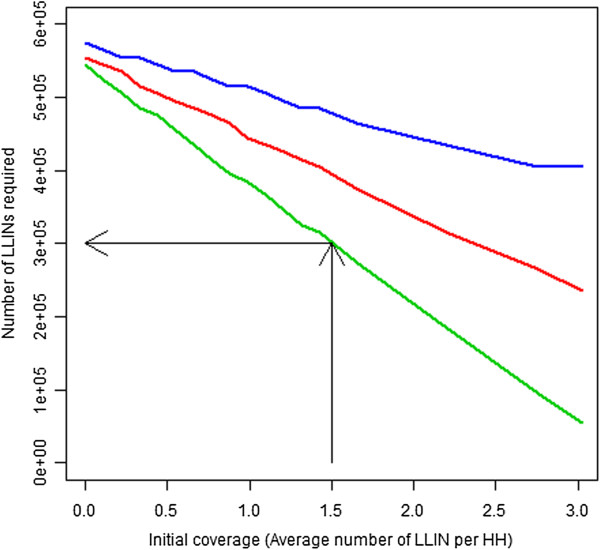
Results indicate that (i) where pre-campaign coverage is around 40% (of households owning at least 1 LLIN), accounting for existing nets in the campaign will have little effect on the mean age of the net population and (ii) even at pre-campaign coverage levels above 40%, an approach that reduces LLIN distribution requirements by taking existing nets into account may have only a small chance of being cost-saving overall, depending largely on the feasibility of identifying nets in the field. Based on existing literature the epidemiological implications of such a strategy is likely to vary by transmission setting, and the risks of leaving older nets in the field when accounting for existing nets must be considered.
Where pre-campaign coverage levels established by a household survey are below 40% we recommend that planners do not take such LLINs into account and instead plan a blanket mass distribution. At pre-campaign coverage levels above 40%, campaign planners should make explicit consideration of the cost and feasibility of accounting for existing LLINs before planning blanket mass distributions. Planners should also consider restricting the coverage estimates used for this decision to only include nets under two years of age in order to ensure that old and damaged nets do not compose too large a fraction of existing net coverage.
长效驱虫蚊帐(LLINs)的大规模分发导致许多非洲国家的 LLIN 覆盖率大幅提高。随着 LLIN 拥有率的提高,未来大规模分发的规划者面临着一个挑战,即是否忽略家庭已经拥有的蚊帐,或者考虑这些蚊帐并试图针对没有蚊帐的个人或家庭进行目标定位。考虑到现有的蚊帐将降低商品成本,但需要更复杂、潜在成本更高的分发程序。这一决定还可能对使用中的蚊帐的平均年龄以及随着时间的推移对普遍 LLIN 覆盖的维护产生影响。
使用基于 NetCALC 算法的随机模拟模型来确定考虑现有蚊帐的成本节约方案,并确定这样做对所拥有的 LLIN 年龄分布的潜在影响。该模型考虑了分发时间的可变性、连续分发系统的同时使用、人口增长、战前覆盖调查中的抽样误差、可变的网“衰减”参数以及其他因素,包括在实地识别现有网的可行性和准确性。
结果表明:(i)战前覆盖率约为 40%(拥有至少 1 顶 LLIN 的家庭),在运动中考虑现有蚊帐对蚊帐人群的平均年龄影响不大;(ii)即使战前覆盖率高于 40%,通过考虑现有蚊帐来降低 LLIN 分发要求的方法,总体上只有很小的节省成本的机会,这在很大程度上取决于在实地识别蚊帐的可行性。根据现有文献,这种策略的流行病学意义可能因传播环境而异,在考虑现有蚊帐时,必须考虑将旧蚊帐留在实地的风险。
如果家庭调查确定的战前覆盖率低于 40%,我们建议规划者不要考虑这些 LLINs,而是计划进行全面的大规模分发。在战前覆盖率高于 40%的情况下,运动规划者在计划全面大规模分发之前,应明确考虑核算现有 LLINs 的成本和可行性。规划者还应考虑仅将使用年限在两年内的网纳入这一决策的覆盖率估计,以确保旧的和损坏的网不会在现有网的覆盖率中占太大比例。