Bucher T, Weltert M, Rollo M E, Smith S P, Jia W, Collins C E, Sun M
Department of Health Sciences and Technology, ETH Zurich, Universitätsrasse 16, 8092, Zurich, Switzerland.
Priority Research Centre for Physical Activity and Nutrition, Faculty of Health and medicine, The University of Newcastle, Newcastle, Australia.
Int J Behav Nutr Phys Act. 2017 Sep 12;14(1):124. doi: 10.1186/s12966-017-0583-y.
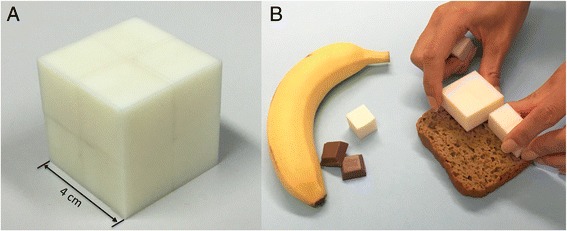
Portion size education tools, aids and interventions can be effective in helping prevent weight gain. However consumers have difficulties in estimating food portion sizes and are confused by inconsistencies in measurement units and terminologies currently used. Visual cues are an important mediator of portion size estimation, but standardized measurement units are required. In the current study, we present a new food volume estimation tool and test the ability of young adults to accurately quantify food volumes. The International Food Unit™ (IFU™) is a 4x4x4 cm cube (64cm), subdivided into eight 2 cm sub-cubes for estimating smaller food volumes. Compared with currently used measures such as cups and spoons, the IFU™ standardizes estimation of food volumes with metric measures. The IFU™ design is based on binary dimensional increments and the cubic shape facilitates portion size education and training, memory and recall, and computer processing which is binary in nature.
The performance of the IFU™ was tested in a randomized between-subject experiment (n = 128 adults, 66 men) that estimated volumes of 17 foods using four methods; the IFU™ cube, a deformable modelling clay cube, a household measuring cup or no aid (weight estimation). Estimation errors were compared between groups using Kruskall-Wallis tests and post-hoc comparisons.
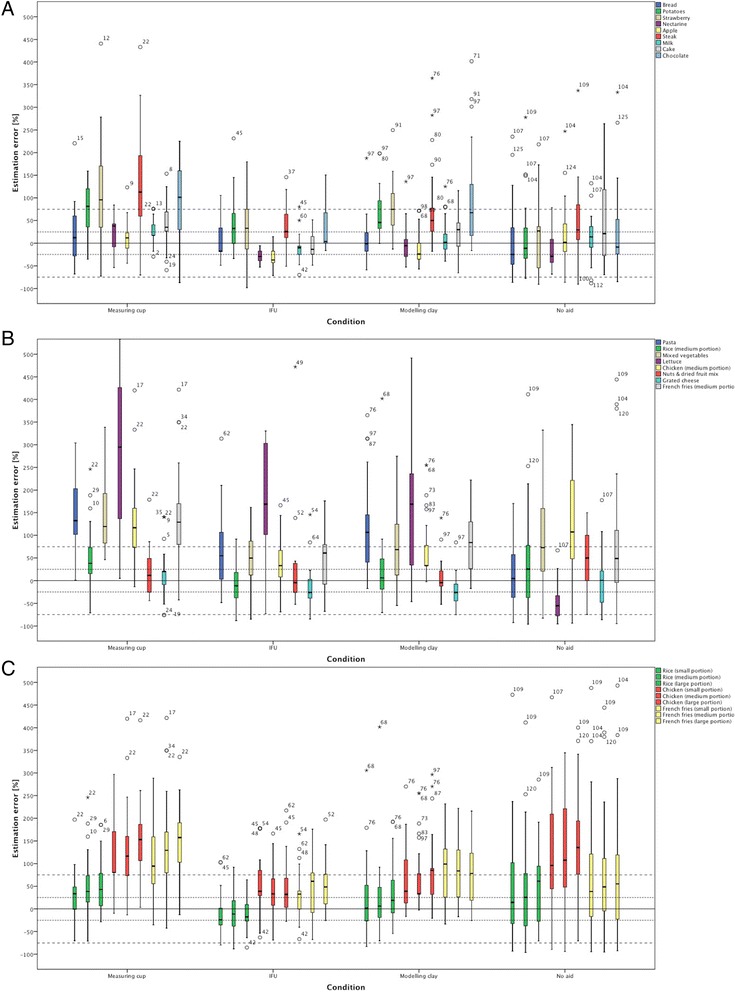
Estimation errors differed significantly between groups (H(3) = 28.48, p < .001). The volume estimations were most accurate in the group using the IFU™ cube (Mdn = 18.9%, IQR = 50.2) and least accurate using the measuring cup (Mdn = 87.7%, IQR = 56.1). The modelling clay cube led to a median error of 44.8% (IQR = 41.9). Compared with the measuring cup, the estimation errors using the IFU™ were significantly smaller for 12 food portions and similar for 5 food portions. Weight estimation was associated with a median error of 23.5% (IQR = 79.8).
The IFU™ improves volume estimation accuracy compared to other methods. The cubic shape was perceived as favourable, with subdivision and multiplication facilitating volume estimation. Further studies should investigate whether the IFU™ can facilitate portion size training and whether portion size education using the IFU™ is effective and sustainable without the aid. A 3-dimensional IFU™ could serve as a reference object for estimating food volume.
食物分量教育工具、辅助手段及干预措施在帮助预防体重增加方面可能有效。然而,消费者在估计食物分量时存在困难,并且对当前使用的计量单位和术语的不一致感到困惑。视觉线索是食物分量估计的重要调节因素,但需要标准化的计量单位。在本研究中,我们展示了一种新的食物体积估计工具,并测试了年轻人准确量化食物体积的能力。国际食物单位(IFU™)是一个4×4×4厘米的立方体(64立方厘米),被细分为八个2厘米的子立方体,用于估计较小的食物体积。与目前使用的如杯子和勺子等度量工具相比,IFU™使用公制单位对食物体积估计进行了标准化。IFU™的设计基于二进制维度增量,立方体形状便于进行食物分量教育与培训、记忆与回忆,以及本质上为二进制的计算机处理。
在一项随机的组间实验(n = 128名成年人,66名男性)中测试了IFU™的性能,该实验使用四种方法估计17种食物的体积;IFU™立方体、可变形的造型粘土立方体、家用量杯或无辅助工具(重量估计)。使用Kruskal-Wallis检验和事后比较来比较各组之间的估计误差。
各组之间的估计误差存在显著差异(H(3) = 28.48,p <.001)。使用IFU™立方体的组中体积估计最为准确(中位数 = 18.9%,四分位距 = 50.2),而使用量杯的组最不准确(中位数 = 87.7%,四分位距 = 56.1)。造型粘土立方体导致的中位数误差为44.8%(四分位距 = 41.9)。与量杯相比,使用IFU™对12种食物分量的估计误差显著更小,对5种食物分量的估计误差相似。重量估计的中位数误差为23.5%(四分位距 = 79.8)。
与其他方法相比,IFU™提高了体积估计的准确性。立方体形状被认为是有利的,细分和乘法运算便于体积估计。进一步的研究应调查IFU™是否能促进食物分量训练,以及使用IFU™进行的食物分量教育在无辅助工具的情况下是否有效且可持续。一个三维的IFU™可以作为估计食物体积的参考对象。