• 文献检索
  • 文档翻译
  • 深度研究
  • 学术资讯
  • Suppr Zotero 插件Zotero 插件
  • 邀请有礼
  • 套餐&价格
  • 历史记录
应用&插件
Suppr Zotero 插件Zotero 插件浏览器插件Mac 客户端Windows 客户端微信小程序
定价
高级版会员购买积分包购买API积分包
服务
文献检索文档翻译深度研究API 文档MCP 服务
关于我们
关于 Suppr公司介绍联系我们用户协议隐私条款
关注我们

Suppr 超能文献

核心技术专利:CN118964589B侵权必究
粤ICP备2023148730 号-1Suppr @ 2026

文献检索

告别复杂PubMed语法,用中文像聊天一样搜索,搜遍4000万医学文献。AI智能推荐,让科研检索更轻松。

立即免费搜索

文件翻译

保留排版,准确专业,支持PDF/Word/PPT等文件格式,支持 12+语言互译。

免费翻译文档

深度研究

AI帮你快速写综述,25分钟生成高质量综述,智能提取关键信息,辅助科研写作。

立即免费体验

加强季节性流感监测:利用推特数据对广泛使用的药物进行主题分析

Enhancing Seasonal Influenza Surveillance: Topic Analysis of Widely Used Medicinal Drugs Using Twitter Data.

作者信息

Kagashe Ireneus, Yan Zhijun, Suheryani Imran

机构信息

School of Management and Economics, Beijing Institute of Technology, Beijing, China.

Sustainable Development Research Institute for Economy and Society of Beijing, Beijing, China.

出版信息

J Med Internet Res. 2017 Sep 12;19(9):e315. doi: 10.2196/jmir.7393.

DOI:10.2196/jmir.7393
PMID:28899847
原文链接:https://pmc.ncbi.nlm.nih.gov/articles/PMC5617904/
Abstract

BACKGROUND

Uptake of medicinal drugs (preventive or treatment) is among the approaches used to control disease outbreaks, and therefore, it is of vital importance to be aware of the counts or frequencies of most commonly used drugs and trending topics about these drugs from consumers for successful implementation of control measures. Traditional survey methods would have accomplished this study, but they are too costly in terms of resources needed, and they are subject to social desirability bias for topics discovery. Hence, there is a need to use alternative efficient means such as Twitter data and machine learning (ML) techniques.

OBJECTIVE

Using Twitter data, the aim of the study was to (1) provide a methodological extension for efficiently extracting widely consumed drugs during seasonal influenza and (2) extract topics from the tweets of these drugs and to infer how the insights provided by these topics can enhance seasonal influenza surveillance.

METHODS

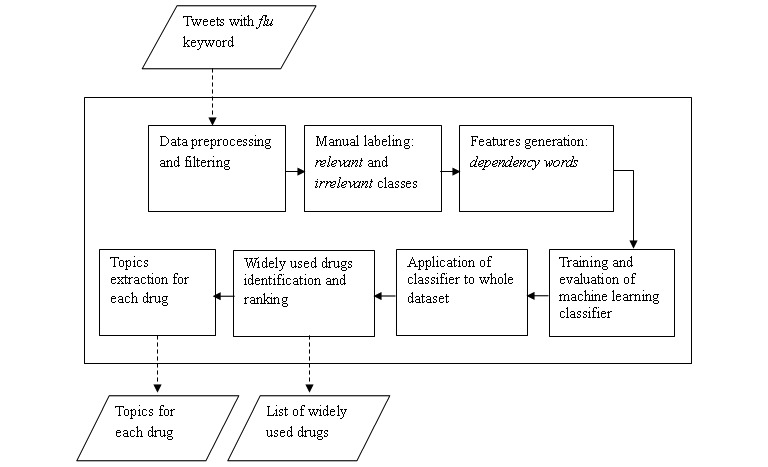
From tweets collected during the 2012-13 flu season, we first identified tweets with mentions of drugs and then constructed an ML classifier using dependency words as features. The classifier was used to extract tweets that evidenced consumption of drugs, out of which we identified the mostly consumed drugs. Finally, we extracted trending topics from each of these widely used drugs' tweets using latent Dirichlet allocation (LDA).

RESULTS

Our proposed classifier obtained an F score of 0.82, which significantly outperformed the two benchmark classifiers (ie, P<.001 with the lexicon-based and P=.048 with the 1-gram term frequency [TF]). The classifier extracted 40,428 tweets that evidenced consumption of drugs out of 50,828 tweets with mentions of drugs. The most widely consumed drugs were influenza virus vaccines that had around 76.95% (31,111/40,428) share of the total; other notable drugs were Theraflu, DayQuil, NyQuil, vitamins, acetaminophen, and oseltamivir. The topics of each of these drugs exhibited common themes or experiences from people who have consumed these drugs. Among these were the enabling and deterrent factors to influenza drugs uptake, which are keys to mitigating the severity of seasonal influenza outbreaks.

CONCLUSIONS

The study results showed the feasibility of using tweets of widely consumed drugs to enhance seasonal influenza surveillance in lieu of the traditional or conventional surveillance approaches. Public health officials and other stakeholders can benefit from the findings of this study, especially in enhancing strategies for mitigating the severity of seasonal influenza outbreaks. The proposed methods can be extended to the outbreaks of other diseases.

摘要

背景

使用药物(预防性或治疗性)是控制疾病暴发的方法之一,因此,了解最常用药物的数量或频率以及消费者对这些药物的热门话题,对于成功实施控制措施至关重要。传统的调查方法本可以完成这项研究,但就所需资源而言成本过高,而且在发现话题方面容易受到社会期望偏差的影响。因此,需要使用替代的有效方法,如推特数据和机器学习(ML)技术。

目的

利用推特数据,本研究的目的是(1)提供一种方法扩展,以有效提取季节性流感期间广泛使用的药物,(2)从这些药物的推文提取话题,并推断这些话题提供的见解如何加强季节性流感监测。

方法

从2012 - 13流感季节收集的推文中,我们首先识别提及药物的推文,然后使用依存词作为特征构建一个ML分类器。该分类器用于提取证明有药物消费的推文,从中我们识别出最常使用的药物。最后,我们使用潜在狄利克雷分配(LDA)从这些广泛使用的药物的每条推文中提取热门话题。

结果

我们提出的分类器获得了0.82的F分数,显著优于两个基准分类器(即,基于词典的分类器P <.001,单字项频率[TF]分类器P =.048)。该分类器从50,828条提及药物的推文中提取了40,428条证明有药物消费的推文。最广泛使用的药物是流感病毒疫苗,占总数的76.95%左右(31,111 / 40,428);其他值得注意的药物有泰勒诺流感、日夜百服宁、奈奎尔、维生素、对乙酰氨基酚和奥司他韦。这些药物各自的话题展示了服用这些药物的人的共同主题或经历。其中包括流感药物使用的促进因素和阻碍因素,这些是减轻季节性流感暴发严重程度的关键。

结论

研究结果表明,使用广泛使用药物的推文来加强季节性流感监测以替代传统监测方法是可行的。公共卫生官员和其他利益相关者可以从本研究的结果中受益,特别是在加强减轻季节性流感暴发严重程度的策略方面。所提出的方法可以扩展到其他疾病的暴发。
https://cdn.ncbi.nlm.nih.gov/pmc/blobs/8124/5617904/8f655598dbc9/jmir_v19i9e315_fig1.jpg

相似文献

1
Enhancing Seasonal Influenza Surveillance: Topic Analysis of Widely Used Medicinal Drugs Using Twitter Data.加强季节性流感监测:利用推特数据对广泛使用的药物进行主题分析
J Med Internet Res. 2017 Sep 12;19(9):e315. doi: 10.2196/jmir.7393.
2
Digital Epidemiology of Prescription Drug References on X (Formerly Twitter): Neural Network Topic Modeling and Sentiment Analysis.X(前身为 Twitter)上处方药引用的数字流行病学:神经网络主题建模和情感分析。
J Med Internet Res. 2024 Aug 23;26:e57885. doi: 10.2196/57885.
3
Tweet Topics and Sentiments Relating to COVID-19 Vaccination Among Australian Twitter Users: Machine Learning Analysis.澳大利亚推特用户与 COVID-19 疫苗接种相关的推文主题和情绪:机器学习分析。
J Med Internet Res. 2021 May 19;23(5):e26953. doi: 10.2196/26953.
4
The reliability of tweets as a supplementary method of seasonal influenza surveillance.推文作为季节性流感监测补充方法的可靠性。
J Med Internet Res. 2014 Nov 14;16(11):e250. doi: 10.2196/jmir.3532.
5
Social Media Monitoring of the COVID-19 Pandemic and Influenza Epidemic With Adaptation for Informal Language in Arabic Twitter Data: Qualitative Study.对新冠疫情和流感流行进行社交媒体监测,并针对阿拉伯语推特数据中的非正式语言进行调整:定性研究。
JMIR Med Inform. 2021 Sep 17;9(9):e27670. doi: 10.2196/27670.
6
Applying GIS and Machine Learning Methods to Twitter Data for Multiscale Surveillance of Influenza.应用地理信息系统和机器学习方法于推特数据以进行流感的多尺度监测。
PLoS One. 2016 Jul 25;11(7):e0157734. doi: 10.1371/journal.pone.0157734. eCollection 2016.
7
Characterizing Twitter Discussions About HPV Vaccines Using Topic Modeling and Community Detection.使用主题建模和社区检测来刻画关于HPV疫苗的推特讨论。
J Med Internet Res. 2016 Aug 29;18(8):e232. doi: 10.2196/jmir.6045.
8
Change in Threads on Twitter Regarding Influenza, Vaccines, and Vaccination During the COVID-19 Pandemic: Artificial Intelligence-Based Infodemiology Study.新冠疫情期间推特上关于流感、疫苗及疫苗接种的话题变化:基于人工智能的信息流行病学研究
JMIR Infodemiology. 2021 Oct 14;1(1):e31983. doi: 10.2196/31983. eCollection 2021 Jan-Dec.
9
Topics, Trends, and Sentiments of Tweets About the COVID-19 Pandemic: Temporal Infoveillance Study.关于新冠疫情的推文主题、趋势和情绪:时间信息监测研究
J Med Internet Res. 2020 Oct 23;22(10):e22624. doi: 10.2196/22624.
10
A case study of the New York City 2012-2013 influenza season with daily geocoded Twitter data from temporal and spatiotemporal perspectives.一项利用2012 - 2013年纽约市流感季节每日地理编码推特数据从时间和时空角度进行的案例研究。
J Med Internet Res. 2014 Oct 20;16(10):e236. doi: 10.2196/jmir.3416.

引用本文的文献

1
Natural Language Processing-Powered Real-Time Monitoring Solution for Vaccine Sentiments and Hesitancy on Social Media: System Development and Validation.用于社交媒体上疫苗情绪和犹豫态度的自然语言处理驱动的实时监测解决方案:系统开发与验证
JMIR Med Inform. 2024 Jun 21;12:e57164. doi: 10.2196/57164.
2
A Survey on COVID-19 Data Analysis Using AI, IoT, and Social Media.人工智能、物联网和社交媒体在新冠病毒数据分析中的应用研究综述。
Sensors (Basel). 2023 Jun 13;23(12):5543. doi: 10.3390/s23125543.
3
Methods for Analyzing the Contents of Social Media for Health Care: Scoping Review.

本文引用的文献

1
Twitter sentiment classification for measuring public health concerns.用于衡量公众健康担忧的推特情感分类
Soc Netw Anal Min. 2015;5(1):13. doi: 10.1007/s13278-015-0253-5. Epub 2015 May 12.
2
Changing attitudes to childhood immunisation in English parents.英国父母对儿童免疫接种态度的转变
Vaccine. 2017 May 19;35(22):2979-2985. doi: 10.1016/j.vaccine.2017.03.089. Epub 2017 Apr 23.
3
Role of non-traditional locations for seasonal flu vaccination: Empirical evidence and evaluation.季节性流感疫苗接种非传统地点的作用:实证证据与评估
社交媒体在医疗保健分析中的应用方法:范围综述。
J Med Internet Res. 2023 Jun 26;25:e43349. doi: 10.2196/43349.
4
Surveillance of communicable diseases using social media: A systematic review.利用社交媒体进行传染病监测:系统评价。
PLoS One. 2023 Feb 24;18(2):e0282101. doi: 10.1371/journal.pone.0282101. eCollection 2023.
5
Examining Analytic Practices in Latent Dirichlet Allocation Within Psychological Science: Scoping Review.心理科学中潜在狄利克雷分配分析实践的考察:范围综述。
J Med Internet Res. 2022 Nov 8;24(11):e33166. doi: 10.2196/33166.
6
Using topic modelling for unsupervised annotation of electronic health records to identify an outbreak of disease in UK dogs.使用主题建模对电子健康记录进行无监督标注,以识别英国犬群中的疾病爆发。
PLoS One. 2021 Dec 9;16(12):e0260402. doi: 10.1371/journal.pone.0260402. eCollection 2021.
7
A panoramic view and swot analysis of artificial intelligence for achieving the sustainable development goals by 2030: progress and prospects.到2030年实现可持续发展目标的人工智能全景与SWOT分析:进展与前景
Appl Intell (Dordr). 2021;51(9):6497-6527. doi: 10.1007/s10489-021-02264-y. Epub 2021 Jun 11.
8
Knowledge-based approaches to drug discovery for rare diseases.基于知识的罕见病药物发现方法。
Drug Discov Today. 2022 Feb;27(2):490-502. doi: 10.1016/j.drudis.2021.10.014. Epub 2021 Oct 27.
9
Data and Digital Solutions to Support Surveillance Strategies in the Context of the COVID-19 Pandemic.支持新冠疫情背景下监测策略的数据与数字解决方案
Front Digit Health. 2021 Aug 6;3:707902. doi: 10.3389/fdgth.2021.707902. eCollection 2021.
10
Pulse of the pandemic: Iterative topic filtering for clinical information extraction from social media.疫情脉搏:社交媒体中临床信息提取的迭代主题过滤。
J Biomed Inform. 2021 Aug;120:103844. doi: 10.1016/j.jbi.2021.103844. Epub 2021 Jun 19.
Vaccine. 2017 May 19;35(22):2943-2948. doi: 10.1016/j.vaccine.2017.04.023. Epub 2017 Apr 19.
4
Recruiting Pregnant Patients for Survey Research: A Head to Head Comparison of Social Media-Based Versus Clinic-Based Approaches.招募孕妇参与调查研究:基于社交媒体与基于诊所的方法的直接比较。
J Med Internet Res. 2016 Dec 21;18(12):e326. doi: 10.2196/jmir.6593.
5
Attitudes and Beliefs of Pregnant Women and New Mothers Regarding Influenza Vaccination in British Columbia.不列颠哥伦比亚省孕妇和新妈妈对流感疫苗接种的态度与信念
J Obstet Gynaecol Can. 2016 Nov;38(11):1045-1052. doi: 10.1016/j.jogc.2016.08.004. Epub 2016 Sep 21.
6
Association Between Influenza Infection and Vaccination During Pregnancy and Risk of Autism Spectrum Disorder.妊娠期流感感染和接种与自闭症谱系障碍风险的关联。
JAMA Pediatr. 2017 Jan 2;171(1):e163609. doi: 10.1001/jamapediatrics.2016.3609.
7
Avian Influenza Risk Surveillance in North America with Online Media.利用在线媒体对北美的禽流感风险进行监测。
PLoS One. 2016 Nov 23;11(11):e0165688. doi: 10.1371/journal.pone.0165688. eCollection 2016.
8
Evaluating Google, Twitter, and Wikipedia as Tools for Influenza Surveillance Using Bayesian Change Point Analysis: A Comparative Analysis.使用贝叶斯变化点分析评估谷歌、推特和维基百科作为流感监测工具:一项比较分析。
JMIR Public Health Surveill. 2016 Oct 20;2(2):e161. doi: 10.2196/publichealth.5901.
9
Applying GIS and Machine Learning Methods to Twitter Data for Multiscale Surveillance of Influenza.应用地理信息系统和机器学习方法于推特数据以进行流感的多尺度监测。
PLoS One. 2016 Jul 25;11(7):e0157734. doi: 10.1371/journal.pone.0157734. eCollection 2016.
10
Estimating Influenza Outbreaks Using Both Search Engine Query Data and Social Media Data in South Korea.利用搜索引擎查询数据和社交媒体数据估算韩国的流感疫情
J Med Internet Res. 2016 Jul 4;18(7):e177. doi: 10.2196/jmir.4955.