Stokke Randi
NTNU Norwegian University of Science and Technology, Centre for Care Research, P.O. Box 191, 2802, Gjøvik, Norway.
Inland Norway University of Applied Sciences - INN University, The Centre for Innovation in Services, P.O. Box 400, 2418, Elverum, Norway.
BMC Health Serv Res. 2017 Sep 15;17(1):657. doi: 10.1186/s12913-017-2587-3.
Technological innovations are strongly promoted to meet the demands posed by increased pressure on home care services and to assist ageing in place in western societies. Although heavily advocated as plug and play solutions, technologies have proven difficult and unpredictable when integrated into home care services. We need greater insight into what happens when technologies are integrated into caring practices. All technologies come with expectations as to their function. This study explores how actors who are involved with the social alarm, which is an established technology innovation, relate to, perceive and articulate these expectations of the technology in everyday living.
The article presents results from a two-case study, using a triangulation of qualitative methods in order to gain an in-depth understanding of technology in use in home care services through "thick descriptions". The study was conducted in Norway and data were analysed using a stepwise deductive-inductive analysis.
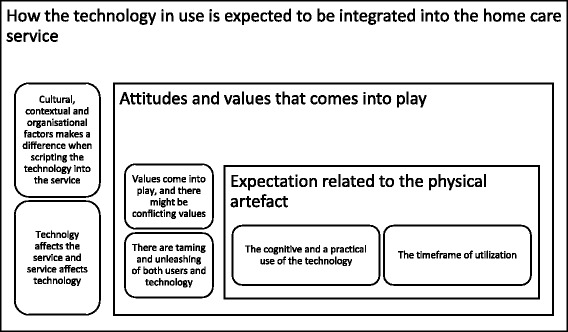
The empirical findings demonstrate that expectations regarding the social alarm, even though it represents a simple and well-established technology, are complex and multidimensional. The notion of script and domestication provided relevant tools for exploring these expectations and for understanding how actors interpret and adapt their practices of using the technology. This enabled a more comprehensive understanding of how technology opens up for different interpretations and puts values in play.
This article suggests exploring technology in use as scripted in multidimensional script, and offers a frame for doing so. It also reveals how technology scripts and articulation prove important for understanding the complex reality when integrated into home care practices, thus identifying how using the technology leads to the taming and unleashing of both technology and actors. The study offers an increased understanding of how and why technology is unpredictable and works differently in different contexts. Moreover, it stresses the importance of avoiding expectations of plug-and-play in a reality of complex interactions between different actors.
大力推动技术创新,以满足家庭护理服务压力增加所带来的需求,并帮助西方社会实现就地养老。尽管技术被大力倡导为即插即用的解决方案,但事实证明,将其整合到家庭护理服务中既困难又不可预测。我们需要更深入地了解技术整合到护理实践中会发生什么。所有技术都伴随着对其功能的期望。本研究探讨了参与社会警报(一项既定的技术创新)的行为者在日常生活中如何与这些技术期望相关联、感知并表达这些期望。
本文呈现了一项双案例研究的结果,采用定性方法的三角测量法,以便通过“详细描述”深入了解家庭护理服务中使用的技术。该研究在挪威进行,数据采用逐步演绎 - 归纳分析。
实证研究结果表明,尽管社会警报代表一种简单且成熟的技术,但其相关期望却复杂且具有多维度性。脚本和驯化的概念为探索这些期望以及理解行为者如何解释和调整其技术使用实践提供了相关工具。这使得我们能够更全面地理解技术如何引发不同的解释并使价值观发挥作用。
本文建议将使用中的技术作为多维脚本进行探索,并提供了这样做的框架。它还揭示了技术脚本和表达对于理解整合到家庭护理实践中的复杂现实如何重要,从而确定使用技术如何导致技术和行为者的驯化与释放。该研究增进了我们对技术如何以及为何不可预测且在不同背景下运作方式不同的理解。此外,它强调了在不同行为者之间复杂互动的现实中避免即插即用期望的重要性。