Mukherjee Vaskar, Radecka Dorota, Aerts Guido, Verstrepen Kevin J, Lievens Bart, Thevelein Johan M
Laboratory of Molecular Cell Biology, Institute of Botany and Microbiology, VIB Center of Microbiology, KU Leuven, Kasteelpark Arenberg 31, B-3001 Louvain, Belgium.
Laboratory for Enzyme, Fermentation and Brewing Technology (EFBT), Department of Microbial and Molecular Systems, KU Leuven, Technology Campus Ghent, Gebroeders De Smetstraat 1, B-9000 Ghent, Belgium.
Biotechnol Biofuels. 2017 Sep 13;10:216. doi: 10.1186/s13068-017-0899-5. eCollection 2017.
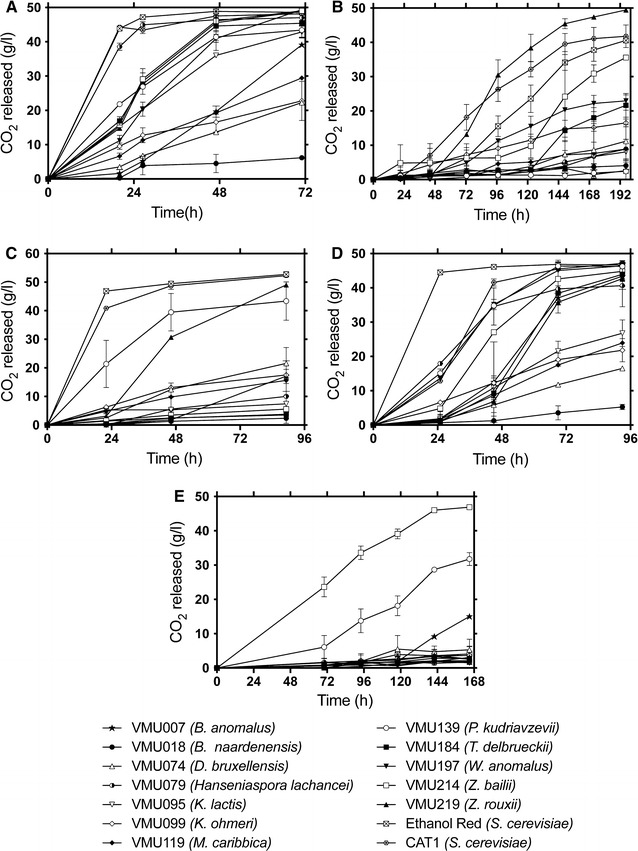
Non-conventional yeasts present a huge, yet barely exploited, resource of yeast biodiversity for industrial applications. This presents a great opportunity to explore alternative ethanol-fermenting yeasts that are more adapted to some of the stress factors present in the harsh environmental conditions in second-generation (2G) bioethanol fermentation. Extremely tolerant yeast species are interesting candidates to investigate the underlying tolerance mechanisms and to identify genes that when transferred to existing industrial strains could help to design more stress-tolerant cell factories. For this purpose, we performed a high-throughput phenotypic evaluation of a large collection of non-conventional yeast species to identify the tolerance limits of the different yeast species for desirable stress tolerance traits in 2G bioethanol production. Next, 12 multi-tolerant strains were selected and used in fermentations under different stressful conditions. Five strains out of which, showing desirable fermentation characteristics, were then evaluated in small-scale, semi-anaerobic fermentations with lignocellulose hydrolysates.
Our results revealed the phenotypic landscape of many non-conventional yeast species which have not been previously characterized for tolerance to stress conditions relevant for bioethanol production. This has identified for each stress condition evaluated several extremely tolerant non- yeasts. It also revealed multi-tolerance in several yeast species, which makes those species good candidates to investigate the molecular basis of a robust general stress tolerance. The results showed that some non-conventional yeast species have similar or even better fermentation efficiency compared to in the presence of certain stressful conditions.
Prior to this study, our knowledge on extreme stress-tolerant phenotypes in non-conventional yeasts was limited to only few species. Our work has now revealed in a systematic way the potential of non- species to emerge either as alternative host species or as a source of valuable genetic information for construction of more robust industrial bioethanol production yeasts. Striking examples include yeast species like and that show very high tolerance to diverse stress factors. This large-scale phenotypic analysis has yielded a detailed database useful as a resource for future studies to understand and benefit from the molecular mechanisms underlying the extreme phenotypes of non-conventional yeast species.
非常规酵母是工业应用中酵母生物多样性的巨大资源,但尚未得到充分利用。这为探索替代乙醇发酵酵母提供了一个绝佳机会,这些酵母更能适应第二代(2G)生物乙醇发酵恶劣环境条件下的一些压力因素。极端耐受酵母物种是研究潜在耐受机制以及鉴定基因的有趣候选对象,将这些基因转移到现有工业菌株中有助于设计更具压力耐受性的细胞工厂。为此,我们对大量非常规酵母物种进行了高通量表型评估,以确定不同酵母物种在2G生物乙醇生产中对所需压力耐受性状的耐受极限。接下来,选择了12个多耐受菌株并用于不同压力条件下的发酵。其中5个表现出理想发酵特性的菌株随后在小规模半厌氧发酵中用木质纤维素水解产物进行了评估。
我们的结果揭示了许多非常规酵母物种的表型概况,这些物种此前尚未针对与生物乙醇生产相关的压力条件耐受性进行过表征。这为每个评估的压力条件鉴定了几种极端耐受的非酵母物种。它还揭示了几种酵母物种的多耐受性,这使得这些物种成为研究强大的一般压力耐受性分子基础的良好候选对象。结果表明,在某些压力条件下,一些非常规酵母物种的发酵效率与……相似甚至更高。
在本研究之前,我们对非常规酵母中极端压力耐受表型的了解仅限于少数物种。我们的工作现在以系统的方式揭示了非……物种作为替代宿主物种或作为构建更强健的工业生物乙醇生产酵母的有价值遗传信息来源的潜力。显著的例子包括……等酵母物种,它们对多种压力因素表现出非常高的耐受性。这种大规模表型分析产生了一个详细的数据库,可作为未来研究的资源,以了解非常规酵母物种极端表型背后的分子机制并从中受益。