Department of Trauma, Reconstructive Surgery and Rehabilitation Medicine, University Medicine Greifswald, Ferdinand-Sauerbruch-Straße, 17475 Greifswald, Germany.
Department of Trauma and Orthopaedic Surgery, BG Klinikum Unfallkrankenhaus Berlin gGmbH, Warener Str. 7, 12683 Berlin, Germany.
Int J Mol Sci. 2017 Sep 19;18(9):2004. doi: 10.3390/ijms18092004.
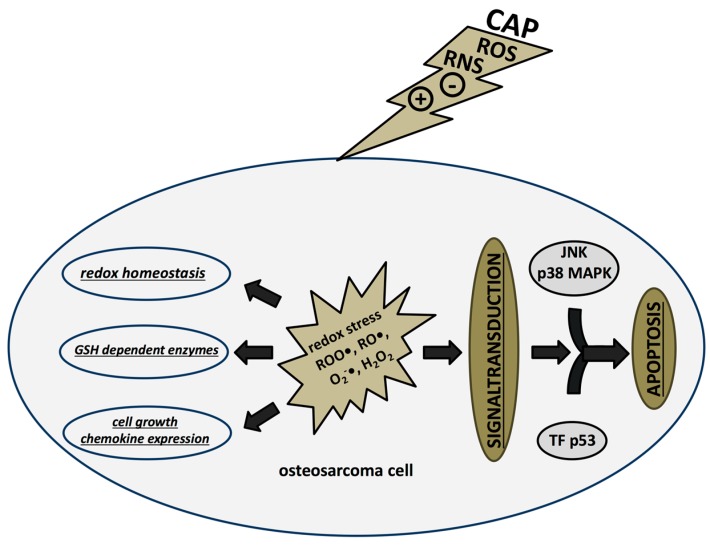
Human osteosarcoma (OS) is the most common primary malignant bone tumor occurring most commonly in adolescents and young adults. Major improvements in disease-free survival have been achieved by implementing a combination therapy consisting of radical surgical resection of the tumor and systemic multi-agent chemotherapy. However, long-term survival remains poor, so novel targeted therapies to improve outcomes for patients with osteosarcoma remains an area of active research. This includes immunotherapy, photodynamic therapy, or treatment with nanoparticles. Cold atmospheric plasma (CAP), a highly reactive (partially) ionized physical state, has been shown to inherit a significant anticancer capacity, leading to a new field in medicine called "plasma oncology." The current article summarizes the potential of CAP in the treatment of human OS and reviews the underlying molecular mode of action.
人骨肉瘤(OS)是最常见的原发性恶性骨肿瘤,多发生于青少年和年轻人。通过实施包括肿瘤根治性切除术和全身多药物化疗的联合治疗,无病生存率得到了显著提高。然而,长期生存率仍然较差,因此,寻找新的靶向治疗方法以改善骨肉瘤患者的预后仍然是一个活跃的研究领域。这包括免疫疗法、光动力疗法或纳米粒子治疗。冷等离体(CAP)是一种高度反应性(部分)离子化的物理状态,已被证明具有显著的抗癌能力,从而在医学领域开辟了一个新的领域,称为“等离子体肿瘤学”。本文总结了 CAP 在治疗人骨肉瘤中的潜力,并综述了其潜在的分子作用机制。