Weh Eric, Takeuchi Hideyuki, Muheisen Sanaa, Haltiwanger Robert S, Semina Elena V
Department of Pediatrics and Children's Research Institute at the Medical College of Wisconsin, Milwaukee, Wisconsin, United States of America.
Department of Cell Biology, Neurobiology, and Anatomy at the Medical College of Wisconsin, Milwaukee, Wisconsin, United States of America.
PLoS One. 2017 Sep 19;12(9):e0184903. doi: 10.1371/journal.pone.0184903. eCollection 2017.
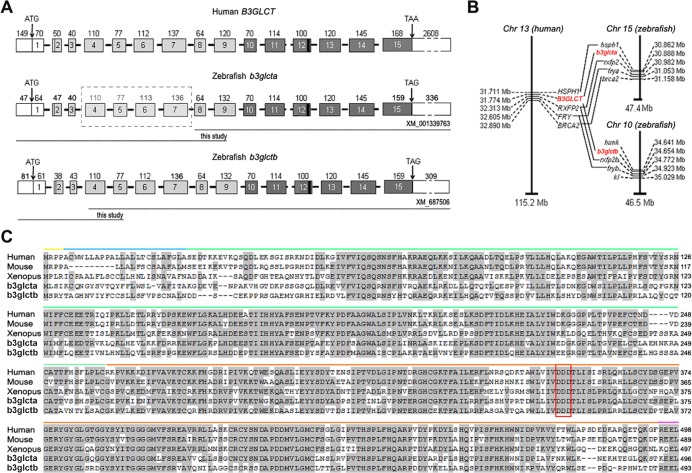
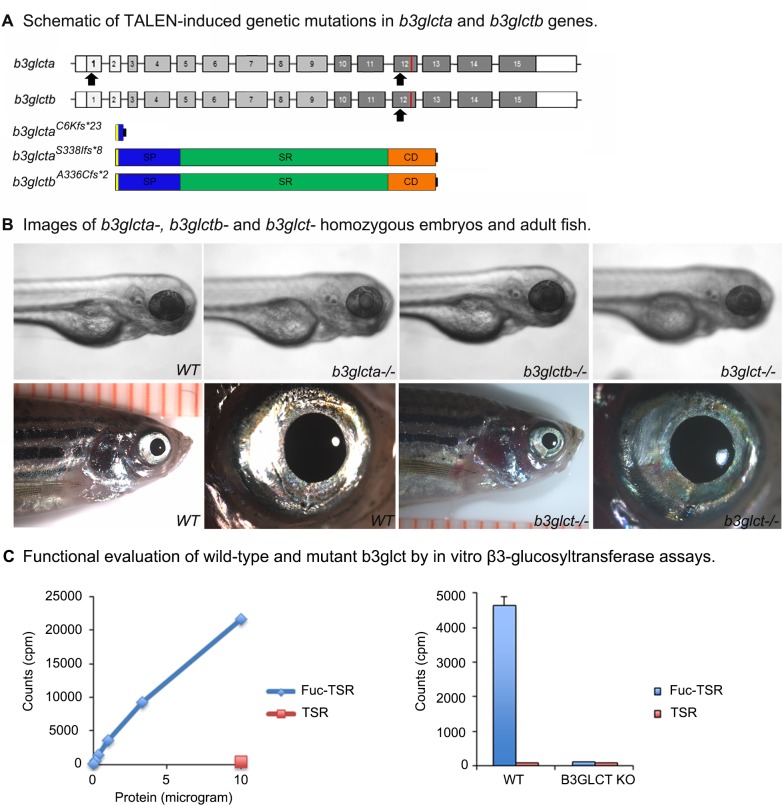
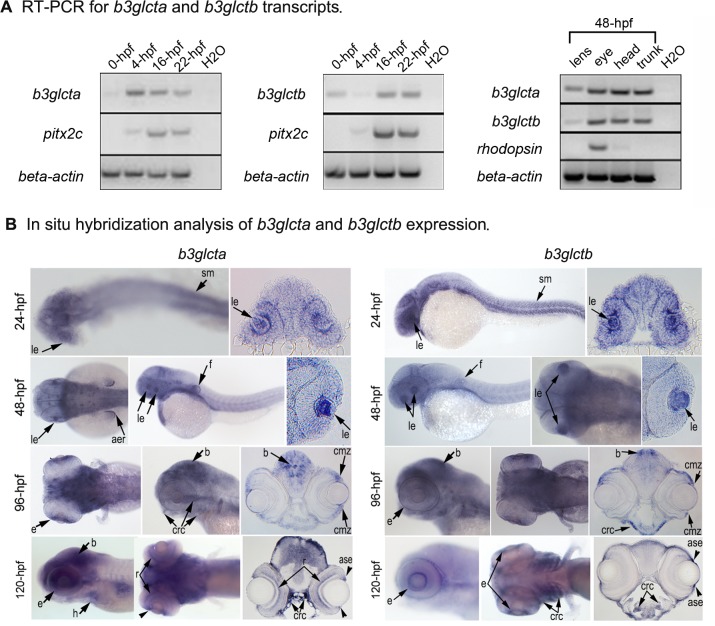
Peters Plus Syndrome (PPS) is a rare autosomal recessive disease characterized by ocular defects, short stature, brachydactyly, characteristic facial features, developmental delay and other highly variable systemic defects. Classic PPS is caused by loss-of-function mutations in the B3GLCT gene encoding for a β3-glucosyltransferase that catalyzes the attachment of glucose via a β1-3 glycosidic linkage to O-linked fucose on thrombospondin type 1 repeats (TSRs). B3GLCT was shown to participate in a non-canonical ER quality control mechanism; however, the exact molecular processes affected in PPS are not well understood. Here we report the identification and characterization of two zebrafish orthologs of the human B3GLCT gene, b3glcta and b3glctb. The b3glcta and b3glctb genes encode for 496-aa and 493-aa proteins with 65% and 57% identity to human B3GLCT, respectively. Expression studies demonstrate that both orthologs are widely expressed with strong presence in embryonic tissues affected in PPS. In vitro glucosylation assays demonstrated that extracts from wildtype embryos contain active b3glct enzyme capable of transferring glucose from UDP-glucose to an O-fucosylated TSR, indicating functional conservation with human B3GLCT. To determine the developmental role of the zebrafish genes, single and double b3glct knockouts were generated using TALEN-induced genome editing. Extracts from double homozygous b3glct-/- embryos demonstrated complete loss of in vitro b3glct activity. Surprisingly, b3glct-/- homozygous fish developed normally. Transcriptome analyses of head and trunk tissues of b3glct-/- 24-hpf embryos identified 483 shared differentially regulated transcripts that may be involved in compensation for b3glct function in these embryos. The presented data show that both sequence and function of B3GLCT/b3glct genes is conserved in vertebrates. At the same time, complete b3glct deficiency in zebrafish appears to be inconsequential and possibly compensated for by a yet unknown mechanism.
彼得斯综合征(PPS)是一种罕见的常染色体隐性疾病,其特征为眼部缺陷、身材矮小、短指畸形、特征性面部特征、发育迟缓以及其他高度可变的全身缺陷。经典的PPS是由B3GLCT基因突变导致功能丧失引起的,该基因编码一种β3-葡糖基转移酶,可催化葡萄糖通过β1-3糖苷键连接到血小板反应蛋白1型重复序列(TSR)上的O-连接岩藻糖。已证明B3GLCT参与一种非经典的内质网质量控制机制;然而,PPS中受影响的确切分子过程尚不清楚。在此,我们报告了人类B3GLCT基因的两个斑马鱼直系同源基因b3glcta和b3glctb的鉴定与特征分析。b3glcta和b3glctb基因分别编码496个氨基酸和493个氨基酸的蛋白质,与人类B3GLCT的同源性分别为65%和57%。表达研究表明,这两个直系同源基因均广泛表达,在PPS中受影响的胚胎组织中大量存在。体外糖基化试验表明,野生型胚胎提取物含有能够将葡萄糖从UDP-葡萄糖转移至O-岩藻糖基化TSR的活性b3glct酶,表明其与人类B3GLCT功能保守。为了确定斑马鱼基因在发育中的作用,利用TALEN诱导的基因组编辑技术构建了单基因和双基因b3glct敲除模型。双纯合b3glct-/-胚胎的提取物显示体外b3glct活性完全丧失。令人惊讶的是,b3glct-/-纯合鱼发育正常。对b3glct-/- 24小时胚胎头部和躯干组织的转录组分析确定了483个共同差异调节转录本,这些转录本可能参与了对这些胚胎中b3glct功能的补偿。所呈现的数据表明,B3GLCT/b3glct基因的序列和功能在脊椎动物中是保守的。同时,斑马鱼中b3glct完全缺失似乎无关紧要,可能由一种未知机制进行补偿。