• 文献检索
  • 文档翻译
  • 深度研究
  • 学术资讯
  • Suppr Zotero 插件Zotero 插件
  • 邀请有礼
  • 套餐&价格
  • 历史记录
应用&插件
Suppr Zotero 插件Zotero 插件浏览器插件Mac 客户端Windows 客户端微信小程序
定价
高级版会员购买积分包购买API积分包
服务
文献检索文档翻译深度研究API 文档MCP 服务
关于我们
关于 Suppr公司介绍联系我们用户协议隐私条款
关注我们

Suppr 超能文献

核心技术专利:CN118964589B侵权必究
粤ICP备2023148730 号-1Suppr @ 2026

文献检索

告别复杂PubMed语法,用中文像聊天一样搜索,搜遍4000万医学文献。AI智能推荐,让科研检索更轻松。

立即免费搜索

文件翻译

保留排版,准确专业,支持PDF/Word/PPT等文件格式,支持 12+语言互译。

免费翻译文档

深度研究

AI帮你快速写综述,25分钟生成高质量综述,智能提取关键信息,辅助科研写作。

立即免费体验

精神分裂症谱系障碍患者的互联网使用、电子健康素养及对计算机/互联网的态度:在两个遥远欧洲地区开展的横断面研究

Internet use, eHealth literacy and attitudes toward computer/internet among people with schizophrenia spectrum disorders: a cross-sectional study in two distant European regions.

作者信息

Athanasopoulou Christina, Välimäki Maritta, Koutra Katerina, Löttyniemi Eliisa, Bertsias Antonios, Basta Maria, Vgontzas Alexandros N, Lionis Christos

机构信息

Department of Nursing Science, Faculty of Medicine, University of Turku, Turku, Finland.

Turku University Hospital, Turku, Finland.

出版信息

BMC Med Inform Decis Mak. 2017 Sep 20;17(1):136. doi: 10.1186/s12911-017-0531-4.

DOI:10.1186/s12911-017-0531-4
PMID:28931385
原文链接:https://pmc.ncbi.nlm.nih.gov/articles/PMC5607489/
Abstract

BACKGROUND

Individuals with schizophrenia spectrum disorders use the Internet for general and health-related purposes. Their ability to find, understand, and apply the health information they acquire online in order to make appropriate health decisions - known as eHealth literacy - has never been investigated. The European agenda strives to limit health inequalities and enhance mental health literacy. Nevertheless, each European member state varies in levels of Internet use and online health information-seeking. This study aimed to examine computer/Internet use for general and health-related purposes, eHealth literacy, and attitudes toward computer/Internet among adults with schizophrenia spectrum disorders from two distant European regions.

METHODS

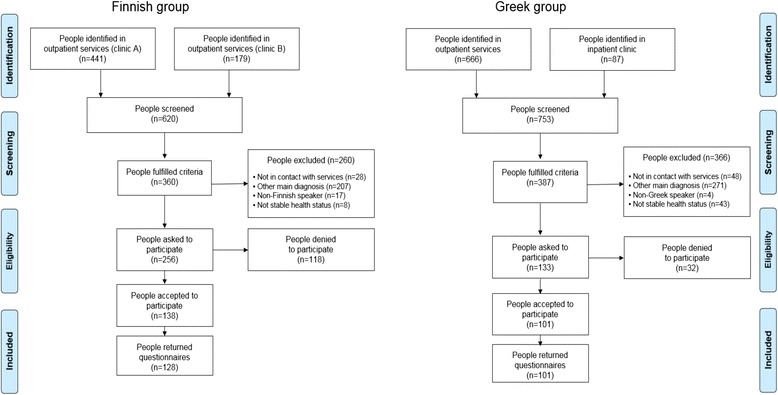
Data were collected from mental health services of psychiatric clinics in Finland (FI) and Greece (GR). A total of 229 patients (FI = 128, GR = 101) participated in the questionnaire survey. The data analysis included evaluation of frequencies and group comparisons with multiple linear and logistic regression models.

RESULTS

The majority of Finnish participants were current Internet users (FI = 111, 87%, vs. GR = 33, 33%, P < .0001), while the majority of Greek participants had never used computers/Internet, mostly due to their perception that they do not need it. In both countries, more than half of Internet users used the Internet for health-related purposes (FI = 61, 55%, vs. GR = 20, 61%). The eHealth literacy of Internet users (previous and current Internet users) was found significantly higher in the Finnish group (FI: Mean = 27.05, SD 5.36; GR: Mean = 23.15, SD = 7.23, P < .0001) upon comparison with their Greek counterparts. For current Internet users, Internet use patterns were significantly different between country groups. When adjusting for gender, age, education and disease duration, country was a significant predictor of frequency of Internet use, eHealth literacy and Interest. The Finnish group of Internet users scored higher in eHealth literacy, while the Greek group of never Internet users had a higher Interest in computer/Internet.

CONCLUSIONS

eHealth literacy is either moderate (Finnish group) or low (Greek group). Thus, exposure to ICT and eHealth skills training are needed for this population. Recommendations to improve the eHealth literacy and access to health information among these individuals are provided.

摘要

背景

精神分裂症谱系障碍患者会使用互联网进行一般用途和与健康相关的用途。他们查找、理解并应用从网上获取的健康信息以做出适当健康决策的能力——即所谓的电子健康素养——从未被研究过。欧洲议程致力于减少健康不平等并提高心理健康素养。然而,每个欧洲成员国在互联网使用水平和在线健康信息搜索方面存在差异。本研究旨在调查来自两个遥远欧洲地区的患有精神分裂症谱系障碍的成年人使用计算机/互联网进行一般用途和与健康相关用途的情况、电子健康素养以及对计算机/互联网的态度。

方法

数据收集自芬兰(FI)和希腊(GR)的精神科诊所的心理健康服务部门。共有229名患者(芬兰 = 128名,希腊 = 101名)参与了问卷调查。数据分析包括频率评估以及使用多元线性和逻辑回归模型进行组间比较。

结果

大多数芬兰参与者是当前的互联网用户(芬兰 = 111名,87%,对比希腊 = 33名,33%,P <.0001),而大多数希腊参与者从未使用过计算机/互联网,主要是因为他们认为自己不需要。在两个国家,超过一半的互联网用户使用互联网用于与健康相关的目的(芬兰 = 61名,55%,对比希腊 = 20名,61%)。与希腊同行相比,芬兰组中互联网用户(以前和当前的互联网用户)的电子健康素养显著更高(芬兰:均值 = 27.05,标准差5.36;希腊:均值 = 23.15,标准差 = 7.23,P <.0001)。对于当前的互联网用户,国家组之间的互联网使用模式存在显著差异。在调整性别、年龄、教育程度和病程后,国家是互联网使用频率、电子健康素养和兴趣的显著预测因素。芬兰组的互联网用户在电子健康素养方面得分更高,而希腊组从未使用过互联网的用户对计算机/互联网的兴趣更高。

结论

电子健康素养在芬兰组中为中等水平,在希腊组中为低水平。因此,这一人群需要接触信息通信技术并接受电子健康技能培训。本文提供了提高这些个体的电子健康素养和获取健康信息的建议。
https://cdn.ncbi.nlm.nih.gov/pmc/blobs/2a0a/5607489/788c72d8bb08/12911_2017_531_Fig1_HTML.jpg

相似文献

1
Internet use, eHealth literacy and attitudes toward computer/internet among people with schizophrenia spectrum disorders: a cross-sectional study in two distant European regions.精神分裂症谱系障碍患者的互联网使用、电子健康素养及对计算机/互联网的态度:在两个遥远欧洲地区开展的横断面研究
BMC Med Inform Decis Mak. 2017 Sep 20;17(1):136. doi: 10.1186/s12911-017-0531-4.
2
The digital divide among low-income homebound older adults: Internet use patterns, eHealth literacy, and attitudes toward computer/Internet use.低收入居家老年人中的数字鸿沟:互联网使用模式、电子健康素养以及对计算机/互联网使用的态度。
J Med Internet Res. 2013 May 2;15(5):e93. doi: 10.2196/jmir.2645.
3
Online Health Information Seeking, eHealth Literacy, and Health Behaviors Among Chinese Internet Users: Cross-Sectional Survey Study.中文互联网用户的在线健康信息搜索、电子健康素养和健康行为:横断面调查研究。
J Med Internet Res. 2024 Oct 18;26:e54135. doi: 10.2196/54135.
4
Assessing Electronic Health Literacy in the State of Kuwait: Survey of Internet Users From an Arab State.科威特国电子健康素养评估:对一个阿拉伯国家互联网用户的调查
J Med Internet Res. 2019 May 24;21(5):e11174. doi: 10.2196/11174.
5
Being an Informed Consumer of Health Information and Assessment of Electronic Health Literacy in a National Sample of Internet Users: Validity and Reliability of the e-HLS Instrument.成为健康信息的明智消费者并在全国互联网用户样本中评估电子健康素养:电子健康素养量表(e-HLS)的有效性和可靠性
J Med Internet Res. 2016 Jul 11;18(7):e161. doi: 10.2196/jmir.5496.
6
E-health literacy and associated factors among chronic patients in a low-income country: a cross-sectional survey.电子健康素养与低收入国家慢性病患者的相关因素:一项横断面调查。
BMC Med Inform Decis Mak. 2020 Aug 6;20(1):181. doi: 10.1186/s12911-020-01202-1.
7
Associations of eHealth Literacy With Health Behavior Among Adult Internet Users.成年互联网用户的电子健康素养与健康行为的关联。
J Med Internet Res. 2016 Jul 18;18(7):e192. doi: 10.2196/jmir.5413.
8
Internet use for health-related information via personal computers and cell phones in Japan: a cross-sectional population-based survey.日本通过个人电脑和手机利用互联网获取健康相关信息的情况:一项基于人群的横断面调查。
J Med Internet Res. 2011 Dec 14;13(4):e110. doi: 10.2196/jmir.1796.
9
Comparing Factors Associated With eHealth Literacy Between Young and Older Adults.比较年轻和老年成年人电子健康素养相关因素。
J Gerontol Nurs. 2020 Aug 1;46(8):46-56. doi: 10.3928/00989134-20200707-02.
10
Modelling and Predicting eHealth Usage in Europe: A Multidimensional Approach From an Online Survey of 13,000 European Union Internet Users.欧洲电子健康使用情况的建模与预测:基于对13000名欧盟互联网用户的在线调查的多维方法。
J Med Internet Res. 2016 Jul 22;18(7):e188. doi: 10.2196/jmir.5605.

引用本文的文献

1
A Brief Video-Based Intervention to Improve Digital Health Literacy for Individuals With Bipolar Disorder: Intervention Development and Results of a Single-Arm Quantitative Pilot Study.一项基于视频的简短干预措施,旨在提高双相情感障碍患者的数字健康素养:干预措施的开发及单臂定量试点研究结果
J Particip Med. 2025 May 9;17:e59806. doi: 10.2196/59806.
2
Remote assessment of exercise capacity in adults with chronic respiratory disease: Safety, reliability and acceptability.慢性呼吸道疾病成人运动能力的远程评估:安全性、可靠性和可接受性。
Chron Respir Dis. 2025 Jan-Dec;22:14799731251318033. doi: 10.1177/14799731251318033.
3
Establishment and Maintenance of a Digital Therapeutic Alliance in People Living With Negative Symptoms of Schizophrenia: Two Exploratory Single-Arm Studies.

本文引用的文献

1
Pediatric injury information seeking for mothers with young children: The role of health literacy and ehealth literacy.幼儿母亲获取儿科伤害信息的情况:健康素养与电子健康素养的作用。
J Commun Healthc. 2016;9(3):223-231. doi: 10.1080/17538068.2016.1192757. Epub 2016 Jun 16.
2
Associations of eHealth Literacy With Health Behavior Among Adult Internet Users.成年互联网用户的电子健康素养与健康行为的关联。
J Med Internet Res. 2016 Jul 18;18(7):e192. doi: 10.2196/jmir.5413.
3
Construct Validity of the eHealth Literacy Scale (eHEALS) Among Two Adult Populations: A Rasch Analysis.
精神分裂症阴性症状患者数字治疗联盟的建立与维持:两项探索性单臂研究
JMIR Ment Health. 2025 Jan 27;12:e64959. doi: 10.2196/64959.
4
Relationship between the Use of Mobile Applications and Social Functioning in Patients with Schizophrenia.精神分裂症患者使用移动应用程序与社交功能之间的关系。
Turk Psikiyatri Derg. 2024 Sep 19;36:138-49. doi: 10.5080/u27385.
5
Exploring online and offline social experiences and interaction patterns of young adults with psychosis with the social media and internet social engagement questionnaire: Analyses and future directions.使用社交媒体和互联网社交参与问卷探索精神病青年成年人的线上和线下社交经历及互动模式:分析与未来方向。
Digit Health. 2024 Aug 30;10:20552076241277186. doi: 10.1177/20552076241277186. eCollection 2024 Jan-Dec.
6
Exploring how members of the public access and use health research and information: a scoping review.探索公众如何获取和使用健康研究和信息:范围综述。
BMC Public Health. 2023 Nov 7;23(1):2179. doi: 10.1186/s12889-023-16918-8.
7
Digital health literacy and digital engagement for people with severe mental ill health across the course of the COVID-19 pandemic in England.英格兰在 COVID-19 大流行期间严重精神疾病患者的数字健康素养和数字参与度。
BMC Med Inform Decis Mak. 2023 Sep 26;23(1):193. doi: 10.1186/s12911-023-02299-w.
8
The Use of Digital Health Services Among Patients and Citizens Living at Home: Scoping Review.居家患者和居民使用数字健康服务的情况:范围综述。
J Med Internet Res. 2023 Mar 27;25:e44711. doi: 10.2196/44711.
9
Digital technologies as sources of information for patients and caregivers during COVID-19 pandemic: A cross-sectional survey.新冠疫情期间作为患者及护理人员信息来源的数字技术:一项横断面调查
Digit Health. 2023 Mar 7;9:20552076231156214. doi: 10.1177/20552076231156214. eCollection 2023 Jan-Dec.
10
Digital Health Literacy During the COVID-19 Pandemic Among Health Care Providers in Resource-Limited Settings: Cross-sectional Study.资源有限环境下医疗保健提供者在新冠疫情期间的数字健康素养:横断面研究
JMIR Nurs. 2022 Nov 14;5(1):e39866. doi: 10.2196/39866.
电子健康素养量表(eHEALS)在两个成年人群体中的构建效度:一项 Rasch 分析。
JMIR Public Health Surveill. 2016 May 20;2(1):e24. doi: 10.2196/publichealth.4967.
4
eHealth literacy among undergraduate nursing students.本科护理专业学生的电子健康素养
Nurse Educ Today. 2016 Jul;42:47-52. doi: 10.1016/j.nedt.2016.04.003. Epub 2016 Apr 22.
5
The role of social media in schizophrenia: evaluating risks, benefits, and potential.社交媒体在精神分裂症中的作用:评估风险、益处及潜力。
Curr Opin Psychiatry. 2016 May;29(3):190-5. doi: 10.1097/YCO.0000000000000246.
6
Global economic burden of schizophrenia: a systematic review.精神分裂症的全球经济负担:一项系统综述。
Neuropsychiatr Dis Treat. 2016 Feb 16;12:357-73. doi: 10.2147/NDT.S96649. eCollection 2016.
7
Interconnected or disconnected? Promotion of mental health and prevention of mental disorder in the digital age.相互关联还是相互脱节?数字时代的心理健康促进与精神障碍预防。
Br J Psychiatry. 2016 Mar;208(3):205-7. doi: 10.1192/bjp.bp.114.161067.
8
Psychosocial Health, e-Health Literacy, and Perceptions of e-Health as Predictors and Moderators of e-Health Use Among Caregivers of Children with Special Healthcare Needs.心理社会健康、电子健康素养以及对电子健康的认知作为有特殊医疗需求儿童照料者使用电子健康的预测因素和调节因素
Telemed J E Health. 2016 Feb;22(2):123-131. doi: 10.1089/tmj.2015.0028. Epub 2015 Aug 21.
9
Effects of antipsychotics, antidepressants and mood stabilizers on risk for physical diseases in people with schizophrenia, depression and bipolar disorder.抗精神病药、抗抑郁药和心境稳定剂对精神分裂症、抑郁症和双相情感障碍患者身体疾病风险的影响。
World Psychiatry. 2015 Jun;14(2):119-36. doi: 10.1002/wps.20204.
10
Motivational deficits in early schizophrenia: prevalent, persistent, and key determinants of functional outcome.早期精神分裂症的动机缺陷:普遍存在、持续存在且是功能结局的关键决定因素。
Schizophr Res. 2015 Aug;166(1-3):9-16. doi: 10.1016/j.schres.2015.04.040. Epub 2015 May 15.