Boelke Georg, Berger Uwe, Bergmann Karl-Christian, Bindslev-Jensen Carsten, Bousquet Jean, Gildemeister Julia, Jutel Marek, Pfaar Oliver, Sehlinger Torsten, Zuberbier Torsten
Charité - Universitätsmedizin Berlin, corporate member of Freie Universität Berlin, Humboldt-Universität zu Berlin, and Berlin Institute of Health, Department of Dermatology and Allergy, Allergy-Center-Charité, Berlin, Germany.
Department of Otorhinolaryngology, Aerobiology and Pollen Information Research Unit, Medical University of Vienna, Vienna, Austria.
Clin Transl Allergy. 2017 Sep 17;7:33. doi: 10.1186/s13601-017-0169-4. eCollection 2017.
The GALEN chamber has been developed as a novel mobile allergen exposure chamber (AEC) allowing standardized multicenter trials in allergy. Hitherto, subjective nasal symptom scores have been the most often used outcome parameter, but in standardized modern trials objective parameters are preferred. Despite its practicability, the objective parameter peak nasal inspiratory flow (PNIF) has been rarely used for allergy trials in the setting of allergen exposure chambers. This study aims to evaluate PNIF as an outcome parameter for provocation studies in AECs.
In a randomized controlled blinded setting subjects suffering from allergic rhinitis were exposed to grass pollen, birch pollen, house dust mite and/or placebo in the GALEN chamber. Different allergen concentrations were used to evaluate symptom severities. Patients had to perform PNIF before and every 30 min during a challenge using a portable PNIF meter.
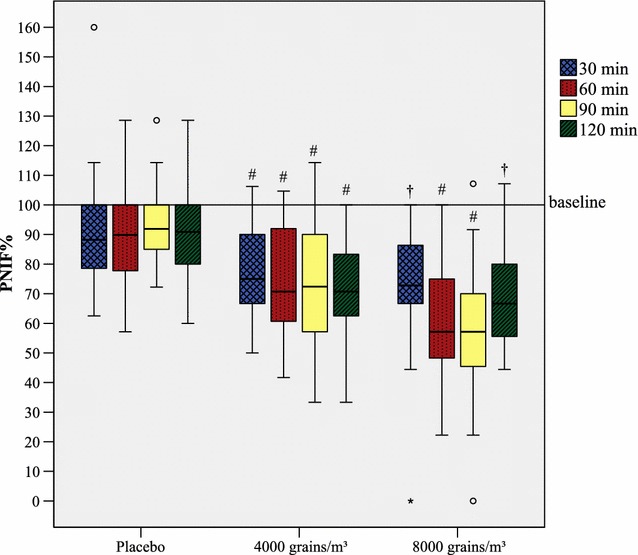
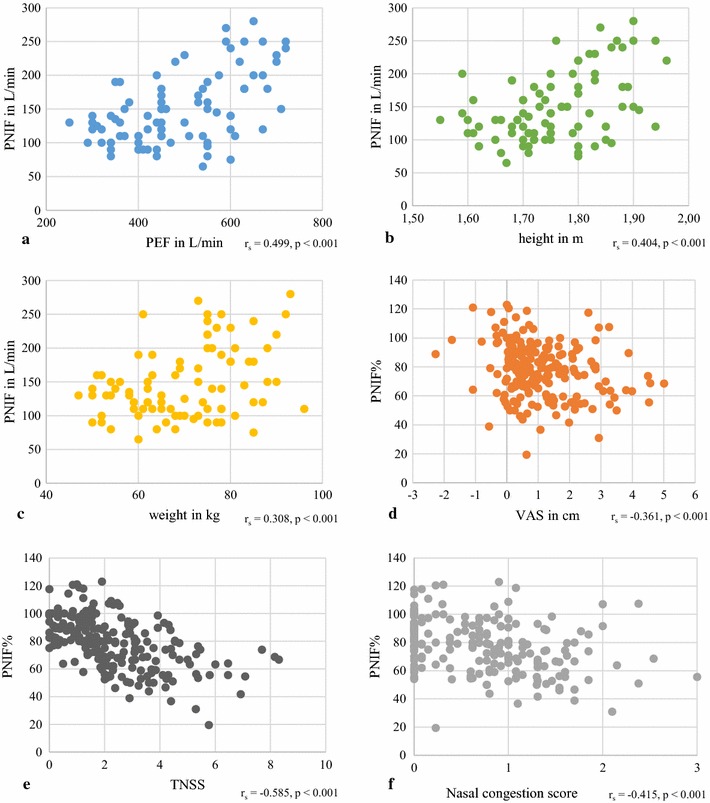
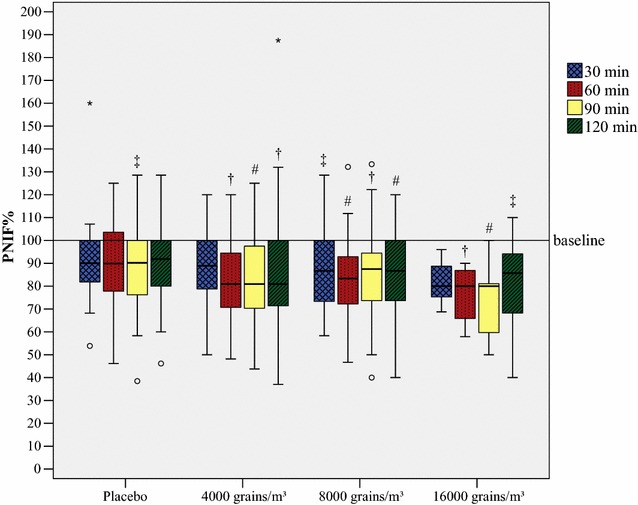
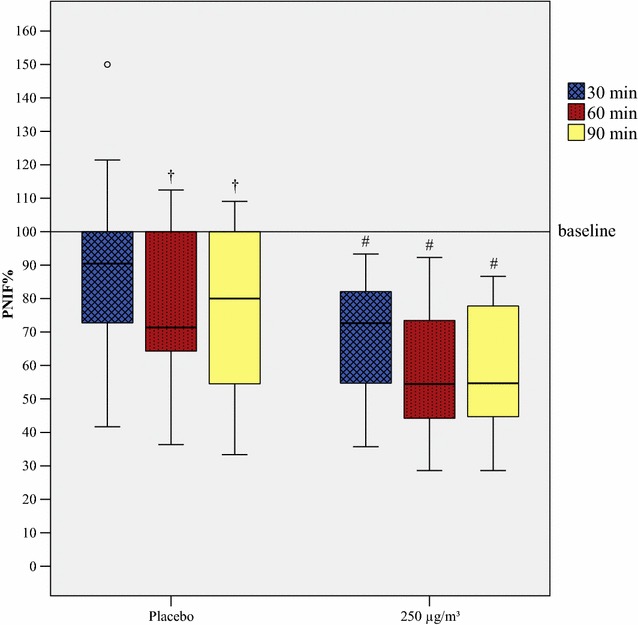
86 subjects participated in 203 challenges, altogether. House dust mite provocations caused the greatest reduction in PNIF values, followed by grass pollen and birch pollen. Provocations with every allergen or pollen concentration led to a significant decrease (p < 0.05) in PNIF compared to baseline. Furthermore, positive correlations were obtained between PNIF and peak expiratory flow, height and weight, and inverse correlations between PNIF and total nasal symptom score, nasal congestion score and visual analog scale of overall subjective symptoms.
PNIF is a helpful and feasible tool for conducting provocation trials with allergens, especially grass pollen and house dust mite, in an AEC.
GALEN舱已被开发为一种新型的移动过敏原暴露舱(AEC),可用于开展标准化的多中心过敏试验。迄今为止,主观鼻症状评分一直是最常用的结局参数,但在标准化的现代试验中,更倾向于使用客观参数。尽管鼻吸气峰流量(PNIF)这个客观参数具有实用性,但在过敏原暴露舱环境下的过敏试验中却很少使用。本研究旨在评估PNIF作为AEC中激发试验的结局参数。
在随机对照双盲试验中,患有过敏性鼻炎的受试者在GALEN舱中暴露于草花粉、桦树花粉、屋尘螨和/或安慰剂。使用不同的过敏原浓度来评估症状严重程度。患者在激发试验前以及使用便携式PNIF仪进行激发试验期间每30分钟测量一次PNIF。
共有86名受试者参与了203次激发试验。屋尘螨激发试验导致PNIF值下降幅度最大,其次是草花粉和桦树花粉。与基线相比,每种过敏原或花粉浓度的激发试验均导致PNIF显著下降(p<0.05)。此外,PNIF与呼气峰流量、身高和体重之间呈正相关,与总鼻症状评分、鼻充血评分和总体主观症状视觉模拟量表之间呈负相关。
PNIF是在AEC中对过敏原(尤其是草花粉和屋尘螨)进行激发试验的一种有用且可行的工具。