Skowronski Danuta M, Chambers Catharine, De Serres Gaston, Sabaiduc Suzana, Winter Anne-Luise, Dickinson James A, Gubbay Jonathan B, Fonseca Kevin, Drews Steven J, Charest Hugues, Martineau Christine, Krajden Mel, Petric Martin, Bastien Nathalie, Li Yan
British Columbia Centre for Disease Control.
University of British Columbia, Vancouver.
J Infect Dis. 2017 Sep 15;216(6):697-702. doi: 10.1093/infdis/jix393.
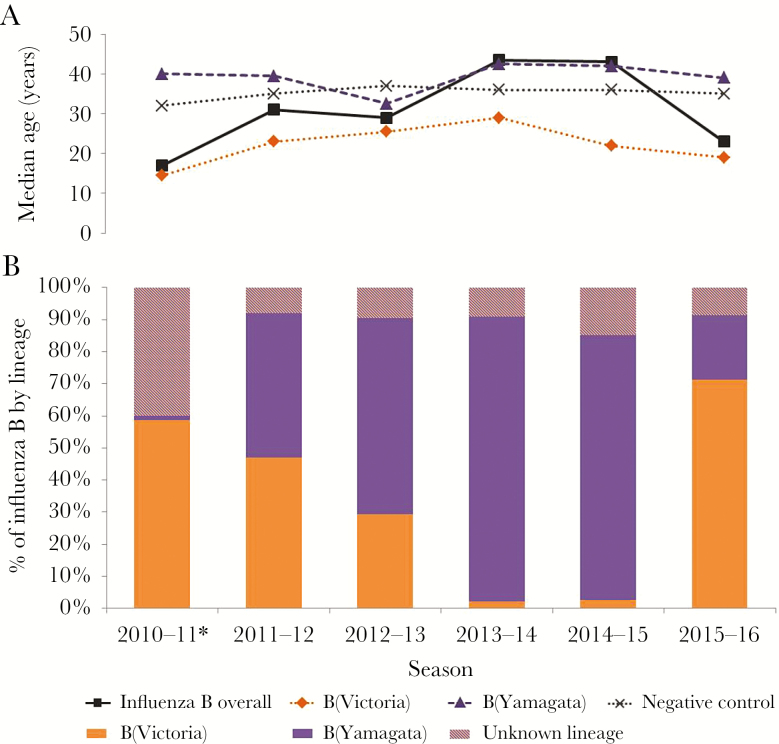
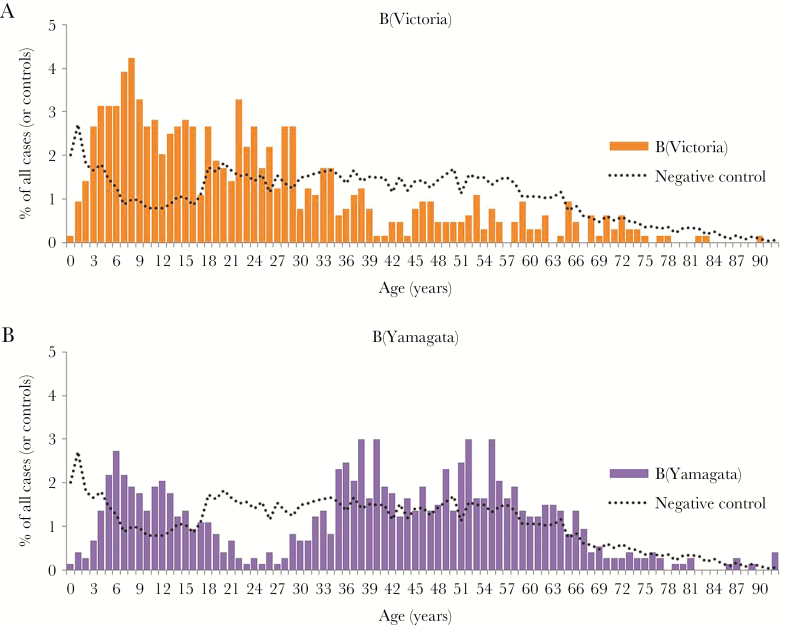
Age-related differences in influenza B lineage detection were explored in the community-based Canadian Sentinel Practitioner Surveillance Network (SPSN) from 2010-2011 to 2015-2016. Whereas >80% of B(Victoria) cases were <40 years old, B(Yamagata) cases showed a bimodal age distribution with 27% who were <20 years old and 61% who were 30-64 years old, but with a notable gap in cases between 20 and 29 years old (4%). Overall, the median age was 20 years lower for B(Victoria) vs B(Yamagata) cases (20 vs 40 years; P < .01). Additional phylodynamic and immuno-epidemiological research is needed to understand age-related variation in influenza B risk by lineage, with potential implications for prevention and control across the lifespan.
在2010 - 2011年至2015 - 2016年期间,通过加拿大社区哨兵医生监测网络(SPSN)对乙型流感病毒谱系检测中的年龄相关差异进行了探索。虽然超过80%的B(维多利亚)型病例年龄小于40岁,但B(山形)型病例呈现双峰年龄分布,27%的病例年龄小于20岁,61%的病例年龄在30 - 64岁之间,但20至29岁之间的病例存在明显差距(4%)。总体而言,B(维多利亚)型病例的中位年龄比B(山形)型病例低20岁(20岁对40岁;P <.01)。需要进行更多的系统发育动力学和免疫流行病学研究,以了解不同谱系乙型流感病毒风险的年龄相关差异,这可能对整个生命周期的预防和控制具有潜在意义。