Padin Avelina C, Emery Charles F, Vasey Michael, Kiecolt-Glaser Janice K
1 The Ohio State University.
2 The Ohio State University Wexner Medical Center.
J Sport Exerc Psychol. 2017 Aug 1;39(4):237-248. doi: 10.1123/jsep.2017-0056. Epub 2017 Sep 22.
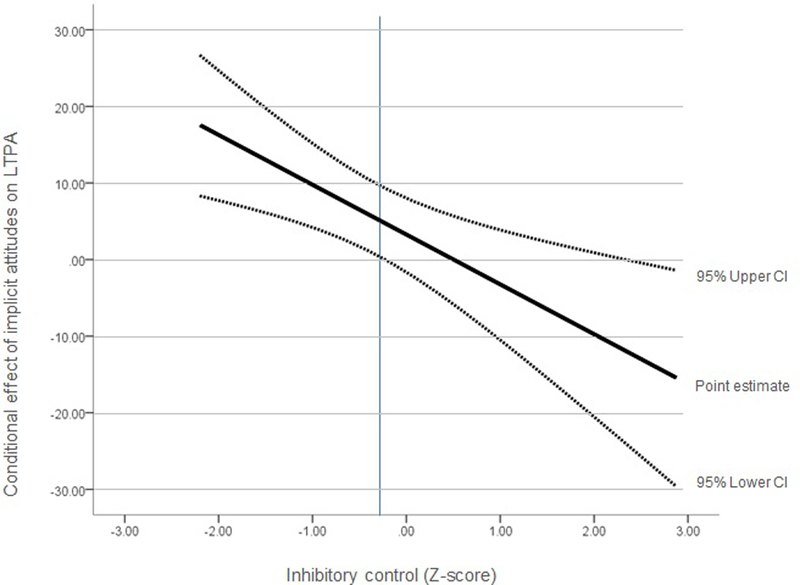
Dual-process models of health behavior posit that implicit and explicit attitudes independently drive healthy behaviors. Prior evidence indicates that implicit attitudes may be related to weekly physical activity (PA) levels, but the extent to which self-regulation attenuates this link remains unknown. This study examined the associations between implicit attitudes and self-reported PA during leisure time among 150 highly active young adults and evaluated the extent to which effortful control (one aspect of self-regulation) moderated this relationship. Results indicated that implicit attitudes toward exercise were unrelated to average workout length among individuals with higher effortful control. However, those with lower effortful control and more negative implicit attitudes reported shorter average exercise sessions compared with those with more positive attitudes. Implicit and explicit attitudes were unrelated to total weekly PA. A combination of poorer self-regulation and negative implicit attitudes may leave individuals vulnerable to mental and physical health consequences of low PA.
健康行为的双过程模型认为,内隐态度和外显态度独立驱动健康行为。先前的证据表明,内隐态度可能与每周的身体活动(PA)水平有关,但自我调节减弱这种联系的程度尚不清楚。本研究调查了150名高活跃度的年轻成年人在休闲时间的内隐态度与自我报告的身体活动之间的关联,并评估了努力控制(自我调节的一个方面)调节这种关系的程度。结果表明,在努力控制能力较高的个体中,对运动的内隐态度与平均锻炼时长无关。然而,与态度更积极的人相比,努力控制能力较低且内隐态度更消极的人报告的平均锻炼时间较短。内隐态度和外显态度与每周总的身体活动无关。自我调节能力较差和内隐态度消极相结合,可能会使个体易受低身体活动水平对身心健康造成的影响。