Wang Xiaohui, Bao Zhengqiang, Zhang Xiaoju, Li Fei, Lai Tianwen, Cao Chao, Chen Zhihua, Li Wen, Shen Huahao, Ying Songmin
Department of Respiratory and Critical Care Medicine, Second Affiliated Hospital, Institute of Respiratory Diseases, Zhejiang University School of Medicine, Hangzhou, China.
Department of Pharmacology, Zhejiang University School of Medicine, Hangzhou, China.
Oncotarget. 2017 May 31;8(35):59901-59914. doi: 10.18632/oncotarget.18316. eCollection 2017 Aug 29.
PD-1/PD-L1 inhibitors have been implicated as potentially effective anti-cancer therapies. Some clinical randomized controlled trials (RCTs) have been completed for a variety of PD-1/PD-L1 inhibitors to treat various malignancies, and more RCTs are still under way. We carried out this systematic meta-analysis to evaluate the efficacy and safety of PD-1/PD-L1 inhibitors in the treatment of solid tumors.
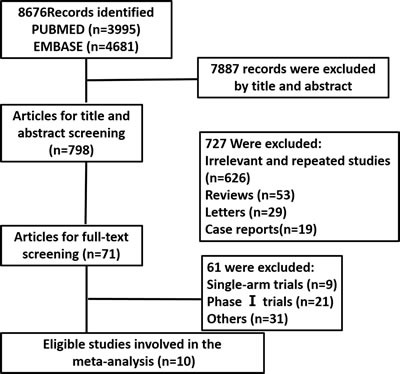
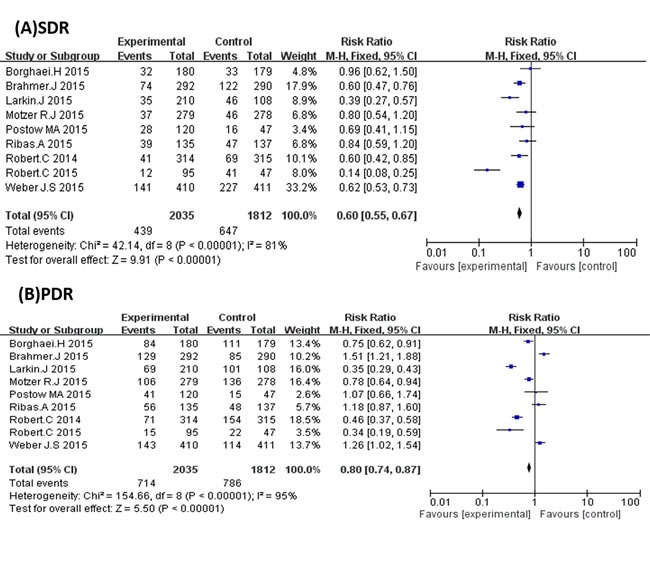
We searched PubMed, EMBASE, clinical trial registers, conference reports, and related reviews. Eligible RCTs that compared PD-1/PD-L1 inhibitors with other chemotherapy agents or placebo in solid tumor patients were included. For each RCT, progression-free survival (PFS), overall survival (OS), objective response rate (ORR), disease control rate (DCR), stable disease rate (SDR), progressive disease rate (PDR), and adverse events (AEs) were pooled for meta-analysis.
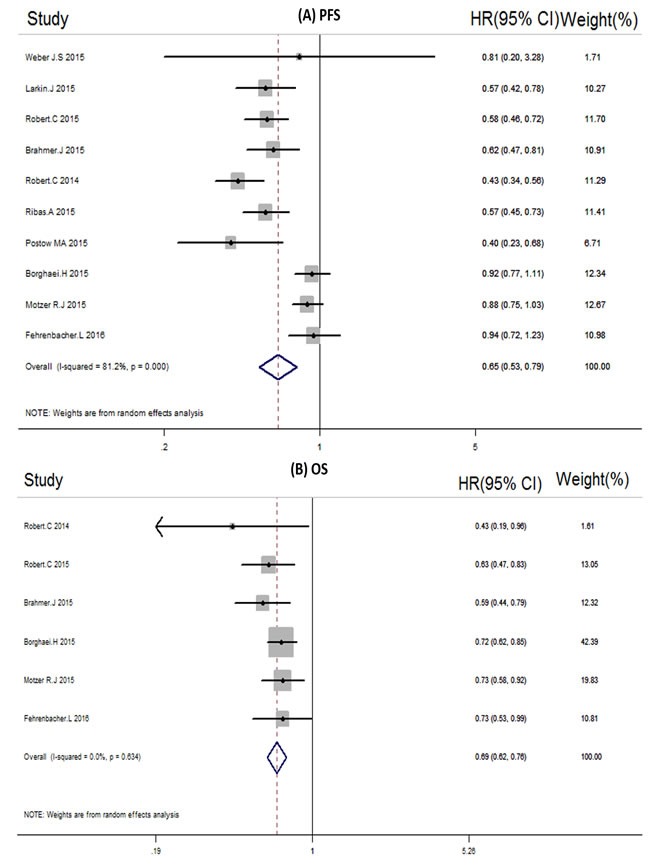
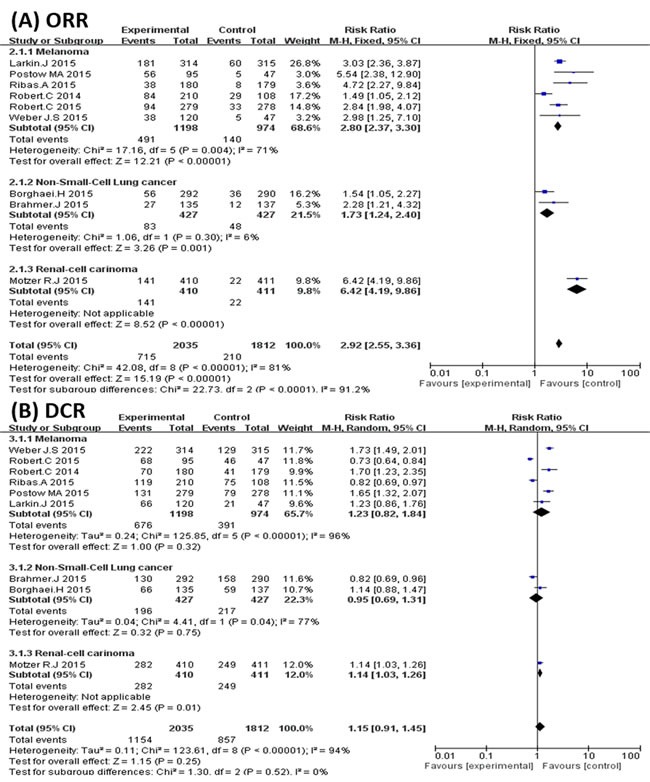
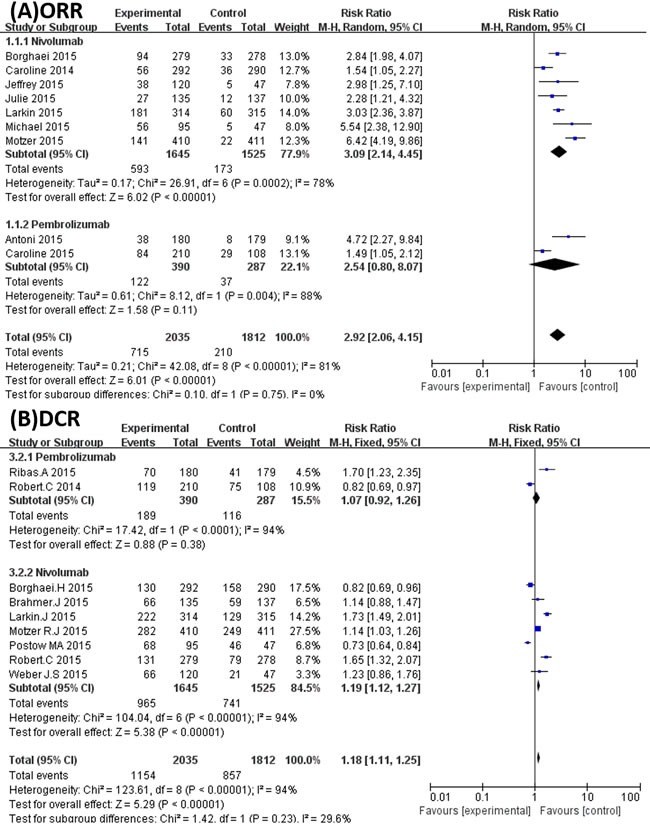
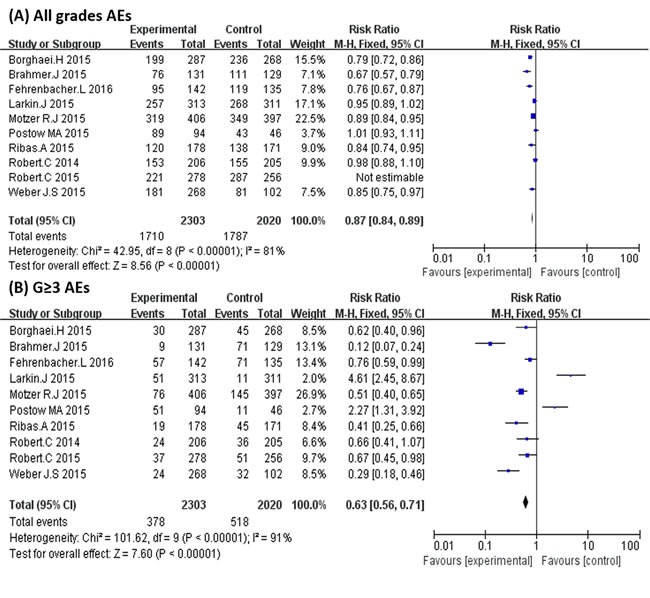
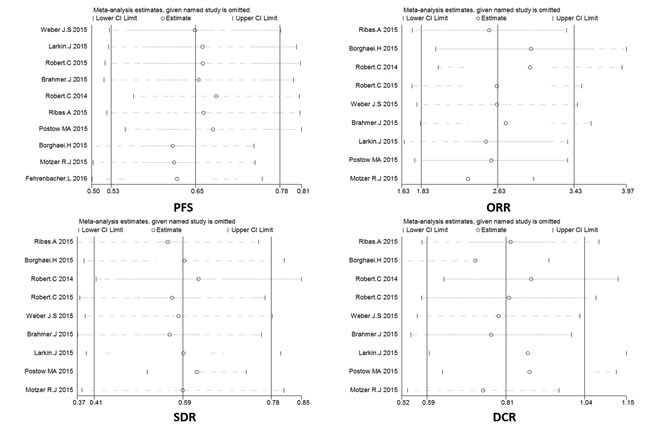
Based on an analysis of 10 eligible RCTs, PD-1/PD-L1 inhibitors were found to significantly improve PFS (Hazard ratio (HR), 0.65; 95% confidence interval (CI) 0.53 to 0.79, <0.001), OS (HR, 0.69; 95%CI 0.62 to 0.76, <0.001), and ORR (Risk Ratio (RR) 292; 95% confidence interval (CI) 2.06 to 4.15, <0.00001) in all populations, including melanoma and NSCLC subgroups. However, they failed to increase the DCR of cancer patients (RR 1.15; 95%CI 0.91 to 1.45, =0.25). Furthermore, less AEs were observed in the PD-1/PD-L1 inhibitor groups than the control groups.
PD-1 inhibitors are more effective for improving the PFS, OS, and ORR of cancer patients with little toxicity, despite having little effect on increasing of the DCR.
PD-1/PD-L1抑制剂已被认为是潜在有效的抗癌疗法。一些关于各种PD-1/PD-L1抑制剂治疗各种恶性肿瘤的临床随机对照试验(RCT)已经完成,更多的RCT仍在进行中。我们进行了这项系统的荟萃分析,以评估PD-1/PD-L1抑制剂治疗实体瘤的疗效和安全性。
我们检索了PubMed、EMBASE、临床试验注册库、会议报告和相关综述。纳入了在实体瘤患者中将PD-1/PD-L1抑制剂与其他化疗药物或安慰剂进行比较的合格RCT。对于每个RCT,汇总无进展生存期(PFS)、总生存期(OS)、客观缓解率(ORR)、疾病控制率(DCR)、疾病稳定率(SDR)、疾病进展率(PDR)和不良事件(AE)进行荟萃分析。
基于对10项合格RCT的分析,发现PD-1/PD-L1抑制剂在所有人群中,包括黑色素瘤和非小细胞肺癌亚组,均能显著改善PFS(风险比(HR),0.65;95%置信区间(CI)0.53至0.79,<0.001)、OS(HR,0.69;95%CI 0.62至0.76,<0.001)和ORR(风险比(RR)2.92;95%置信区间(CI)2.06至4.15,<0.00001)。然而,它们未能提高癌症患者的DCR(RR 1.15;95%CI 0.91至1.45,=0.25)。此外,与对照组相比,PD-1/PD-L1抑制剂组观察到的AE较少。
PD-1抑制剂对提高癌症患者的PFS、OS和ORR更有效,且毒性较小,尽管对提高DCR作用不大。