James Carl A, Hayes Mark, Willmott Ashley G B, Gibson Oliver R, Flouris Andreas D, Schlader Zachary J, Maxwell Neil S
Environmental Extremes Laboratory, Centre for Sport and Exercise Science and Medicine (SESAME), University of Brighton, Eastbourne, UK.
National Sports Institute of Malaysia (Institut Sukan Negara), Bukit Jalil Stadium, Kuala Lumpur, Malaysia.
Temperature (Austin). 2017 May 25;4(3):314-329. doi: 10.1080/23328940.2017.1333189. eCollection 2017.
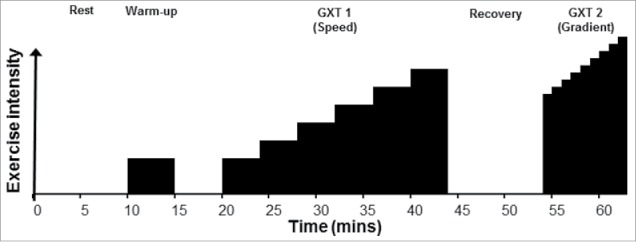
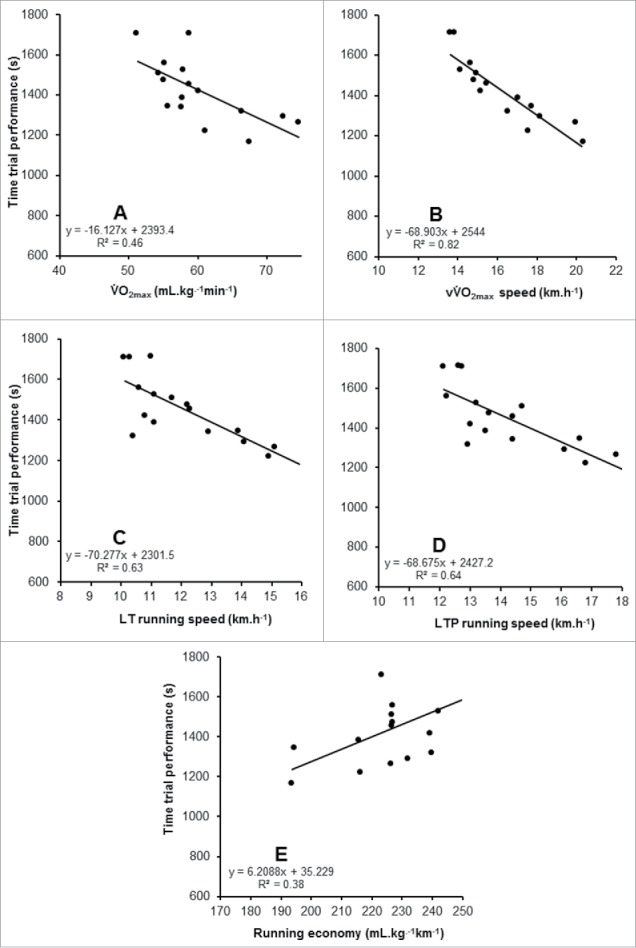
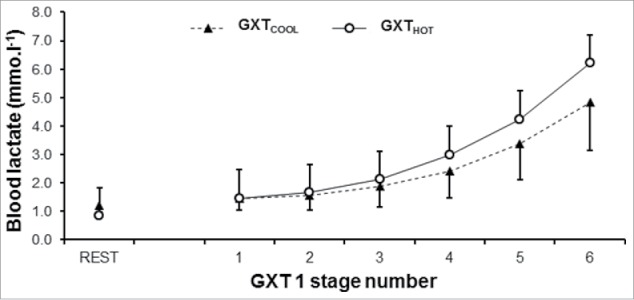
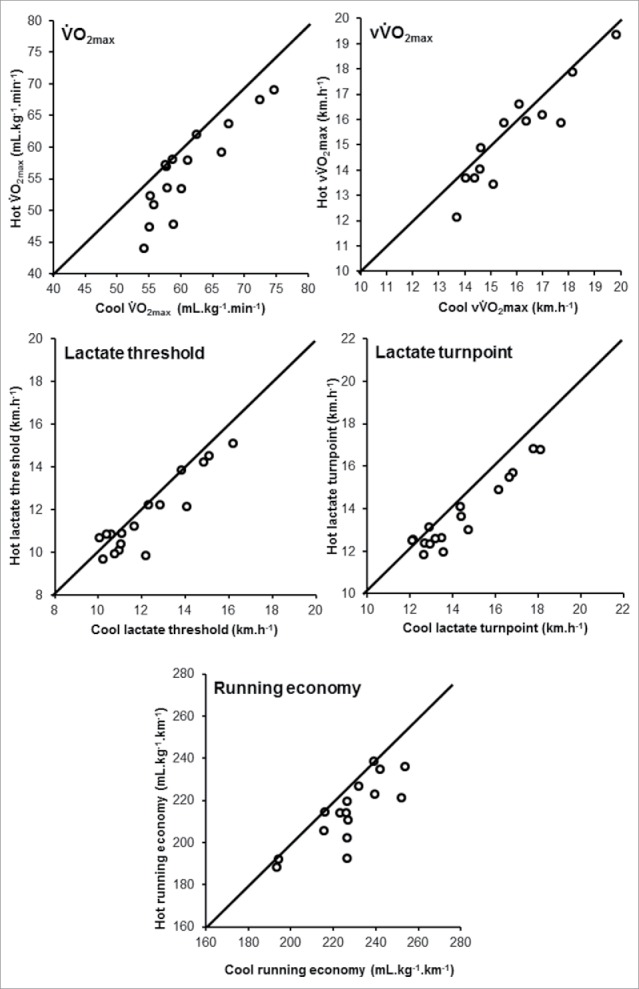
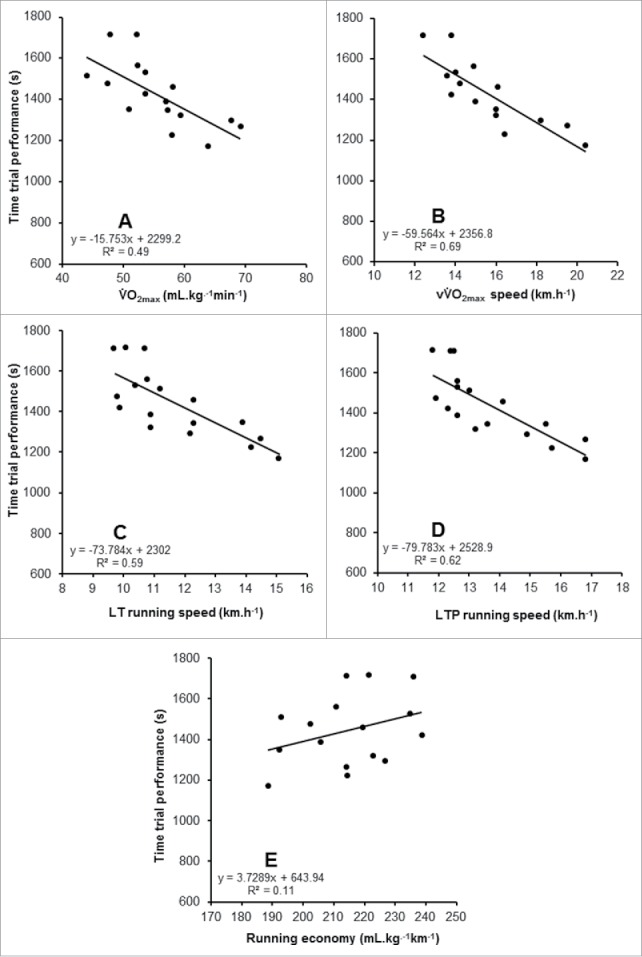
In cool conditions, physiologic markers accurately predict endurance performance, but it is unclear whether thermal strain and perceived thermal strain modify the strength of these relationships. This study examined the relationships between traditional determinants of endurance performance and time to complete a 5-km time trial in the heat. Seventeen club runners completed graded exercise tests (GXT) in hot (GXTHOT; 32°C, 60% RH, 27.2°C WBGT) and cool conditions (GXTCOOL; 13°C, 50% RH, 9.3°C WBGT) to determine maximal oxygen uptake (V̇O), running economy (RE), velocity at V̇O (vV̇O), and running speeds corresponding to the lactate threshold (LT, 2 mmol.l) and lactate turnpoint (LTP, 4 mmol.l). Simultaneous multiple linear regression was used to predict 5 km time, using these determinants, indicating neither GXTHOT (R = 0.72) nor GXTCOOL (R = 0.86) predicted performance in the heat as strongly has previously been reported in cool conditions. vV̇O was the strongest individual predictor of performance, both when assessed in GXT ( = -0.83) and GXT ( = -0.90). The GXTs revealed the following correlations for individual predictors in GXT; V̇O = -0.7, RE = 0.36, LT = -0.77, LTP = -0.78 and in GXT; V̇O = -0.67, RE = 0.62, LT = -0.79, LTP = -0.8. These data indicate (i) GXT does not predict 5 km running performance in the heat as strongly as a GXT, (ii) as in cool conditions, vV̇O may best predict running performance in the heat.
在凉爽条件下,生理指标能准确预测耐力表现,但尚不清楚热应激和主观热应激是否会改变这些关系的强度。本研究调查了耐力表现的传统决定因素与在高温环境下完成5公里计时赛的时间之间的关系。17名俱乐部跑步者在炎热(GXTHOT;32°C,60%相对湿度,27.2°C湿球黑球温度)和凉爽条件(GXTCOOL;13°C,50%相对湿度,9.3°C湿球黑球温度)下完成了分级运动测试(GXT),以确定最大摄氧量(V̇O)、跑步经济性(RE)、V̇O时的速度(vV̇O)以及对应乳酸阈(LT,2 mmol.l)和乳酸拐点(LTP,4 mmol.l)的跑步速度。使用这些决定因素,通过多元线性回归预测5公里用时,结果表明,GXTHOT(R = 0.72)和GXTCOOL(R = 0.86)对高温环境下表现的预测强度均不如之前在凉爽条件下报道的那样强。vV̇O是表现最强的个体预测指标,在GXT中评估时(= -0.83)和在GXT中评估时(= -0.90)均如此。GXT显示了GXT中个体预测指标的以下相关性;V̇O = -0.7,RE = 0.36,LT = -0.77,LTP = -0.78,以及在GXT中;V̇O = -0.67,RE = 0.62,LT = -0.79,LTP = -0.8。这些数据表明:(i)GXT对高温环境下5公里跑步表现的预测强度不如GXT,(ii)与凉爽条件下一样,vV̇O可能最能预测高温环境下的跑步表现。