Ipswich Hospital NHS Trust, Ipswich, UK.
Zentrum fur Diabetologie Hamburg Bergedorf, Hamburg, Germany.
Diabet Med. 2018 Apr;35(4):491-494. doi: 10.1111/dme.13515. Epub 2017 Oct 14.
Many countries require individuals with diabetes to adhere to standards regarding blood glucose testing in order to be granted or retain a driving licence. Currently, interstitial glucose results may not be used. The aim of this study was to determine whether interstitial glucose measurements using flash glucose-sensing technology can provide additional information to augment safe driving.
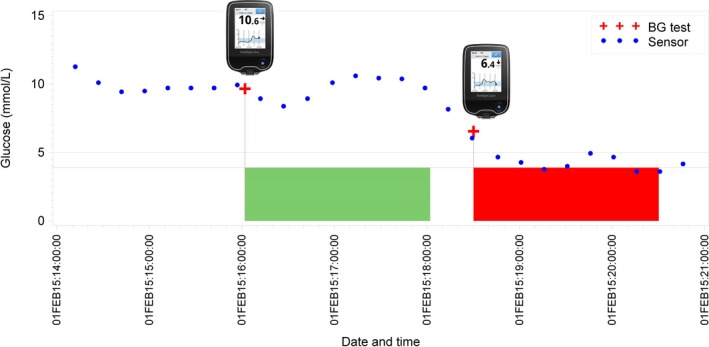
Sensor data from two European studies (NCT02232698 and NCT02082184) of the FreeStyle Libre Glucose Monitoring System in insulin-treated Type 1 and Type 2 diabetes, 241 and 224 participants respectively, were used to determine the frequency of a low interstitial sensor glucose result (< 3.9 mmol/l) up to 4 h subsequent to a daytime (07:00-21:00 h) capillary blood glucose result ≥ 5 mmol/l.
Within 4 h of a capillary blood glucose result ≥ 5 mmol/l a sensor glucose result of < 3.9 mmol/l occurred on 22.0% of occasions (2573 of 11 706 blood glucose readings) for those with Type 1 diabetes, and 8.4% of occasions (699/8352) for those with Type 2 diabetes; 13.8% (1610/11 628) and 4.4% (365/8203) within 2 h, and 10.0% (1160/11 601) and 3.1% (254/8152) within 1.5 h. Analysis of sensor glucose results 5-7 mmol/l demonstrated the glucose trend arrow descending on 14.7% (1163/7894, Type 1 diabetes) and 9.4% (305/3233, Type 2 diabetes) of occasions.
Sensor-based glucose information with directional arrows has the potential to support assessment of safe glucose levels associated with driving and offers distinct advantages over blood glucose testing for individuals with Type 1 and Type 2 diabetes to concord with driving safety standards.
许多国家要求糖尿病患者遵循血糖检测标准,以获得或保留驾驶执照。目前,不能使用间质葡萄糖结果。本研究旨在确定使用瞬态葡萄糖感应技术的间质葡萄糖测量是否可以提供额外信息以增强安全驾驶。
使用来自两个欧洲研究(NCT02232698 和 NCT02082184)的 FreeStyle Libre 葡萄糖监测系统的传感器数据,这些数据来自分别接受胰岛素治疗的 1 型和 2 型糖尿病患者 241 名和 224 名,用于确定日间(07:00-21:00)毛细血管血糖结果≥5mmol/L 后 4 小时内低间质传感器葡萄糖结果(<3.9mmol/L)的频率。
在毛细血管血糖结果≥5mmol/L 后 4 小时内,1 型糖尿病患者的传感器葡萄糖结果<3.9mmol/L 的情况发生在 22.0%(11706 次血糖读数中的 2573 次),2 型糖尿病患者的情况发生在 8.4%(8352 次中的 699 次);在 2 小时内分别为 13.8%(11628 次中的 1610 次)和 4.4%(8203 次中的 365 次),在 1.5 小时内分别为 10.0%(11601 次中的 1160 次)和 3.1%(8152 次中的 254 次)。分析传感器葡萄糖结果为 5-7mmol/L 表明在 14.7%(7894 次中的 1163 次,1 型糖尿病)和 9.4%(3233 次中的 305 次,2 型糖尿病)的情况下葡萄糖趋势箭头下降。
具有方向箭头的基于传感器的葡萄糖信息有可能支持评估与驾驶相关的安全血糖水平,并为 1 型和 2 型糖尿病患者提供比血糖检测更具优势的驾驶安全标准。