Zhang Xu, Hu Weiling, Chen Fei, Liu Jiquan, Yang Yuanhang, Wang Liangjing, Duan Huilong, Si Jianmin
College of Biomedical Engineering & Instrument Science, Zhejiang University, Hangzhou, China.
Key Laboratory of Biomedical Engineering, Ministry of Education, Zhejiang University, Hangzhou, China.
PLoS One. 2017 Sep 26;12(9):e0185508. doi: 10.1371/journal.pone.0185508. eCollection 2017.
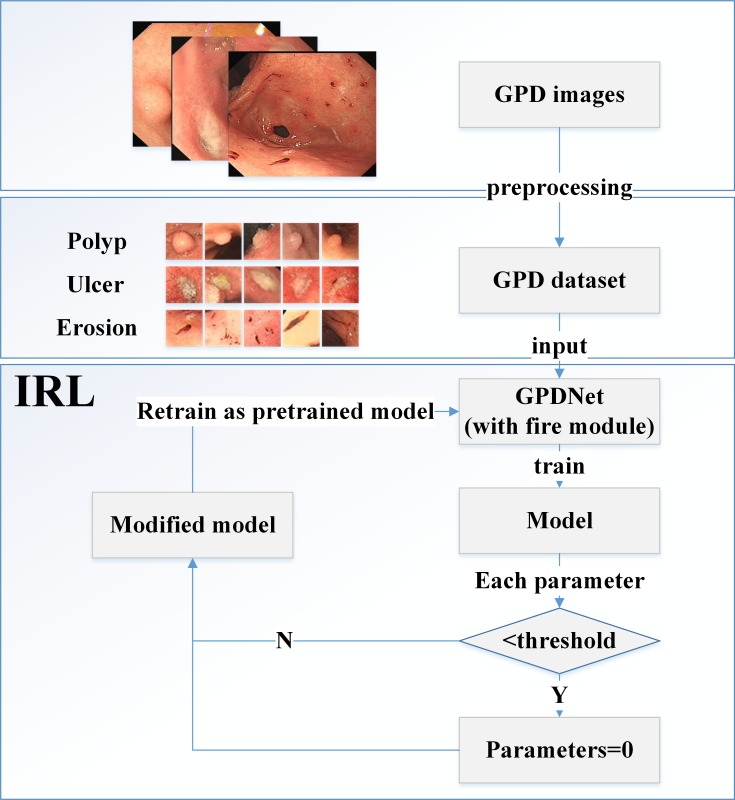
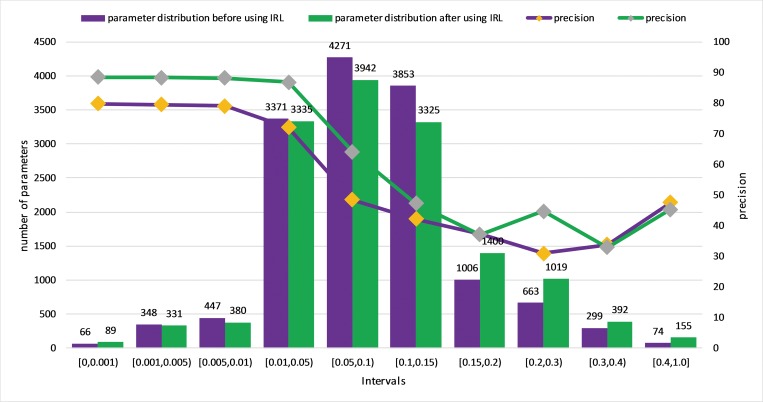
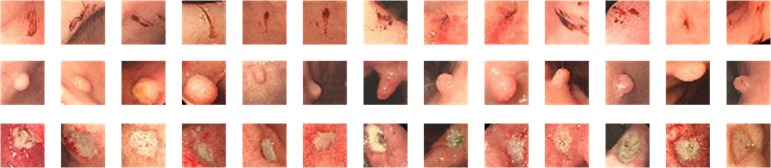
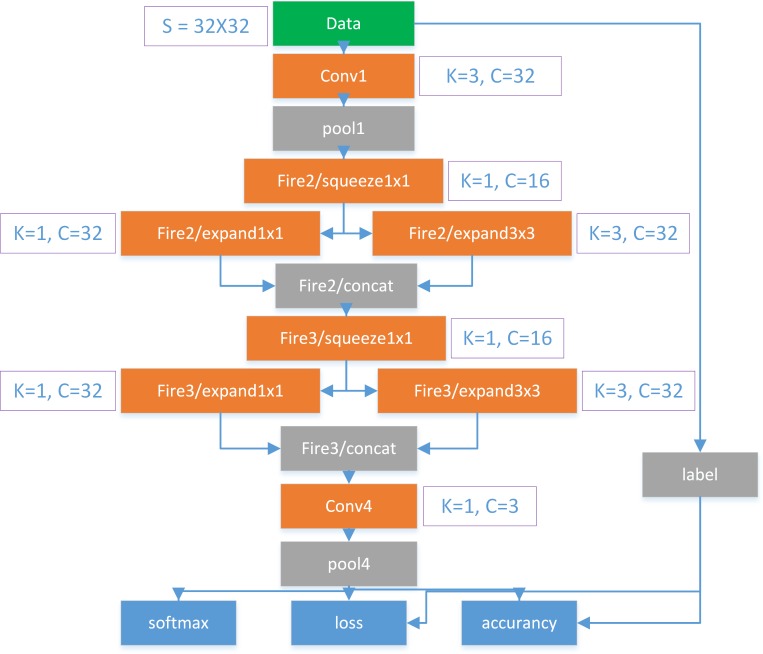
Gastric precancerous diseases (GPD) may deteriorate into early gastric cancer if misdiagnosed, so it is important to help doctors recognize GPD accurately and quickly. In this paper, we realize the classification of 3-class GPD, namely, polyp, erosion, and ulcer using convolutional neural networks (CNN) with a concise model called the Gastric Precancerous Disease Network (GPDNet). GPDNet introduces fire modules from SqueezeNet to reduce the model size and parameters about 10 times while improving speed for quick classification. To maintain classification accuracy with fewer parameters, we propose an innovative method called iterative reinforced learning (IRL). After training GPDNet from scratch, we apply IRL to fine-tune the parameters whose values are close to 0, and then we take the modified model as a pretrained model for the next training. The result shows that IRL can improve the accuracy about 9% after 6 iterations. The final classification accuracy of our GPDNet was 88.90%, which is promising for clinical GPD recognition.
胃癌前疾病(GPD)若误诊可能恶化为早期胃癌,因此帮助医生准确快速识别GPD很重要。在本文中,我们使用一种名为胃癌前疾病网络(GPDNet)的简洁模型,通过卷积神经网络(CNN)实现了对息肉、糜烂和溃疡这三类GPD的分类。GPDNet引入了来自SqueezeNet的火模块,在提高快速分类速度的同时,将模型大小和参数减少了约10倍。为了用更少的参数保持分类精度,我们提出了一种名为迭代强化学习(IRL)的创新方法。在从零开始训练GPDNet后,我们应用IRL对值接近0的参数进行微调,然后将修改后的模型作为预训练模型用于下一次训练。结果表明,经过6次迭代后,IRL可将准确率提高约9%。我们的GPDNet最终分类准确率为88.90%,这对于临床GPD识别很有前景。