Center on Young Adult Health and Development, University of Maryland School of Public Health, Department of Behavioral and Community Health, 1234 School of Public Health Building, College Park, MD 20742, USA.
Department of Psychology, University of Maryland, 3109 Biology-Psychology Building, College Park, MD 20742, USA.
Drug Alcohol Depend. 2017 Nov 1;180:332-339. doi: 10.1016/j.drugalcdep.2017.08.032. Epub 2017 Sep 18.
Driving under the influence of alcohol is a leading cause of injury and premature death among young adults, and college-educated individuals are at particularly high risk. Less is known about driving under the influence of other drugs, which is on the rise.
This study describes prospective seven-year trends in alcohol and other drug (AOD)-involved driving among a young-adult sample beginning with their second year of college (i.e., Years 2-8), and documents the extent of continuity in such behaviors across time. Originally recruited as incoming first-year students at one large public university, participants (n=1194) were interviewed annually about how frequently they drove while drunk/intoxicated (DWI), after drinking any alcohol (DAD), and/or while under the influence of other drugs (DD). Follow-up rates were high (>75% annually).
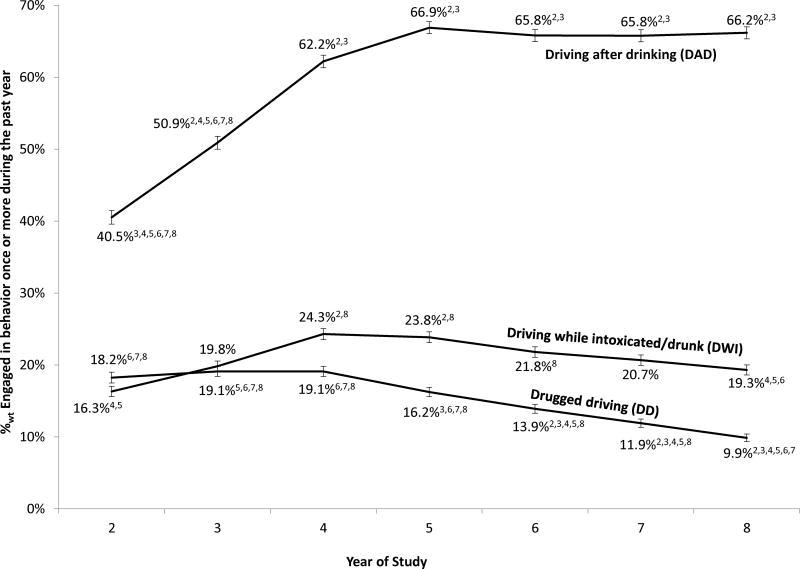
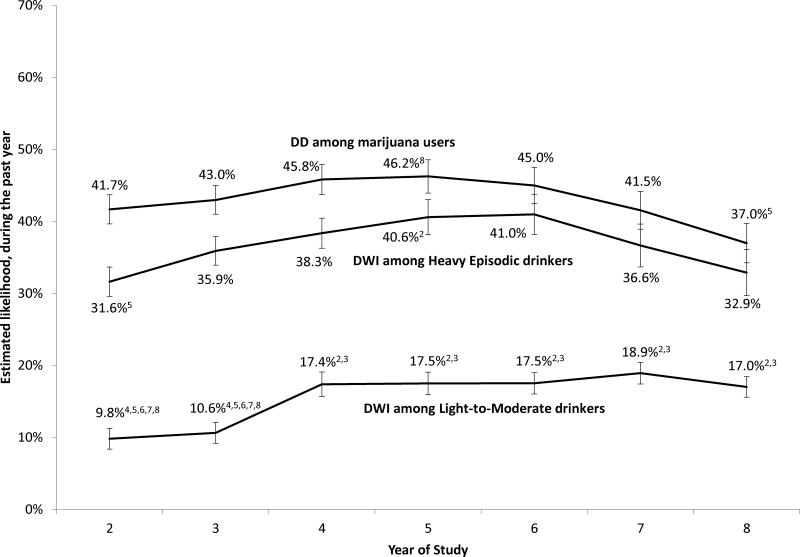
Among participants with access to drive a car, annual prevalence peaked in Year 4 (modal age 21) for both DWI (24.3%) and DD (19.1%) and declined significantly thereafter through Year 8 (both ps<0.05). DAD was far more prevalent than DWI or DD, increasing from 40.5% in Year 2 to 66.9% in Year 5, and plateauing thereafter. Among marijuana-using participants, likelihood of DD was consistently greater than the likelihood of DWI among Heavy Episodic and Light-to-Moderate drinkers, and it declined significantly during Years 5-8 (p<0.05).
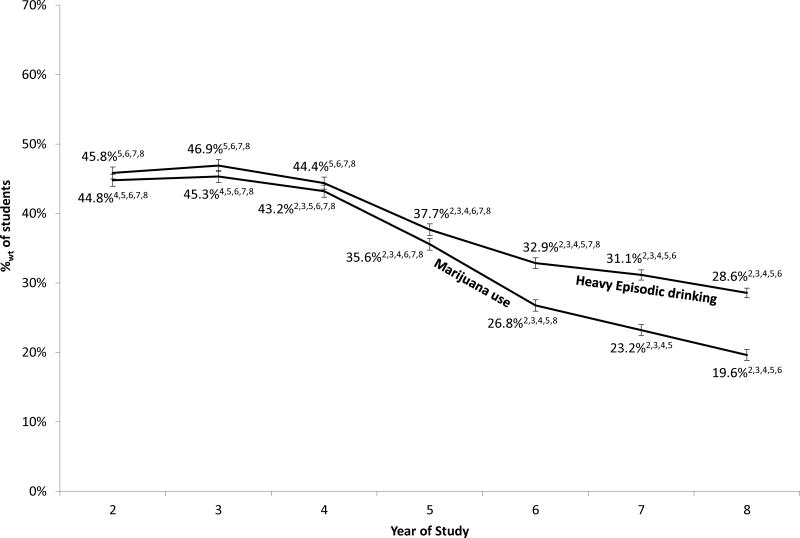
Post-college declines in heavy drinking and DWI prevalence were encouraging but did not necessarily translate to reductions in likelihood of engaging in DWI, depending on drinking pattern. College-educated individuals represent an important target for AOD-involved driving prevention.
在年轻人中,酒后驾车是导致伤害和早逝的主要原因,而受过大学教育的人风险尤其高。对于其他药物(AOD)的影响下驾驶的了解较少,而这种情况正在上升。
本研究描述了一项针对年轻成年人的为期七年的前瞻性研究,该研究从他们的大学第二年(即第 2 年至第 8 年)开始,描述了酒精和其他药物(AOD)涉及驾驶的趋势,并记录了这些行为在时间上的连续性程度。最初是在一所大型公立大学招收的一年级新生,参与者(n=1194)每年都会接受采访,询问他们酒后驾车(DWI)、酒后驾车(DAD)和/或在其他药物影响下驾车(DD)的频率。随访率很高(每年>75%)。
在有驾驶能力的参与者中,DWI(24.3%)和 DD(19.1%)的年患病率在第 4 年(模态年龄 21 岁)达到峰值,此后显著下降至第 8 年(均 p<0.05)。DAD 的流行程度远高于 DWI 或 DD,从第 2 年的 40.5%增加到第 5 年的 66.9%,此后趋于平稳。在使用大麻的参与者中,DD 的可能性始终大于重度饮酒者和轻度至中度饮酒者的 DWI 可能性,并且在第 5 年至第 8 年期间显著下降(p<0.05)。
大学生活后,重度饮酒和 DWI 流行率的下降令人鼓舞,但这并不一定转化为 DWI 可能性的降低,具体取决于饮酒模式。受过大学教育的人是 AOD 涉及驾驶预防的重要目标。