Leitner Lorenz, Sybesma Wilbert, Chanishvili Nina, Goderdzishvili Marina, Chkhotua Archil, Ujmajuridze Aleksandre, Schneider Marc P, Sartori Andrea, Mehnert Ulrich, Bachmann Lucas M, Kessler Thomas M
Neuro-Urology, Spinal Cord Injury Center & Research, University of Zürich, Balgrist University Hospital, Zürich, Switzerland.
Department of Urology, University Hospital Basel, Basel, Switzerland.
BMC Urol. 2017 Sep 26;17(1):90. doi: 10.1186/s12894-017-0283-6.
Urinary tract infections (UTI) are among the most prevalent microbial diseases and their financial burden on society is substantial. The continuing increase of antibiotic resistance worldwide is alarming. Thus, well-tolerated, highly effective therapeutic alternatives are urgently needed. Although there is evidence indicating that bacteriophage therapy may be effective and safe for treating UTIs, the number of investigated patients is low and there is a lack of randomized controlled trials.
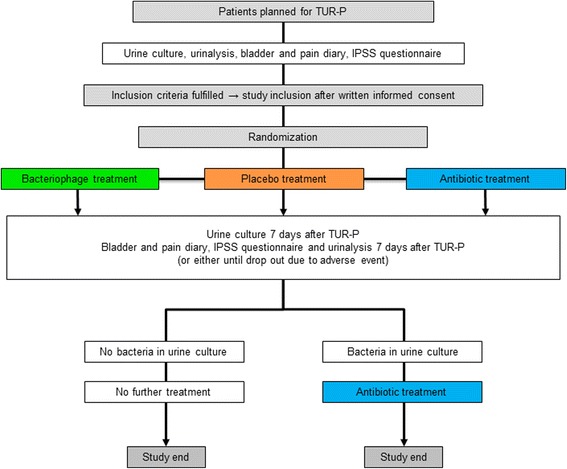
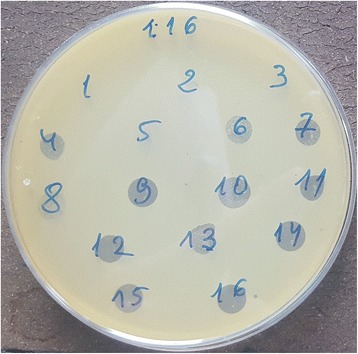
This study is the first randomized, placebo-controlled, double-blind trial investigating bacteriophages in UTI treatment. Patients planned for transurethral resection of the prostate are screened for UTIs and enrolled if in urine culture eligible microorganisms ≥10 colony forming units/mL are found. Patients are randomized in a double-blind fashion to the 3 study treatment arms in a 1:1:1 ratio to receive either: a) bacteriophage (i.e. commercially available Pyo bacteriophage) solution, b) placebo solution, or c) antibiotic treatment according to the antibiotic sensitivity pattern. All treatments are intended for 7 days. No antibiotic prophylaxes will be given to the double-blinded treatment arms a) and b). As common practice, the Pyo bacteriophage cocktail is subjected to periodic adaptation cycles during the study. Urinalysis, urine culture, bladder and pain diary, and IPSS questionnaire will be completed prior to and at the end of treatment (i.e. after 7 days) or at withdrawal/drop out from the study. Patients with persistent UTIs will undergo antibiotic treatment according to antibiotic sensitivity pattern.
Based on the high lytic activity and the potential of resistance optimization by direct adaptation of bacteriophages, and considering the continuing increase of antibiotic resistance worldwide, bacteriophage therapy is a very promising treatment option for UTIs. Thus, our randomized controlled trial investigating bacteriophages for treating UTIs will provide essential insights into this potentially revolutionizing treatment option.
This study has been registered at clinicaltrials.gov ( www.clinicaltrials.gov/ct2/show/NCT03140085 ). April 27, 2017.
尿路感染(UTI)是最常见的微生物疾病之一,给社会带来了巨大的经济负担。全球抗生素耐药性的持续增加令人担忧。因此,迫切需要耐受性良好、高效的治疗替代方案。尽管有证据表明噬菌体疗法可能对治疗尿路感染有效且安全,但研究的患者数量较少,且缺乏随机对照试验。
本研究是第一项调查噬菌体治疗尿路感染的随机、安慰剂对照、双盲试验。计划进行经尿道前列腺切除术的患者接受尿路感染筛查,若尿培养中发现符合条件的微生物≥10菌落形成单位/毫升,则纳入研究。患者以1:1:1的比例双盲随机分为3个研究治疗组,分别接受:a)噬菌体(即市售的溶脓噬菌体)溶液,b)安慰剂溶液,或c)根据抗生素敏感性模式进行的抗生素治疗。所有治疗为期7天。双盲治疗组a)和b)不给予抗生素预防。按照常规做法,溶脓噬菌体鸡尾酒在研究期间会进行定期适应性循环。在治疗前、治疗结束时(即7天后)或退出/退出研究时,将完成尿液分析、尿培养、膀胱和疼痛日记以及国际前列腺症状评分(IPSS)问卷。持续性尿路感染患者将根据抗生素敏感性模式接受抗生素治疗。
基于噬菌体的高裂解活性和通过直接适应性优化耐药性的潜力,并考虑到全球抗生素耐药性的持续增加,噬菌体疗法是治疗尿路感染非常有前景的治疗选择。因此,我们关于噬菌体治疗尿路感染的随机对照试验将为这一潜在的革命性治疗选择提供重要见解。
本研究已在clinicaltrials.gov(www.clinicaltrials.gov/ct2/show/NCT03140085)注册。2017年4月27日。