Wang Shun, Li Wei, Chang Keke, Liu Juan, Guo Qingqian, Sun Haifeng, Jiang Min, Zhang Hao, Chen Jing, Hu Jiandong
College of Mechanical and Electrical Engineering, Henan Agricultural University, Zhengzhou, China.
State Key Laboratory of Wheat and Maize Crop Science, Zhengzhou, China.
PLoS One. 2017 Sep 27;12(9):e0185530. doi: 10.1371/journal.pone.0185530. eCollection 2017.
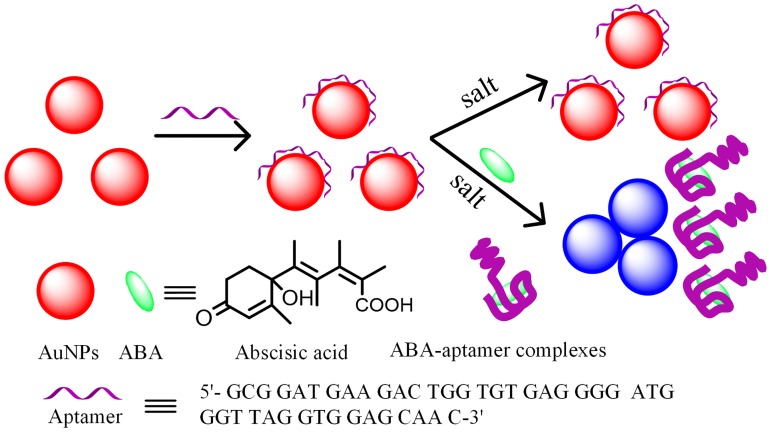
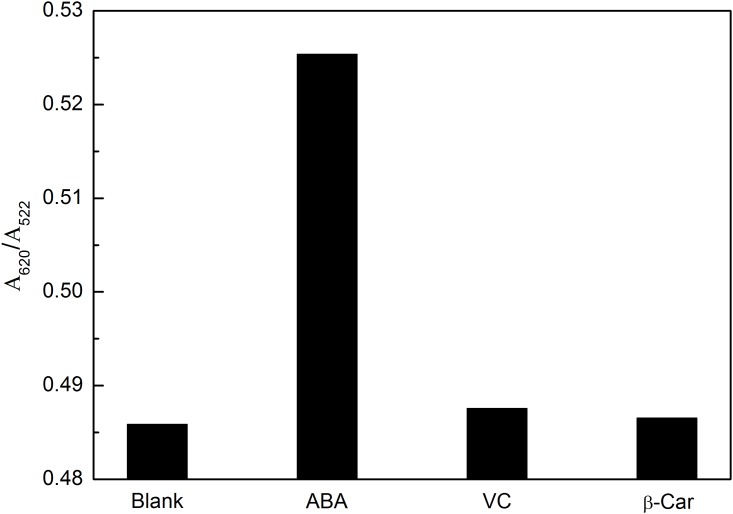
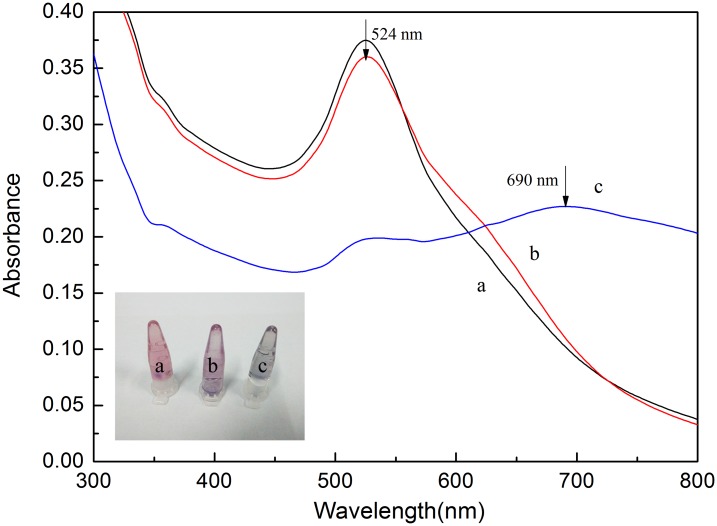
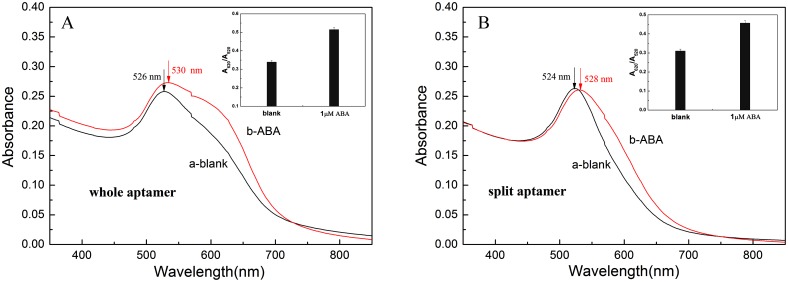
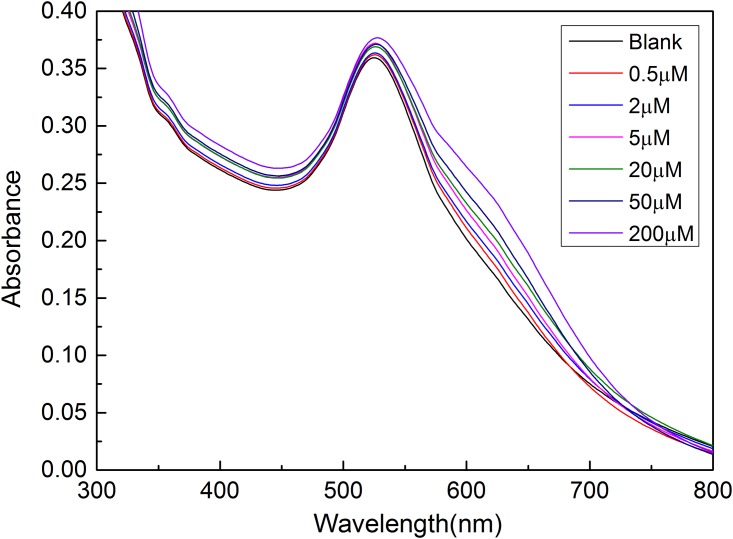
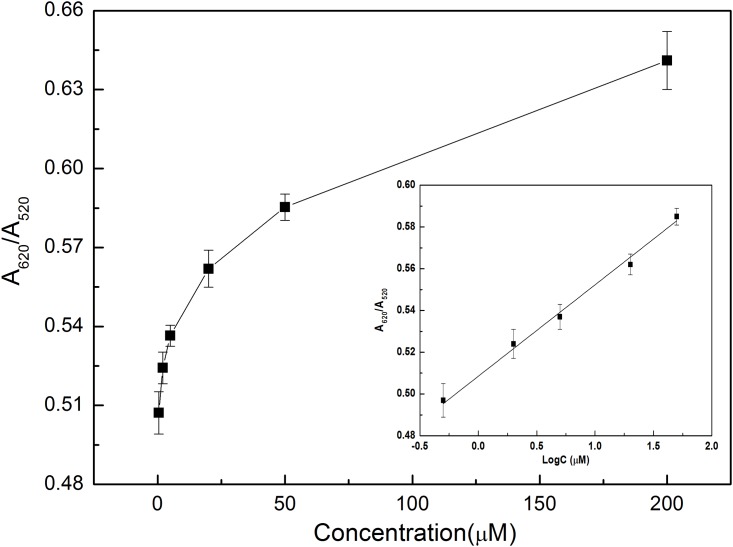
Abscisic acid (ABA) plays an important role in abiotic stress response and physiological signal transduction resisting to the adverse environment. Therefore, it is very essential for the quantitative detection of abscisic acid (ABA) due to its indispensable role in plant physiological activities. Herein, a new detection method based on localized surface plasmon resonance (LSPR) using aptamer-functionalized gold nanoparticles (AuNPs) is developed without using expensive instrument and antibody. In the presence of ABA, ABA specifically bind with their aptamers to form the ABA-aptamer complexes with G-quadruplex-like structure and lose the ability to stabilize AuNPs against NaCl-induced aggregation. Meanwhile, the changes of the LSPR spectra of AuNP solution occur and therefore the detection of ABA achieved. Under optimized conditions, this method showed a good linear range covering from 5×10⁻⁷ M to 5×10⁻⁵ M with a detection limit of 0.33 μM. In practice, the usage of this novel method has been demonstrated by its application to detect ABA from fresh leaves of rice with the relative error of 6.59%-7.93% compared with ELISA bioassay. The experimental results confirmed that this LSPR-based biosensor is simple, selective and sensitive for the detection of ABA. The proposed LSPR method could offer a new analytical platform for the detection of other plant hormones by changing the corresponding aptamer.
脱落酸(ABA)在非生物胁迫响应和抵抗逆境的生理信号转导中发挥着重要作用。因此,由于其在植物生理活动中不可或缺的作用,对脱落酸(ABA)进行定量检测至关重要。在此,开发了一种基于局域表面等离子体共振(LSPR)的新型检测方法,该方法使用适配体功能化的金纳米颗粒(AuNPs),无需使用昂贵的仪器和抗体。在ABA存在的情况下,ABA与其适配体特异性结合形成具有G-四链体样结构的ABA-适配体复合物,并失去稳定AuNPs抵抗NaCl诱导聚集的能力。同时,AuNP溶液的LSPR光谱发生变化,从而实现了ABA的检测。在优化条件下,该方法显示出良好的线性范围,从5×10⁻⁷ M到5×10⁻⁵ M,检测限为0.33 μM。在实际应用中,通过将该新方法应用于检测水稻新鲜叶片中的ABA,与酶联免疫吸附测定(ELISA)生物测定法相比,相对误差为6.59%-7.93%,证明了该方法的实用性。实验结果证实,这种基于LSPR的生物传感器对ABA的检测具有简单、选择性好和灵敏度高的特点。所提出的LSPR方法通过改变相应的适配体,可为检测其他植物激素提供一个新的分析平台。