
Cyp3a11对于小鼠胆汁酸的形成并非必不可少。
Cyp3a11 is not essential for the formation of murine bile acids.
作者信息
Wahlström Annika, Al-Dury Samer, Ståhlman Marcus, Bäckhed Fredrik, Marschall Hanns-Ulrich
机构信息
Sahlgrenska Academy, Institute of Medicine, Department of Molecular and Clinical Medicine and Wallenberg Laboratory, University of Gothenburg, S-413 45 Gothenburg, Sweden.
Novo Nordisk Foundation Center for Basic Metabolic Research, Section for Metabolic Receptology and Enteroendocrinology, Faculty of Health Sciences, University of Copenhagen, Copenhagen DK-2200, Denmark.
出版信息
Biochem Biophys Rep. 2017 Mar 8;10:70-75. doi: 10.1016/j.bbrep.2017.02.011. eCollection 2017 Jul.
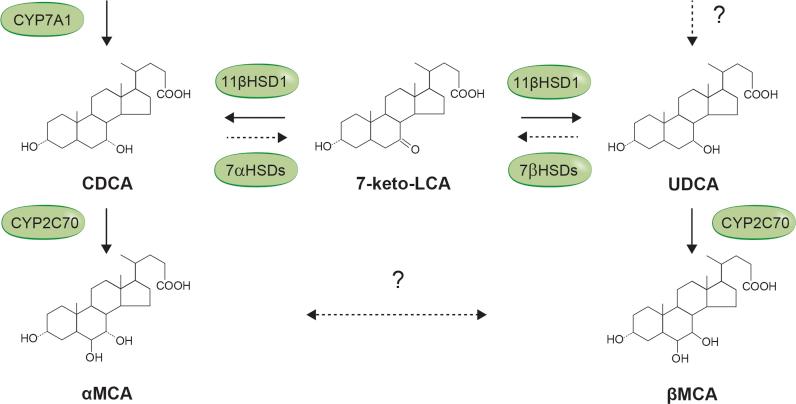
Humans and mice differ substantially in their bile acid profiles as mice in addition to cholic acid (CA) predominantly synthesize 6β-hydroxylated muricholic acids (MCAs) whereas humans produces chenodeoxycholic acid (CDCA) and CA as primary bile acids. Identifying the gene performing 6β-hydroxylation would be useful for 'humanizing' the bile acid profile in mice for studies of the interaction between bile acids, gut microbiota, and host metabolism. We investigated the formation of MCAs in primary murine hepatocytes and found that αMCA is synthesized from CDCA and βMCA from UDCA. It is commonly assumed that the P450-enzyme CYP3A11 catalyzes 6β-hydroxylation of bile acids, thus we hypothesized that mice without the gene would lack MCAs. To test this hypothesis, we analyzed bile acid profiles in deficient mice, which lack 7 genes in the gene cluster including , and compared them with wild-type littermate controls. Bile acid composition in liver, gallbladder, caecum and serum from knock out mice and wild-type littermate controls was analyzed with UPLC-MS/MS and revealed no major differences in bile acid composition. that is not necessary for 6β-hydroxylation and the formation of MCAs.
人类和小鼠的胆汁酸谱存在显著差异,因为小鼠除了胆酸(CA)外,主要合成6β-羟基化的鼠胆酸(MCAs),而人类则产生鹅去氧胆酸(CDCA)和CA作为初级胆汁酸。鉴定执行6β-羟基化的基因对于使小鼠的胆汁酸谱“人源化”以研究胆汁酸、肠道微生物群和宿主代谢之间的相互作用将是有用的。我们研究了原代小鼠肝细胞中MCAs的形成,发现αMCA由CDCA合成,βMCA由UDCA合成。通常认为P450酶CYP3A11催化胆汁酸的6β-羟基化,因此我们假设没有该基因的小鼠将缺乏MCAs。为了验证这一假设,我们分析了基因缺陷小鼠的胆汁酸谱,这些小鼠在基因簇中缺少7个基因,包括,并将它们与野生型同窝对照进行比较。用UPLC-MS/MS分析基因敲除小鼠和野生型同窝对照的肝脏、胆囊、盲肠和血清中的胆汁酸组成,结果显示胆汁酸组成没有主要差异。这表明对于6β-羟基化和MCAs的形成不是必需的。


 Zotero 插件