Al-Malahmeh Amer J, Al-Ajlouni Abdalmajeed M, Wesseling Sebastiaan, Vervoort Jacques, Rietjens Ivonne M C M
Division of Toxicology, Wageningen University, Stippeneng 4, 6708 WE, Wageningen, The Netherlands.
Aqaba International Laboratories/BENHAYYAN, ASEZA, Aqaba 77110, Jordan.
Toxicol Rep. 2016 Nov 30;4:1-8. doi: 10.1016/j.toxrep.2016.11.002. eCollection 2017.
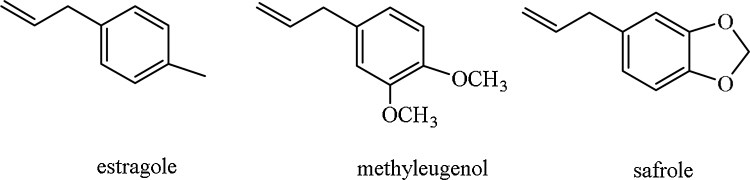
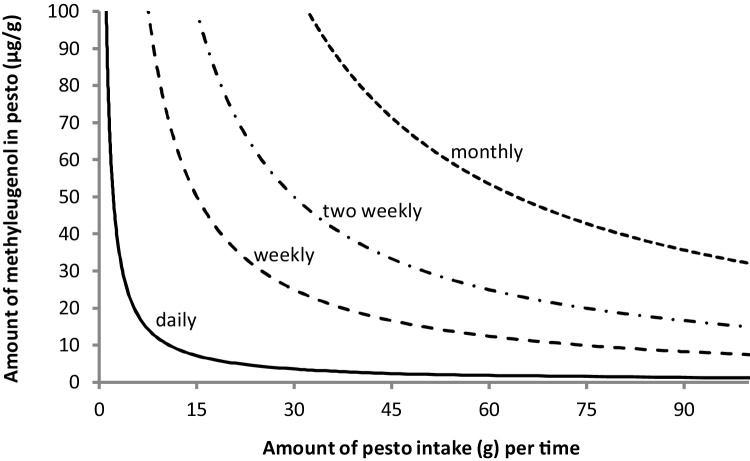
A risk assessment of basil-based pesto sauces containing methyleugenol and related alkenylbenzenes was performed based on their levels detected in a series of pesto sauces available on the Dutch market. The estimated daily intake (EDI) values of alkenylbenzenes as a result of consumption of the different pesto sauces amounted to 1.2-44.3 μg/kg bw for individual alkenylbenzenes, 14.3-43.5 μg/kg bw when adding up the alkenylbenzene levels assuming equal potency, and 17.3-62.9 μg/kg bw when expressed in methyleugenol equivalents using alkenylbenzenes defined toxic equivalency factors (TEF). The margin of exposure approach (MOE), used to evaluate the potential risks, resulted in MOE values that were generally lower than 10000 indicating a priority for risk management when assuming daily consumption. The levels of methyleugenol detected in the pesto sauces would allow consumption of 1.1-29.8, 7.5-208, 15.1-416.5, and 32.4-892.5 g of pesto sauce on a daily basis, once a week, once every two weeks, and once a month, respectively, to achieve MOE values above the 10000 limit indicating low priority for risk management. It is concluded that consumption of pesto sauces would only be of concern if consumed on a daily basis over longer periods of time.
基于在荷兰市场上一系列香蒜酱中检测到的甲基丁香酚和相关链烯基苯的含量,对含有这些成分的罗勒基香蒜酱进行了风险评估。食用不同香蒜酱后,链烯基苯的估计每日摄入量(EDI)值,对于单个链烯基苯而言为1.2 - 44.3μg/kg体重;假设效力相等,将链烯基苯含量相加时为14.3 - 43.5μg/kg体重;使用链烯基苯定义的毒性当量因子(TEF)以甲基丁香酚当量表示时为17.3 - 62.9μg/kg体重。用于评估潜在风险的暴露边际方法(MOE)得出的MOE值通常低于10000,这表明假设每日食用时风险管理具有优先性。在香蒜酱中检测到的甲基丁香酚含量,分别按每日、每周一次、每两周一次和每月一次食用时,允许食用的香蒜酱量为1.1 - 29.8克、7.5 - 208克、15.1 - 416.5克和32.4 - 892.5克,以达到高于10000限值的MOE值,表明风险管理优先级较低。得出的结论是,只有在较长时间内每日食用香蒜酱时才会引起关注。