Mercier Eric, Tardif Pier-Alexandre, Emond Marcel, Ouellet Marie-Christine, de Guise Élaine, Mitra Biswadev, Cameron Peter, Le Sage Natalie
Axe Santé des Populations et Pratiques Optimales en Santé, Unité de recherche en Traumatologie - Urgence - Soins Intensifs, Centre de recherche du CHU de Québec, Université Laval, Quebec, Canada.
Département de Médecine Familiale et Médecine d'Urgence, Faculté de Médecine, Université Laval, Quebec, Canada.
BMJ Open. 2017 Sep 27;7(9):e017848. doi: 10.1136/bmjopen-2017-017848.
Mild traumatic brain injury (mTBI) has been insufficiently researched, and its definition remains elusive. Investigators are confronted by heterogeneity in patients, mechanism of injury and outcomes. Findings are thus often limited in generalisability and clinical application. Serum protein biomarkers are increasingly assessed to enhance prognostication of outcomes, but their translation into clinical practice has yet to be achieved. A systematic review was performed to describe the adult populations included and enrolled in studies that evaluated the prognostic value of protein biomarkers to predict postconcussion symptoms following an mTBI.
Searches of MEDLINE, Embase, CENTRAL, CINAHL, Web of Science, PsycBITE and PsycINFO up to October 2016.
Two reviewers independently screened for potentially eligible studies, extracted data and assessed the overall quality of evidence by outcome using the Grading of Recommendations Assessment, Development and Evaluation approach.
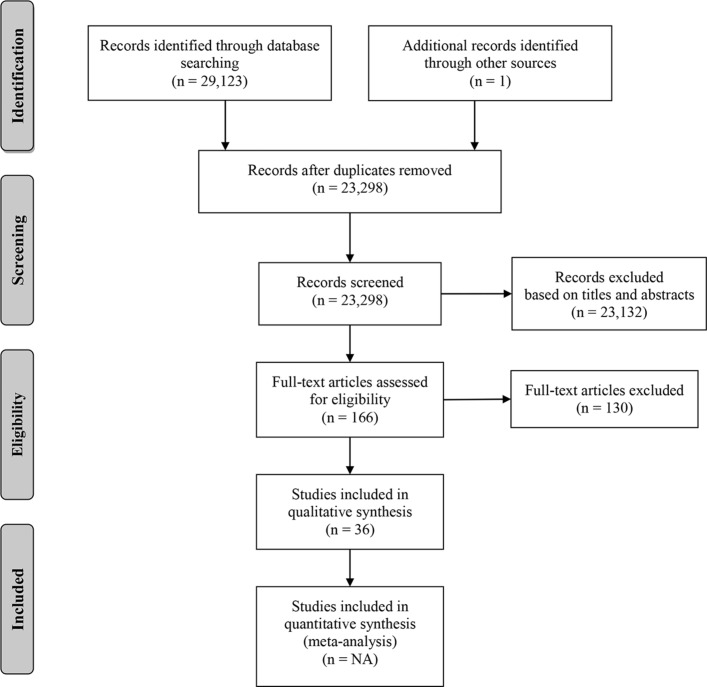
A total of 23 298 citations were obtained from which 166 manuscripts were reviewed. Thirty-six cohort studies (2812 patients) having enrolled between 7 and 311 patients (median 89) fulfilled our inclusion criteria. Most studies excluded patients based on advanced age (n=10 (28%)), neurological disorders (n=20 (56%)), psychiatric disorders (n=17 (47%)), substance abuse disorders (n=13 (36%)) or previous traumatic brain injury (n=10 (28%)). Twenty-one studies (58%) used at least two of these exclusion criteria. The pooled mean age of included patients was 39.3 (SD 4.6) years old (34 studies). The criteria used to define a mTBI were inconsistent. The most frequently reported outcome was postconcussion syndrome using the Rivermead Post-Concussion Symptoms Questionnaire (n=18 (50%)) with follow-ups ranging from 7 days to 5 years after the mTBI.
Most studies have recruited samples that are not representative and generalisable to the mTBI population. These exclusion criteria limit the potential use and translation of promising serum protein biomarkers to predict postconcussion symptoms.
轻度创伤性脑损伤(mTBI)的研究尚不充分,其定义仍不明确。研究人员面临着患者、损伤机制和结果的异质性问题。因此,研究结果在普遍性和临床应用方面往往受到限制。血清蛋白生物标志物越来越多地被用于评估以增强对结果的预后判断,但其转化为临床实践尚未实现。本研究进行了一项系统评价,以描述在评估蛋白生物标志物预测mTBI后震荡后症状的预后价值的研究中所纳入和招募的成年人群。
检索截至2016年10月的MEDLINE、Embase、CENTRAL、CINAHL、科学引文索引、PsycBITE和PsycINFO数据库。
两名评审员独立筛选潜在符合条件的研究,提取数据,并使用推荐分级评估、发展和评价方法按结果评估证据的总体质量。
共获得23298条引文,其中166篇手稿被审查。36项队列研究(2812例患者)纳入了7至311例患者(中位数89例),符合我们的纳入标准。大多数研究根据高龄(n = 10(28%))、神经系统疾病(n = 20(56%))、精神疾病(n = 17(47%))、药物滥用障碍(n = 13(36%))或既往创伤性脑损伤(n = 10(28%))排除患者。21项研究(58%)使用了至少两条这些排除标准。纳入患者的合并平均年龄为39.3(标准差4.6)岁(34项研究)。用于定义mTBI的标准不一致。最常报告的结果是使用Rivermead震荡后症状问卷的震荡后综合征(n = 18(50%)),随访时间为mTBI后7天至5年。
大多数研究招募的样本不具有代表性,无法推广到mTBI人群。这些排除标准限制了有前景的血清蛋白生物标志物预测震荡后症状的潜在用途和转化。