Akter Rokeya, Naish Suchithra, Hu Wenbiao, Tong Shilu
School of Public Health and Social Work, Institute of Health & Biomedical Innovation, Queensland University of Technology, Brisbane, Queensland, Australia.
Shanghai Children's Medical Centre, Shanghai Jiao Tong University, Shanghai, China.
PLoS One. 2017 Oct 2;12(10):e0185551. doi: 10.1371/journal.pone.0185551. eCollection 2017.
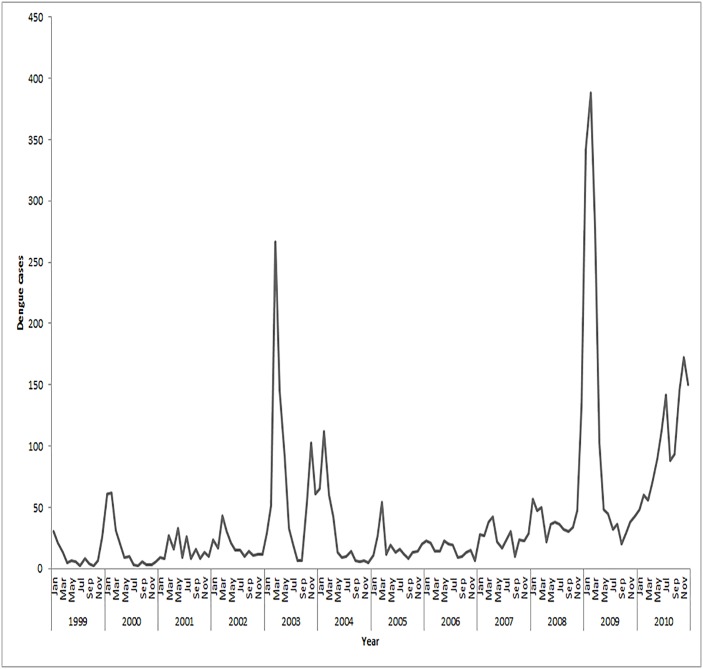
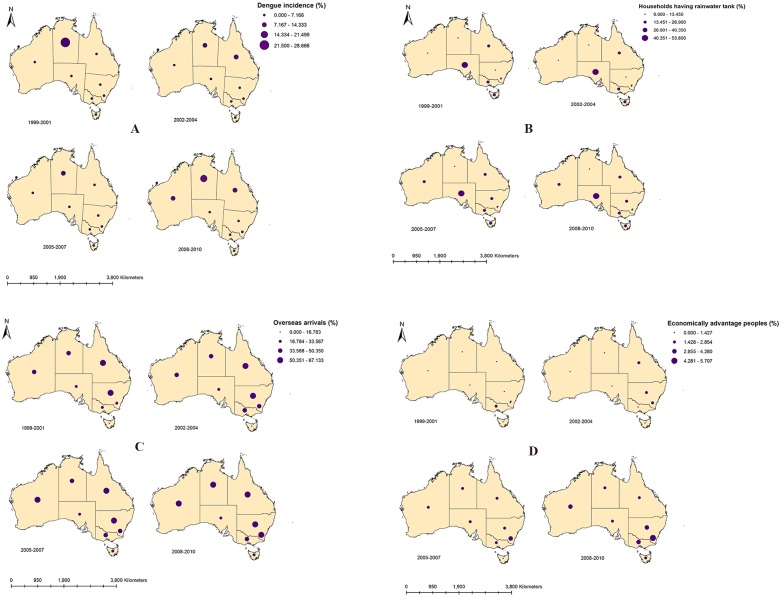
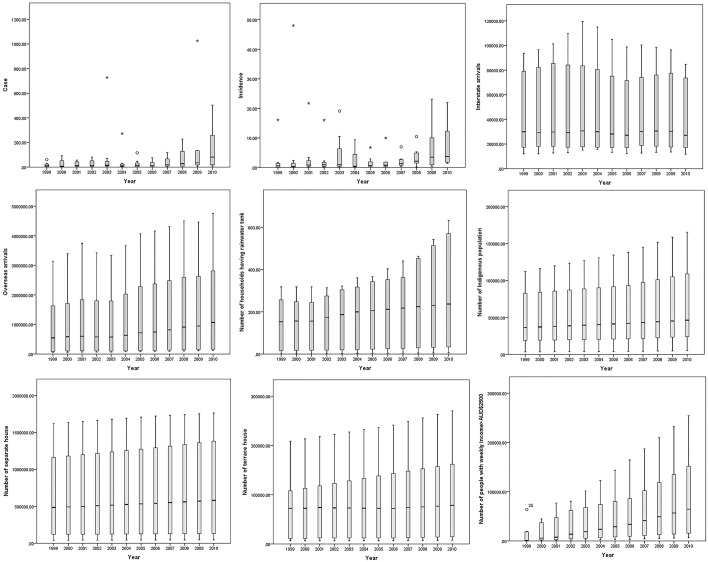
Dengue has been a major public health concern in Australia. This study has explored the spatio-temporal trends of dengue and potential socio- demographic and ecological determinants in Australia. Data on dengue cases, socio-demographic, climatic and land use types for the period January 1999 to December 2010 were collected from Australian National Notifiable Diseases Surveillance System, Australian Bureau of Statistics, Australian Bureau of Meteorology, and Australian Bureau of Agricultural and Resource Economics and Sciences, respectively. Descriptive and linear regression analyses were performed to observe the spatio-temporal trends of dengue, socio-demographic and ecological factors in Australia. A total of 5,853 dengue cases (both local and overseas acquired) were recorded across Australia between January 1999 and December 2010. Most the cases (53.0%) were reported from Queensland, followed by New South Wales (16.5%). Dengue outbreak was highest (54.2%) during 2008-2010. A highest percentage of overseas arrivals (29.9%), households having rainwater tanks (33.9%), Indigenous population (27.2%), separate houses (26.5%), terrace house types (26.9%) and economically advantage people (42.8%) were also observed during 2008-2010. Regression analyses demonstrate that there was an increasing trend of dengue incidence, potential socio-ecological factors such as overseas arrivals, number of households having rainwater tanks, housing types and land use types (e.g. intensive uses and production from dryland agriculture). Spatial variation of socio-demographic factors was also observed in this study. In near future, significant increase of temperature was also projected across Australia. The projected increased temperature as well as increased socio-ecological trend may pose a future threat to the local transmission of dengue in other parts of Australia if Aedes mosquitoes are being established. Therefore, upgraded mosquito and disease surveillance at different ports should be in place to reduce the chance of mosquitoes and dengue cases being imported into all over Australia.
登革热一直是澳大利亚主要的公共卫生问题。本研究探讨了澳大利亚登革热的时空趋势以及潜在的社会人口和生态决定因素。分别从澳大利亚国家法定传染病监测系统、澳大利亚统计局、澳大利亚气象局以及澳大利亚农业与资源经济科学局收集了1999年1月至2010年12月期间登革热病例、社会人口、气候和土地利用类型的数据。进行了描述性和线性回归分析,以观察澳大利亚登革热、社会人口和生态因素的时空趋势。1999年1月至2010年12月期间,澳大利亚共记录了5853例登革热病例(包括本地感染和境外输入)。大多数病例(53.0%)报告来自昆士兰州,其次是新南威尔士州(16.5%)。2008 - 2010年期间登革热疫情最为严重(54.2%)。2008 - 2010年期间还观察到境外入境者比例最高(29.9%)、有雨水收集罐的家庭比例最高(33.9%)、原住民人口比例最高(27.2%)、独立房屋比例最高(26.5%)、联排别墅类型比例最高(26.9%)以及经济优势人群比例最高(42.8%)。回归分析表明,登革热发病率呈上升趋势,境外入境者、有雨水收集罐的家庭数量、住房类型和土地利用类型(如集约利用和旱地农业生产)等潜在社会生态因素也呈上升趋势。本研究还观察到社会人口因素的空间差异。预计在不久的将来,澳大利亚各地气温也将显著升高。如果埃及伊蚊得以定殖,预计气温升高以及社会生态趋势增加可能会给澳大利亚其他地区登革热的本地传播带来未来威胁。因此,应加强不同港口的蚊虫和疾病监测,以减少蚊虫和登革热病例传入澳大利亚各地的机会。